Market Commentary – August 19, 2019

Don’t let volatility get you down.
Last week was the 40th anniversary of BusinessWeek’s infamous cover headline: ‘The Death of Equities: How inflation is destroying the stock market.’ The publication’s current iteration, Bloomberg Businessweek, reported it is still getting grief over the headline and subsequent bull market. In its defense, stocks trended lower for about three years after the magazine hit newsstands.

Since its 1982 low point, “The total return on the Standard & Poor’s 500-stock index…with dividends reinvested has been nearly 7,000 percent. Not bad for a corpse.”

Investors worried back in 1979, just as they do today.

At that time, the Federal Reserve was waging a war against inflation. Late in the summer of 1979, the annual average inflation rate in the United States was 10 percent. Homebuyers were locking in mortgage rates of 11.1 percent on 30-year fixed mortgages and feeling good about it as mortgage rates rose to 18.5 percent by October 1981.

Today, investors aren’t worried about inflation. They are concerned about the U.S.- China trade war, the pace of global economic growth, the influence of monetary policy, negative interest rates…the list goes on.

Recent stock market volatility reflects those concerns.

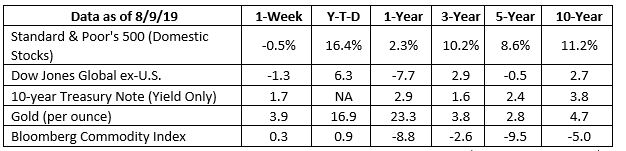
It’s possible we’re nearing the end of the longest bull market for U.S. stocks. Further inversion of the yield curve last week suggested recession could be ahead. However, it’s unlikely to arrive immediately.

If a recession does arrive, remember economic downturns are temporary and are relatively short. The Great Recession lasted 18 months and it was the longest since WWII. Typically, a recession averages six to 16 months, according to the Minneapolis Federal Reserve.

Right now, there is reason to believe the U.S. economy still has some oomph. Barron’s reported, “The economy is obviously slowing, but not necessarily heading for recession. That means it is time for caution, not panic.”

Upcycling is modern day alchemy. When people take items that have been discarded and turn them into something of greater value, it’s known as upcycling. Repurposing objects is appealing to people who want to live sustainably, people who embrace creativity, and/or people who like to make things…it’s got a lot of appeal for a lot of people.

Here are a few interesting upcycling projects you may encounter as you travel:

Bird Calls Phone. A Maryland city wanted an interactive public art exhibit. The artist took a mint-condition payphone and wired it to play calls of local birds when dialed. (Takoma Park, MD)

People’s Bike Library of Portland. It’s an iconic sculpture that is a tribute to the popularity of cycling, as well as a bike rack and a bike ‘lending library.’ (Portland, OR)

Carhenge. It’s built to resemble Stonehenge, but there is no mystery surrounding Carhenge in western Nebraska. The arrangement of repurposed vintage autos was built in the memory of the designer’s father. (Alliance, NE)

The Heidelberg Project. This project isn’t a single piece of art; it’s an open air urban art environment. The artist and children from the neighborhood decorate vacant houses. Heidelberg Houses have included: Doors of Opportunity, The Taxi House, The Clock House, Obstruction of Justice, and others. (Detroit, MI)

City Museum. A 10-story, 100-year-old shoe factory in St. Louis was transformed into an urban playground using salvaged materials. It features, “a sky-high jungle gym making use of two repurposed airplanes, two towering 10-story slides…a rooftop Ferris wheel,” and more. (St. Louis, MO)

It has been said that art is in the eye of the beholder. It’s also in the portfolios of some investors. The 2018 U.S. Trust Insights on Wealth and Worth® survey found, “…financially driven collectors are increasingly incorporating art into their long-term wealth plans.”

Weekly Focus – Think About It
“Art is something that makes you breathe with a different kind of happiness.” 
–Anni Albers, Textile artist

Best regards,

John F. Reutemann, Jr., CLU, CFP®

P.S.  Please feel free to forward this commentary to family, friends, or colleagues. If you would like us to add them to the list, please reply to this email with their email address and we will ask for their permission to be added.

Investment advice offered through Research Financial Strategies, a registered investment advisor.
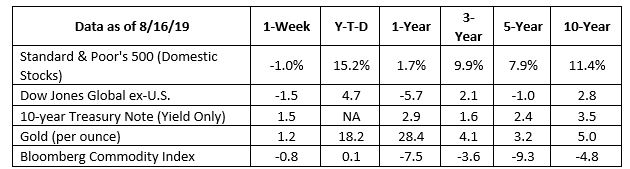
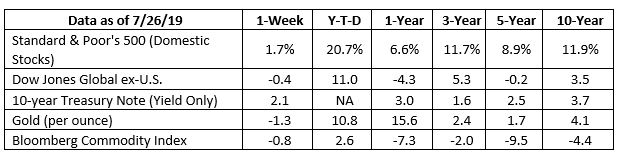
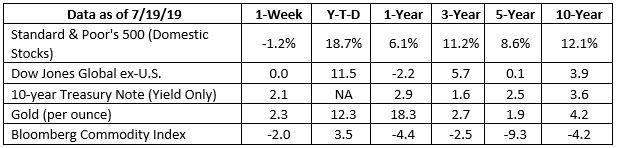
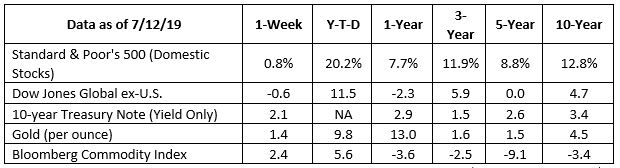
S&P 500, Dow Jones Global ex-US, Gold, Bloomberg Commodity Index returns exclude reinvested dividends (gold does not pay a dividend) and the three-, five-, and 10-year returns are annualized; the DJ Equity All REIT Total Return Index does include reinvested dividends and the three-, five-, and 10-year returns are annualized; and the 10-year Treasury Note is simply the yield at the close of the day on each of the historical time periods.
Sources: Yahoo! Finance, Barron’s, djindexes.com, London Bullion Market Association.
Past performance is no guarantee of future results. Indices are unmanaged and cannot be invested into directly. N/A means not applicable.

Most Popular Financial Stories
Financial Advisor

Explanation of current positions

Several clients have told us they are a little overwhelmed by many of the new ETFs, and what their business model and investment objectives are.   Below is a short summary…

read more…
Happy Thanksgiving

Happy Thanksgiving

Wishing You a Happy Thanksgiving As Thanksgiving approaches, we pause to reflect on and appreciate the abundant blessings in our lives, especially the family and friends who…

read more…

* This newsletter and commentary expressed should not be construed as investment advice.
* Government bonds and Treasury Bills are guaranteed by the U.S. government as to the timely payment of principal and interest and, if held to maturity, offer a fixed rate of return and fixed principal value.  However, the value of fund shares is not guaranteed and will fluctuate.
* Corporate bonds are considered higher risk than government bonds but normally offer a higher yield and are subject to market, interest rate and credit risk as well as additional risks based on the quality of issuer coupon rate, price, yield, maturity, and redemption features.
* The Standard & Poor’s 500 (S&P 500) is an unmanaged group of securities considered to be representative of the stock market in general. You cannot invest directly in this index.
* All indexes referenced are unmanaged. Unmanaged index returns do not reflect fees, expenses, or sales charges. Index performance is not indicative of the performance of any investment.
* The Dow Jones Global ex-U.S. Index covers approximately 95% of the market capitalization of the 45 developed and emerging countries included in the Index.
* The 10-year Treasury Note represents debt owed by the United States Treasury to the public. Since the U.S. Government is seen as a risk-free borrower, investors use the 10-year Treasury Note as a benchmark for the long-term bond market.
* Gold represents the afternoon gold price as reported by the London Bullion Market Association. The gold price is set twice daily by the London Gold Fixing Company at 10:30 and 15:00 and is expressed in U.S. dollars per fine troy ounce.
* The Bloomberg Commodity Index is designed to be a highly liquid and diversified benchmark for the commodity futures market. The Index is composed of futures contracts on 19 physical commodities and was launched on July 14, 1998.
* The Dow Jones Industrial Average (DJIA), commonly known as “The Dow,” is an index representing 30 stock of companies maintained and reviewed by the editors of The Wall Street Journal.
* The NASDAQ Composite is an unmanaged index of securities traded on the NASDAQ system.
* International investing involves special risks such as currency fluctuation and political instability and may not be suitable for all investors. These risks are often heightened for investments in emerging markets.
* Yahoo! Finance is the source for any reference to the performance of an index between two specific periods.
* Opinions expressed are subject to change without notice and are not intended as investment advice or to predict future performance.
* Economic forecasts set forth may not develop as predicted and there can be no guarantee that strategies promoted will be successful.
* Past performance does not guarantee future results. Investing involves risk, including loss of principal.
* You cannot invest directly in an index.
* Stock investing involves risk including loss of principal.
* The foregoing information has been obtained from sources considered to be reliable, but we do not guarantee it is accurate or complete.
* There is no guarantee a diversified portfolio will enhance overall returns or outperform a non-diversified portfolio. Diversification does not protect against market risk.
* Asset allocation does not ensure a profit or protect against a loss.
* Consult your financial professional before making any investment decision.
* To unsubscribe from the Weekly Market Commentary please reply to this e-mail with “Unsubscribe” in the subject.

Sources:
https://www.bloomberg.com/news/articles/2019-08-13/it-s-been-40-years-since-our-cover-story-declared-the-death-of-equities
U.S. Bureau of Economic Analysis, Personal consumption expenditures excluding food and energy [DPCCRC1M027SBEA], retrieved from FRED, Federal Reserve Bank of St. Louis, August 18, 2019: https://fred.stlouisfed.org/series/DPCCRC1M027SBEA (or go to https://peakcontent.s3-us-west-2.amazonaws.com/+Peak+Commentary/08-19-19_FRED-Personal_Consumption_Expenditures_Excluding_Food_and_Energy-Footnote_2.pdf)
Freddie Mac, 30-Year Fixed Rate Mortgage Average in the United States [MORTGAGE30US], retrieved from FRED, Federal Reserve Bank of St. Louis, August 17, 2019: https://fred.stlouisfed.org/series/MORTGAGE30US (or go to https://peakcontent.s3-us-west-2.amazonaws.com/+Peak+Commentary/08-19-19_FRED-30-Year_Fixed_Rate_Mortgage_Average_in_the_United_States-Footnote_3.pdf)
https://www.reuters.com/article/us-global-economy-centralbanks-analysis/going-negative-as-trade-war-rages-central-banks-ponder-radical-steps-idUSKCN1V328N
https://www.barrons.com/articles/stocks-swing-wildly-as-yield-curve-flips-51566002682?mod=hp_DAY_3 (or go to https://peakcontent.s3-us-west-2.amazonaws.com/+Peak+Commentary/08-19-19_Barrons-Stocks_Swing_Wildly_as_Yield_Curve_Flips-Is_There_a_Recession_Out_There-Footnote_5.pdf)
https://www.investopedia.com/ask/answers/08/cause-of-recession.asp
https://www.minneapolisfed.org/publications/special-studies/recession-in-perspective
https://www.merriam-webster.com/dictionary/upcycle
https://www.upi.com/Odd_News/2019/08/16/Maryland-phone-makes-bird-calls-not-phone-calls/6231565970936/
https://thedyrt.com/magazine/lifestyle/5-recycled-art-installations-and-where-to-camp-nearby/
https://thesavvyage.com/heidelberg-project-perseveres/
https://www.thisiscolossal.com/2015/06/city-museum/
https://www.privatebank.bankofamerica.com/articles/insights-on-wealth-and-worth-art-collectors-2018.html
https://www.healing-power-of-art.org/art-and-quotes-by-famous-artists/
Market Commentary – August 12, 2019

Global selloff. Quick comeback.
Investors boomeranged from stocks to safe havens and back as trade tensions between the United States and China intensified last week. The Economist reported:

“On August 1st President Donald Trump warned that he would soon impose a 10 percent levy on roughly $300bn-worth of Chinese goods that have not already been hit by the trade war. Four days later China responded by giving its exchange rate unaccustomed freedom to fall. The yuan weakened past seven to the dollar, an important psychological threshold, for the first time in over a decade. And stock prices in America duly fell…”

Asia Times explained, “Beijing has signaled that it is prepared to endure a long and debilitating trade war with the United States…A reported directive to Chinese companies to refrain from buying U.S. farm products seems an in-your-face challenge to the U.S. president.”

The possibility of a prolonged trade war triggered worries about global recession and set off a selloff. Global stock markets experienced the biggest one-day decline since February 2018, according to Bloomberg, and U.S. stocks delivered the worst one-day performance of 2019, reported MarketWatch.

Stocks staged an impressive recovery on Tuesday. Then, central banks in India, Thailand, and New Zealand announced unexpected rate cuts. The moves incited concern about the health of the global economy and stocks dropped again – and recovered again. By the end of the week, nearly all losses in U.S. stock markets had been erased.

If recent volatility has triggered a desire to change your investments, please get in touch with us before you do.

Can you believe it?
The global bond market deserves a spot in a believe-it-or-not museum, right next to the bathythermograph, radioactive vodka (brewed with Chernobyl grain), and 526 extra teeth recently removed from a youngster’s jaw.

Here’s why: Approximately one-fourth of all bonds issued by governments and companies around the globe are trading at negative yields, according to an index cited by The Economist.

Just imagine. You want to borrow money. An acquaintance agrees to lend you the money and then offers to pay you for borrowing it.

It sounds like a Monty Python skit, right?

It’s not. All over the world, bonds issued by governments and companies are offering negative interest rates. Investors who purchase the bonds are paying governments and companies to borrow their money. For instance, in Germany, investors are paying one-half of a percentage point annually for the assurance their money will be returned when the bond matures.

Why are so many bond yields in negative territory?

Strangely enough, retirement and longevity may play a role. Joachim Fels of PIMCO theorized a ‘savings glut’ could be the reason for low and negative yields. He explained:
“…it can be argued that in affluent societies where people can expect to live ever longer and thus spend a significant amount of their lifetimes in retirement, more and more people demonstrate negative time preference, meaning they value future consumption during their retirement more than today’s consumption…they are thus willing to accept a negative interest rate and bring it about through their saving behavior.”

We live in interesting times.

Weekly Focus – Think About It
“Why do you go away? So that you can come back. So that you can see the place you came from with new eyes and extra colors. And the people there see you differently, too. Coming back to where you started is not the same as never leaving.”
–Sir Terence David John Pratchett, English author

Best regards,

John F. Reutemann, Jr., CLU, CFP®

P.S.  Please feel free to forward this commentary to family, friends, or colleagues. If you would like us to add them to the list, please reply to this email with their email address and we will ask for their permission to be added.

Investment advice offered through Research Financial Strategies, a registered investment advisor.

S&P 500, Dow Jones Global ex-US, Gold, Bloomberg Commodity Index returns exclude reinvested dividends (gold does not pay a dividend) and the three-, five-, and 10-year returns are annualized; the DJ Equity All REIT Total Return Index does include reinvested dividends and the three-, five-, and 10-year returns are annualized; and the 10-year Treasury Note is simply the yield at the close of the day on each of the historical time periods.
Sources: Yahoo! Finance, Barron’s, djindexes.com, London Bullion Market Association.
Past performance is no guarantee of future results. Indices are unmanaged and cannot be invested into directly. N/A means not applicable.

Most Popular Financial Stories

The Cracking Foundation of the American Consumer

The Shifting Ground of the American Consumer: Finding Opportunity in Change The economic landscape is undergoing a significant transformation, and understanding these shifts is key to positioning your portfolio for what comes next. While headline numbers often mask…

read more…

Explanation of current positions

Several clients have told us they are a little overwhelmed by many of the new ETFs, and what their business model and investment objectives are.   Below is a short summary of all the ETFs currently in the growth model as of today.  If you have any questions, please…

read more…

Rate Cut Ahead: Is Your Income Strategy Ready?

Rate Cut Ahead: Is Your Income Strategy Ready? With the Federal Reserve now signaling an 87% chance of cutting interest rates at its upcoming meeting, it is crucial to assess how this shift could impact your financial future—especially if you rely on your portfolio…

read more…

Happy Thanksgiving

Wishing You a Happy Thanksgiving As Thanksgiving approaches, we pause to reflect on and appreciate the abundant blessings in our lives, especially the family and friends who enrich our days. We look forward with great anticipation to the coming year and the entire…

read more…

Textbook example of the single stock risk!

CAVA: Post-CMG Price Action and Market Context CAVA shares experienced an 11% decline this morning, a notable reaction tied to the recent earnings announcement from industry peer Chipotle (CMG). This price movement reflects speculative investor sentiment, as the…

read more…

* This newsletter and commentary expressed should not be construed as investment advice.
* Government bonds and Treasury Bills are guaranteed by the U.S. government as to the timely payment of principal and interest and, if held to maturity, offer a fixed rate of return and fixed principal value.  However, the value of fund shares is not guaranteed and will fluctuate.
* Corporate bonds are considered higher risk than government bonds but normally offer a higher yield and are subject to market, interest rate and credit risk as well as additional risks based on the quality of issuer coupon rate, price, yield, maturity, and redemption features.
* The Standard & Poor’s 500 (S&P 500) is an unmanaged group of securities considered to be representative of the stock market in general. You cannot invest directly in this index.
* All indexes referenced are unmanaged. Unmanaged index returns do not reflect fees, expenses, or sales charges. Index performance is not indicative of the performance of any investment.
* The Dow Jones Global ex-U.S. Index covers approximately 95% of the market capitalization of the 45 developed and emerging countries included in the Index.
* The 10-year Treasury Note represents debt owed by the United States Treasury to the public. Since the U.S. Government is seen as a risk-free borrower, investors use the 10-year Treasury Note as a benchmark for the long-term bond market.
* Gold represents the afternoon gold price as reported by the London Bullion Market Association. The gold price is set twice daily by the London Gold Fixing Company at 10:30 and 15:00 and is expressed in U.S. dollars per fine troy ounce.
* The Bloomberg Commodity Index is designed to be a highly liquid and diversified benchmark for the commodity futures market. The Index is composed of futures contracts on 19 physical commodities and was launched on July 14, 1998.
* The Dow Jones Industrial Average (DJIA), commonly known as “The Dow,” is an index representing 30 stock of companies maintained and reviewed by the editors of The Wall Street Journal.
* The NASDAQ Composite is an unmanaged index of securities traded on the NASDAQ system.
* International investing involves special risks such as currency fluctuation and political instability and may not be suitable for all investors. These risks are often heightened for investments in emerging markets.
* Yahoo! Finance is the source for any reference to the performance of an index between two specific periods.
* Opinions expressed are subject to change without notice and are not intended as investment advice or to predict future performance.
* Economic forecasts set forth may not develop as predicted and there can be no guarantee that strategies promoted will be successful.
* Past performance does not guarantee future results. Investing involves risk, including loss of principal.
* You cannot invest directly in an index.
* Stock investing involves risk including loss of principal.
* The foregoing information has been obtained from sources considered to be reliable, but we do not guarantee it is accurate or complete.
* There is no guarantee a diversified portfolio will enhance overall returns or outperform a non-diversified portfolio. Diversification does not protect against market risk.
* Asset allocation does not ensure a profit or protect against a loss.
* Consult your financial professional before making any investment decision.
* To unsubscribe from the Weekly Market Commentary please reply to this e-mail with “Unsubscribe” in the subject.

Sources:
https://www.economist.com/finance-and-economics/2019/08/05/why-a-weakening-yuan-is-rattling-markets (or go to https://peakcontent.s3-us-west-2.amazonaws.com/+Peak+Commentary/08-12-19_TheEconomist-Why_a_Weakening_Yuan_is_Rattling_Markets-Footnote_1.pdf)
https://www.asiatimes.com/2019/08/article/trade-wars-part-two-the-empire-strikes-back/
https://www.bloomberg.com/news/articles/2019-08-06/asia-stocks-to-start-mixed-u-s-shares-climb-markets-wrap
https://www.marketwatch.com/story/what-a-falling-chinese-yuan-means-for-the-stock-market-and-the-trade-war-2019-08-05
https://www.barrons.com/articles/dow-jones-industrial-average-whipsawed-by-trade-tensions-finishes-week-down-modestly-51565396072?mod=hp_DAY_3 (or go to https://peakcontent.s3-us-west-2.amazonaws.com/+Peak+Commentary/08-12-19_Barrons-The_Dow_Whipsawed_by_Trade_Tensions_Finishes_the_Week_Down_Modestly-Footnote_5.pdf)
https://www.ripleys.com
https://www.economist.com/finance-and-economics/2019/08/08/as-yields-turn-negative-investors-are-having-to-pay-for-safety (or go to https://peakcontent.s3-us-west-2.amazonaws.com/+Peak+Commentary/08-12-19_TheEconomist-As_Yields_Turn_Negative_Investors_are_Having_to_Pay_for_Safety-Footnote_7.pdf)
https://www.barrons.com/articles/how-this-market-will-end-51565369599?mod=hp_DAY_1 (or go to https://peakcontent.s3-us-west-2.amazonaws.com/+Peak+Commentary/08-12-19_Barrons-How_This_Bull_Market_Will_End-Footnote_8.pdf)
https://blog.pimco.com/en/2019/08/interest-rates-naturally-negative
https://www.goodreads.com/author/quotes/1654.Terry_Pratchett

Market Commentary – August 5, 2019

Tariffs strike again.
The Federal Open Market Committee completed what it called ‘a mid-cycle adjustment’ with a quarter-point rate cut last week. Some investors were unhappy when Fed officials implied there would not be another reduction this year. They’d been hoping for at least one, reported Barron’s.

Despite the disappointment, investors settled and U.S. stock markets rallied on Thursday.

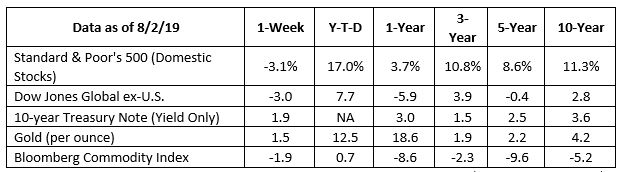
Then, like a movie villain that just won’t die, U.S. import taxes – a.k.a. tariffs – reared their ugly heads and wiped out the week’s gains. Barron’s explained:  “By midday on Thursday, the stock market had all but recouped its losses in the wake of the Federal Reserve’s policy meeting the previous day. That’s when President Donald Trump announced that he will impose a 10 percent levy on an additional $300 billion of Chinese goods on September 1. The shock sent stocks underwater and resulted in this year’s worst week for the S&P 500 index and the Nasdaq Composite, which slid 3.1 percent and 3.92 percent, respectively. The Dow got off with just a 2.6 percent nick. For the broad U.S. stock market, the paper loss was about $1.1 trillion, according to Wilshire Associates.”

Tariffs have pummeled U.S. and Chinese economies for months. Early estimates suggest imports from China to the United States fell by 12.6 percent from June 2018 to June 2019, while exports from the United States to China fell by 16.8 percent during the same period, according to a source cited by Barron’s.

Bond investors were jolted by the tariff announcement, too. The yield on 10-year U.S. Treasury notes dropped from 2.1 percent last week to 1.9 percent, reported MarketWatch. In Germany, all maturities of government bonds are offering negative yields.

In the face-off between rate cuts and tariffs, tariffs may prove to have a greater impact.

Does flying trigger your lizard brain?
Flight attendants and frequent fliers have some crazy stories to tell. Lets Fly Cheaper, Business Insider, and Point Me To The Plane reported on some of the strange things flight attendants have experienced, including:

  • Medicated sleep zombies. Passengers sometimes take sleep aids to slumber while flying. In one instance, a passenger sleep-streaked to first class.
  • Emotional support animals (ESAs). In an effort to remain calm while flying, some people bring pets for emotional support. These have included a turkey, a pig, a monkey, and a kangaroo.
  • Impatient passengers. In 2014, a passenger deployed the emergency slide because he wanted to disembark more quickly.
  • Strange requests. Flight attendants report passengers have asked how to roll down plane windows, if they could stop at the Sky Mall, and whether they could borrow a screwdriver to take a seat apart.

A flight attendant told NPR, “When people get on a plane, they revert to a lizard brain where they forget all social decencies and common sense…Flying takes away everybody’s sense of control. So people tend to grasp at whatever kind of control they can have…”

There may be a scientific explanation for passengers’ odd plane behavior. NPR reported that low air pressure reduces the oxygen in passengers’ blood, making them more emotional and more prone to poor decision-making.

Weekly Focus – Think About It
“The lizard brain is not merely a concept. It’s real, and it’s living on the top of your spine, fighting for your survival. But, of course, survival and success are not the same thing.”
–Seth Godin, American author

Best regards,

John F. Reutemann, Jr., CLU, CFP®

P.S.  Please feel free to forward this commentary to family, friends, or colleagues. If you would like us to add them to the list, please reply to this email with their email address and we will ask for their permission to be added.

Investment advice offered through Research Financial Strategies, a registered investment advisor.

S&P 500, Dow Jones Global ex-US, Gold, Bloomberg Commodity Index returns exclude reinvested dividends (gold does not pay a dividend) and the three-, five-, and 10-year returns are annualized; the DJ Equity All REIT Total Return Index does include reinvested dividends and the three-, five-, and 10-year returns are annualized; and the 10-year Treasury Note is simply the yield at the close of the day on each of the historical time periods.
Sources: Yahoo! Finance, Barron’s, djindexes.com, London Bullion Market Association.
Past performance is no guarantee of future results. Indices are unmanaged and cannot be invested into directly. N/A means not applicable.

Most Popular Financial Stories

The Cracking Foundation of the American Consumer

The Shifting Ground of the American Consumer: Finding Opportunity in Change The economic landscape is undergoing a significant transformation, and understanding these shifts is key to positioning your portfolio for what comes next. While headline numbers often mask…

read more…

Explanation of current positions

Several clients have told us they are a little overwhelmed by many of the new ETFs, and what their business model and investment objectives are.   Below is a short summary of all the ETFs currently in the growth model as of today.  If you have any questions, please…

read more…

Rate Cut Ahead: Is Your Income Strategy Ready?

Rate Cut Ahead: Is Your Income Strategy Ready? With the Federal Reserve now signaling an 87% chance of cutting interest rates at its upcoming meeting, it is crucial to assess how this shift could impact your financial future—especially if you rely on your portfolio…

read more…

Happy Thanksgiving

Wishing You a Happy Thanksgiving As Thanksgiving approaches, we pause to reflect on and appreciate the abundant blessings in our lives, especially the family and friends who enrich our days. We look forward with great anticipation to the coming year and the entire…

read more…

Textbook example of the single stock risk!

CAVA: Post-CMG Price Action and Market Context CAVA shares experienced an 11% decline this morning, a notable reaction tied to the recent earnings announcement from industry peer Chipotle (CMG). This price movement reflects speculative investor sentiment, as the…

read more…

* This newsletter and commentary expressed should not be construed as investment advice.
* Government bonds and Treasury Bills are guaranteed by the U.S. government as to the timely payment of principal and interest and, if held to maturity, offer a fixed rate of return and fixed principal value.  However, the value of fund shares is not guaranteed and will fluctuate.
* Corporate bonds are considered higher risk than government bonds but normally offer a higher yield and are subject to market, interest rate and credit risk as well as additional risks based on the quality of issuer coupon rate, price, yield, maturity, and redemption features.
* The Standard & Poor’s 500 (S&P 500) is an unmanaged group of securities considered to be representative of the stock market in general. You cannot invest directly in this index.
* All indexes referenced are unmanaged. Unmanaged index returns do not reflect fees, expenses, or sales charges. Index performance is not indicative of the performance of any investment.
* The Dow Jones Global ex-U.S. Index covers approximately 95% of the market capitalization of the 45 developed and emerging countries included in the Index.
* The 10-year Treasury Note represents debt owed by the United States Treasury to the public. Since the U.S. Government is seen as a risk-free borrower, investors use the 10-year Treasury Note as a benchmark for the long-term bond market.
* Gold represents the afternoon gold price as reported by the London Bullion Market Association. The gold price is set twice daily by the London Gold Fixing Company at 10:30 and 15:00 and is expressed in U.S. dollars per fine troy ounce.
* The Bloomberg Commodity Index is designed to be a highly liquid and diversified benchmark for the commodity futures market. The Index is composed of futures contracts on 19 physical commodities and was launched on July 14, 1998.
* The Dow Jones Industrial Average (DJIA), commonly known as “The Dow,” is an index representing 30 stock of companies maintained and reviewed by the editors of The Wall Street Journal.
* The NASDAQ Composite is an unmanaged index of securities traded on the NASDAQ system.
* International investing involves special risks such as currency fluctuation and political instability and may not be suitable for all investors. These risks are often heightened for investments in emerging markets.
* Yahoo! Finance is the source for any reference to the performance of an index between two specific periods.
* Opinions expressed are subject to change without notice and are not intended as investment advice or to predict future performance.
* Economic forecasts set forth may not develop as predicted and there can be no guarantee that strategies promoted will be successful.
* Past performance does not guarantee future results. Investing involves risk, including loss of principal.
* You cannot invest directly in an index.
* Stock investing involves risk including loss of principal.
* The foregoing information has been obtained from sources considered to be reliable, but we do not guarantee it is accurate or complete.
* There is no guarantee a diversified portfolio will enhance overall returns or outperform a non-diversified portfolio. Diversification does not protect against market risk.
* Asset allocation does not ensure a profit or protect against a loss.
* Consult your financial professional before making any investment decision.
* To unsubscribe from the Weekly Market Commentary please reply to this e-mail with “Unsubscribe” in the subject.

Sources:
https://www.barrons.com/articles/s-p-500-suffers-worst-week-of-2019-as-trump-reignites-trade-war-51564792500?mod=hp_DAY_4 (or go to https://peakcontent.s3-us-west-2.amazonaws.com/+Peak+Commentary/08-05-19_Barrons-The_SandP_500_Suffered_Its_Worst_Week_of_2019_and_It_Might_Not_Be_Finished_Falling-Footnote_1.pdf)
https://www.barrons.com/articles/new-tariff-threat-bites-investors-51564794880?mod=hp_DAY_1 (or go to https://peakcontent.s3-us-west-2.amazonaws.com/+Peak+Commentary/08-05-19_Barrons-New_Tariff_Threat_Bites_Investors-Footnote_2.pdf)
https://finance.yahoo.com/quote/%5ETNX/history?p=%5ETNX
|https://www.marketwatch.com/story/global-bond-markets-extend-rally-as-trade-tensions-spurs-haven-inflows-2019-08-02
https://pointmetotheplane.boardingarea.com/confessions-of-a-fed-up-flight-attendant-1-attack-of-the-ambien-zombies/
https://www.letsflycheaper.com/blog/weird-esas/
https://www.businessinsider.com/weirdest-things-flight-attendants-have-seen-2017-4#strange-item-requests-8
https://pointmetotheplane.boardingarea.com/say-what-overheard-on-the-plane-edition-28-crazy-things-passengers-say-to-flight-attendants/
https://www.npr.org/2019/07/14/741619152/cool-your-jets-science-might-explain-your-weird-and-emotional-airplane-behavior
https://www.goodreads.com/quotes/304213-the-lizard-brain-is-hungry-scared-angry-and-horny-the

Market Commentary – July 29, 2019

The Markets
It has been said there are two sides to every story. Just look at world financial markets. Stock markets and bond markets are telling very different stories.

In the United States, stock markets were blue ribbon winners last week.

The Standard & Poor’s 500 Index rebounded to a record high. The Nasdaq Composite also set a new record. Barron’s reported U.S. stock markets were supported by abundant optimism inspired by expectations for solid earnings growth and a Federal Reserve rate cut in July.

Optimism pushed stocks higher in Europe last week, too. CNBC reported investors were receptive to news suggesting the European Central Bank would ease monetary policy to support the European economy. A significant number of national stock indices in Europe, the Middle East, and Asia finished last week higher, according to Barron’s.

Bond markets have been telling a less optimistic story.

In many regions of the world, bond yields have sunk below zero, and bond buyers have been locking in losses by investing in bonds with negative yields.

In the United States, the 10-year Treasury yield remains positive, but it has dropped from 3.2 percent in November 2018 to 2.1 percent at the end of last week.

So, what are bond markets saying? Barron’s suggested some possibilities:  “…bond buyers locking in subzero yields aren’t doing it, of course, for love of losses. They might think that the certainty of small losses will prove a better deal in the years ahead than whatever stocks provide…There’s something else that negative yields could be telling us. Investors need bonds for things like diversification and setting aside money at known rates to offset known liabilities. For an investor who must buy bonds, a purchase here with negative yields isn’t necessarily a bet against stocks. It could just be a wager that bond yields won’t get much better – that slow growth and meager inflation will loom for many years.”

Time will tell.

music, earworms, and data storage. Anyone who has ever suffered an earworm (known in scientific circles as Involuntary Musical Imagery) understands the power of music. Some tunes that repeatedly pop into people’s heads may include:

  • It’s a Small World (Disney)
  • Don’t Stop Believing (Journey)
  • Who Let the Dogs Out? (Baha Men)
  • Silver Bells (Bing Crosby)
  • We are the Champions (Queen)

 Let’s face it. Music can be potent. In The Power of Music, Elena Mannes writes, “…science today is showing that music is in fact encoded in our bodies and brains.” She discusses research suggesting music may be able to help people heal, change behavior, and treat neurological disorders.

It may be used in other ways, too. Soon, you may experience a new music phenomenon called Imperceptible Audio Communication. That’s when data is secretly coded into music. You won’t be able to hear it, but your smartphone and other devices will.

At the 44th IEEE (Institute of Electrical and Electronics Engineers) International Conference on Acoustics, Speech and Signal Processing, a pair of doctoral students shared their work, which focuses on storing data in music.

Imagine, someday you may be:

  • Walking through an airport, not really listening to the piped-in sounds, when your phone picks up a data feed from the music and lets you know your flight is delayed.
  • Pushing your cart down a grocery aisle and Muzak® advises your smartphone cauliflower is on sale.
  • Checking into a hotel and having the lobby music send the Wi-Fi password and other check-in data directly to your smartphone.
  • Dancing in a club and having your smartphone flash a drink special.

The times – they are changing.

Weekly Focus – Think About It
“Any sufficiently advanced technology is indistinguishable from magic.”
–Arthur C. Clarke, British writer and inventor

Best regards,

John F. Reutemann, Jr., CLU, CFP®


P.S.  Please feel free to forward this commentary to family, friends, or colleagues. If you would like us to add them to the list, please reply to this email with their email address and we will ask for their permission to be added.

Investment advice offered through Research Financial Strategies, a registered investment advisor.

S&P 500, Dow Jones Global ex-US, Gold, Bloomberg Commodity Index returns exclude reinvested dividends (gold does not pay a dividend) and the three-, five-, and 10-year returns are annualized; the DJ Equity All REIT Total Return Index does include reinvested dividends and the three-, five-, and 10-year returns are annualized; and the 10-year Treasury Note is simply the yield at the close of the day on each of the historical time periods.
Sources: Yahoo! Finance, Barron’s, djindexes.com, London Bullion Market Association.
Past performance is no guarantee of future results. Indices are unmanaged and cannot be invested into directly. N/A means not applicable.

Most Popular Financial Stories

The Cracking Foundation of the American Consumer

The Shifting Ground of the American Consumer: Finding Opportunity in Change The economic landscape is undergoing a significant transformation, and understanding these shifts is key to positioning your portfolio for what comes next. While headline numbers often mask…

read more…

Explanation of current positions

Several clients have told us they are a little overwhelmed by many of the new ETFs, and what their business model and investment objectives are.   Below is a short summary of all the ETFs currently in the growth model as of today.  If you have any questions, please…

read more…

Rate Cut Ahead: Is Your Income Strategy Ready?

Rate Cut Ahead: Is Your Income Strategy Ready? With the Federal Reserve now signaling an 87% chance of cutting interest rates at its upcoming meeting, it is crucial to assess how this shift could impact your financial future—especially if you rely on your portfolio…

read more…

Happy Thanksgiving

Wishing You a Happy Thanksgiving As Thanksgiving approaches, we pause to reflect on and appreciate the abundant blessings in our lives, especially the family and friends who enrich our days. We look forward with great anticipation to the coming year and the entire…

read more…

Textbook example of the single stock risk!

CAVA: Post-CMG Price Action and Market Context CAVA shares experienced an 11% decline this morning, a notable reaction tied to the recent earnings announcement from industry peer Chipotle (CMG). This price movement reflects speculative investor sentiment, as the…

read more…

* This newsletter and commentary expressed should not be construed as investment advice.
* Government bonds and Treasury Bills are guaranteed by the U.S. government as to the timely payment of principal and interest and, if held to maturity, offer a fixed rate of return and fixed principal value.  However, the value of fund shares is not guaranteed and will fluctuate.
* Corporate bonds are considered higher risk than government bonds but normally offer a higher yield and are subject to market, interest rate and credit risk as well as additional risks based on the quality of issuer coupon rate, price, yield, maturity, and redemption features.
* The Standard & Poor’s 500 (S&P 500) is an unmanaged group of securities considered to be representative of the stock market in general. You cannot invest directly in this index.
* All indexes referenced are unmanaged. Unmanaged index returns do not reflect fees, expenses, or sales charges. Index performance is not indicative of the performance of any investment.
* The Dow Jones Global ex-U.S. Index covers approximately 95% of the market capitalization of the 45 developed and emerging countries included in the Index.
* The 10-year Treasury Note represents debt owed by the United States Treasury to the public. Since the U.S. Government is seen as a risk-free borrower, investors use the 10-year Treasury Note as a benchmark for the long-term bond market.
* Gold represents the afternoon gold price as reported by the London Bullion Market Association. The gold price is set twice daily by the London Gold Fixing Company at 10:30 and 15:00 and is expressed in U.S. dollars per fine troy ounce.
* The Bloomberg Commodity Index is designed to be a highly liquid and diversified benchmark for the commodity futures market. The Index is composed of futures contracts on 19 physical commodities and was launched on July 14, 1998.
* The Dow Jones Industrial Average (DJIA), commonly known as “The Dow,” is an index representing 30 stock of companies maintained and reviewed by the editors of The Wall Street Journal.
* The NASDAQ Composite is an unmanaged index of securities traded on the NASDAQ system.
* International investing involves special risks such as currency fluctuation and political instability and may not be suitable for all investors. These risks are often heightened for investments in emerging markets.
* Yahoo! Finance is the source for any reference to the performance of an index between two specific periods.
* Opinions expressed are subject to change without notice and are not intended as investment advice or to predict future performance.
* Economic forecasts set forth may not develop as predicted and there can be no guarantee that strategies promoted will be successful.
* Past performance does not guarantee future results. Investing involves risk, including loss of principal.
* You cannot invest directly in an index.
* Stock investing involves risk including loss of principal.
* The foregoing information has been obtained from sources considered to be reliable, but we do not guarantee it is accurate or complete.
* There is no guarantee a diversified portfolio will enhance overall returns or outperform a non-diversified portfolio. Diversification does not protect against market risk.
* Asset allocation does not ensure a profit or protect against a loss.
* Consult your financial professional before making any investment decision.
* To unsubscribe from the Weekly Market Commentary please reply to this e-mail with “Unsubscribe” in the subject.

Sources:
https://www.barrons.com/articles/why-some-investors-are-buying-bonds-that-lose-money-51564179385?mod=hp_DAY_2 (or go to https://peakcontent.s3-us-west-2.amazonaws.com/+Peak+Commentary/07-29-19_Barrons-Why_Some_Investors_are_Buying_Bonds_that_Lose_Money-Footnote_1.pdf)
https://www.barrons.com/articles/the-s-p-500-hit-a-new-high-because-the-market-still-expects-the-federal-reserve-to-cut-interest-rates-51564195482?mod=hp_DAY_3 (or go to https://peakcontent.s3-us-west-2.amazonaws.com/+Peak+Commentary/07-29-19_Barrons_The_S_and_P_Hit_a_New_High_Because_the_Market_Still_Expects_the_Federal_Reserve_to_Cut_Interest_Rates-Footnote_2.pdf)
https://www.cnbc.com/2019/07/26/europe-stock-markets-ecb-holds-interest-rates-and-earnings-in-focus.html
https://www.barrons.com/market-data/stocks/emea?mod=md_usstk_view_emea (or go to https://peakcontent.s3-us-west-2.amazonaws.com/+Peak+Commentary/07-29-19_Barrons-UK_FTSE_100_Stock_Index-Footnote_4.pdf)
https://www.barrons.com/market-data/stocks/asia?mod=md_emeastk_view_asia (or go to https://peakcontent.s3-us-west-2.amazonaws.com/+Peak+Commentary/07-29-19_Barrons-Hong_Kong_Hang_Seng_Stock_Index-Footnote_5.pdf)
https://finance.yahoo.com/quote/%5ETNX/history?p=%5ETNX
https://www.amazon.com/Poamazon%20Power%20of%20Musicwer-Music-Pioneering-Discoveries-Science/dp/0802719961/ref=sr_1_1?keywords=Elena+Mannes+POwer+of&qid=1564244240&s=dmusic&sr=8-1 (or go to https://peakcontent.s3-us-west-2.amazonaws.com/+Peak+Commentary/07-29-19_Book_Excerpt-The_Power_of_Music-Footnote_7.pdf)
https://www.sciencedaily.com/releases/2019/07/190709122014.htm
https://www.goodreads.com/quotes/tag/technology

Market Commentary – July 22, 2019

The Markets
Did last week mark the start of a new policy for the Federal Reserve?

The U.S. Federal Reserve has a reputation for providing little transparency about the timing and direction of potential rate changes. That reputation was challenged last week.

In back-to-back speeches, two of the three most influential members of the Federal Open Market Committee (FOMC) – Federal Reserve Vice-Chairman Richard Clarida and Fed Bank of New York President John Williams – made a case for lowering the Fed funds rate to support economic growth, reported Financial Times.

When asked about Fed officials’ comments, a currency strategist cited by Financial Times said, “…the communication we received seemed in many ways to be a coordinated attempt to signal the market given its timing and context…”

The magnitude of the change remains a mystery. Barron’s reported debate remains over whether the Fed will cut rates by 0.25 or 0.50 of a percentage point. On Saturday, the CME FedWatch Tool reported a 77.5 percent probability of the former.

There was some positive economic data last week, including an uptick in U.S. consumer spending and positive manufacturing data from the Philadelphia Fed’s July survey, reported Barron’s. However, the Conference Board Leading Economic Index® declined, indicating growth may remain slow during the second half of the year. The index combines 10 individual leading indicators in an effort to reveal patterns in economic data.

The Standard & Poor’s 500 Index was down 1.2 percent last week.

how hot was it last week?
If you were in a region of the United States that didn’t experience some of the hottest and most humid weather in years over the weekend, count your lucky stars.

The Washington Post reported, “The heat wave…comes in the midst of what may turn out to be the hottest month Earth has recorded since instrument records began in the late 19th century…”

So, how hot was it?

It was so hot:

  • The National Weather Service staff in Nebraska attempted to bake biscuits inside a car, reported UPI. The biscuits didn’t bake through, but the tops were crispy. The temperature in the pan reached 185 degrees Fahrenheit.
  • Paved roads were melting in France and Germany. Deteriorating road conditions caused Germany to impose speed limits on the Autobahn, which usually has no limits at all, reported Bloomberg.
  • Bicycles melted and police were called to restore order at public pools in Berlin, Germany, according to tweets cited by Buzzfeed.

The U.S. heat event is expected to end by Tuesday. Forecasters were warning the heat index could rise as high as 115 degrees. If you are in an area afflicted by extreme heat, the National Weather Service advises staying out of the sun, remaining in air-conditioned places, drinking plenty of water, and checking on older or disabled friends and relatives.

Weekly Focus – Think About It
“Hold yourself responsible for a higher standard than anybody else expects of you. Never excuse yourself. Never pity yourself. Be a hard master to yourself – and be lenient to everybody else.”
–Henry Ward Beecher, American minister and speaker

 Best regards,

Best regards,
John F. Reutemann, Jr., CLU, CFP®

P.S.  Please feel free to forward this commentary to family, friends, or colleagues. If you would like us to add them to the list, please reply to this email with their email address and we will ask for their permission to be added.

S&P 500, Dow Jones Global ex-US, Gold, Bloomberg Commodity Index returns exclude reinvested dividends (gold does not pay a dividend) and the three-, five-, and 10-year returns are annualized; the DJ Equity All REIT Total Return Index does include reinvested dividends and the three-, five-, and 10-year returns are annualized; and the 10-year Treasury Note is simply the yield at the close of the day on each of the historical time periods.
Sources: Yahoo! Finance, Barron’s, djindexes.com, London Bullion Market Association.
Past performance is no guarantee of future results. Indices are unmanaged and cannot be invested into directly. N/A means not applicable.

Most Popular Financial Stories

The Cracking Foundation of the American Consumer

The Shifting Ground of the American Consumer: Finding Opportunity in Change The economic landscape is undergoing a significant transformation, and understanding these shifts is key to positioning your portfolio for what comes next. While headline numbers often mask…

read more…

Explanation of current positions

Several clients have told us they are a little overwhelmed by many of the new ETFs, and what their business model and investment objectives are.   Below is a short summary of all the ETFs currently in the growth model as of today.  If you have any questions, please…

read more…

Rate Cut Ahead: Is Your Income Strategy Ready?

Rate Cut Ahead: Is Your Income Strategy Ready? With the Federal Reserve now signaling an 87% chance of cutting interest rates at its upcoming meeting, it is crucial to assess how this shift could impact your financial future—especially if you rely on your portfolio…

read more…

Happy Thanksgiving

Wishing You a Happy Thanksgiving As Thanksgiving approaches, we pause to reflect on and appreciate the abundant blessings in our lives, especially the family and friends who enrich our days. We look forward with great anticipation to the coming year and the entire…

read more…

Textbook example of the single stock risk!

CAVA: Post-CMG Price Action and Market Context CAVA shares experienced an 11% decline this morning, a notable reaction tied to the recent earnings announcement from industry peer Chipotle (CMG). This price movement reflects speculative investor sentiment, as the…

read more…

Investment advice offered through Research Financial Strategies, a registered investment advisor.

* This newsletter and commentary expressed should not be construed as investment advice.
* Wells Fargo Advisors did not assist in the preparation of this report, and its accuracy and completeness are not guaranteed. The opinions expressed in this report are those of the author(s) and are not necessarily those of Wells Fargo Advisors or its affiliates. The material has been prepared or is distributed solely for information purposes and is not a solicitation or an offer to buy any security or instrument or to participate in any trading strategy.
* Government bonds and Treasury Bills are guaranteed by the U.S. government as to the timely payment of principal and interest and, if held to maturity, offer a fixed rate of return and fixed principal value.  However, the value of fund shares is not guaranteed and will fluctuate.
* Corporate bonds are considered higher risk than government bonds but normally offer a higher yield and are subject to market, interest rate and credit risk as well as additional risks based on the quality of issuer coupon rate, price, yield, maturity, and redemption features.
* The Standard & Poor’s 500 (S&P 500) is an unmanaged group of securities considered to be representative of the stock market in general. You cannot invest directly in this index.
* All indexes referenced are unmanaged. Unmanaged index returns do not reflect fees, expenses, or sales charges. Index performance is not indicative of the performance of any investment.
* The Dow Jones Global ex-U.S. Index covers approximately 95% of the market capitalization of the 45 developed and emerging countries included in the Index.
* The 10-year Treasury Note represents debt owed by the United States Treasury to the public. Since the U.S. Government is seen as a risk-free borrower, investors use the 10-year Treasury Note as a benchmark for the long-term bond market.
* Gold represents the afternoon gold price as reported by the London Bullion Market Association. The gold price is set twice daily by the London Gold Fixing Company at 10:30 and 15:00 and is expressed in U.S. dollars per fine troy ounce.
* The Bloomberg Commodity Index is designed to be a highly liquid and diversified benchmark for the commodity futures market. The Index is composed of futures contracts on 19 physical commodities and was launched on July 14, 1998.
* The Dow Jones Industrial Average (DJIA), commonly known as “The Dow,” is an index representing 30 stock of companies maintained and reviewed by the editors of The Wall Street Journal.
* The NASDAQ Composite is an unmanaged index of securities traded on the NASDAQ system.
* International investing involves special risks such as currency fluctuation and political instability and may not be suitable for all investors. These risks are often heightened for investments in emerging markets.
* Yahoo! Finance is the source for any reference to the performance of an index between two specific periods.
* Opinions expressed are subject to change without notice and are not intended as investment advice or to predict future performance.
* Economic forecasts set forth may not develop as predicted and there can be no guarantee that strategies promoted will be successful.
* Past performance does not guarantee future results. Investing involves risk, including loss of principal.
* You cannot invest directly in an index.
* Stock investing involves risk including loss of principal.
* The foregoing information has been obtained from sources considered to be reliable, but we do not guarantee it is accurate or complete.
* Consult your financial professional before making any investment decision.
* To unsubscribe from the Weekly Market Commentary please reply to this e-mail with “Unsubscribe” in the subject.

Sources:
https://www.ft.com/content/15c2d8c6-aa39-11e9-b6ee-3cdf3174eb89 (or go to https://peakcontent.s3-us-west-2.amazonaws.com/+Peak+Commentary/07-22-19_FinancialTimes-Fed_Comes_Under_Fire_from_Wall_Street_Over_Rate_Confusion-Footnote_1.pdf)
https://www.barrons.com/articles/stock-market-gauges-barely-budge-as-fed-decision-looms-51563592175?mod=hp_DAY_3 (or go to https://peakcontent.s3-us-west-2.amazonaws.com/+Peak+Commentary/07-22-19_Barrons-Stock_Market_Gauges_Barely_Budge_as_Fed_Decision_Looms-Footnote_2.pdf)
https://www.cmegroup.com/trading/interest-rates/countdown-to-fomc.html (or go to https://peakcontent.s3-us-west-2.amazonaws.com/+Peak+Commentary/07-22-19_CMEGroup-Probabilities_of_FOMC_Rate_Moves-Footnote_3.pdf)
https://www.conference-board.org/data/bcicountry.cfm?cid=1
https://www.washingtonpost.com/weather/2019/07/19/potentially-deadly-heat-wave-grips-two-thirds-us-with-dozens-records-likely-fall/?noredirect=on&utm_term=.ffd966f965d8
https://www.upi.com/Odd_News/2019/07/19/National-Weather-Service-bakes-biscuits-in-hot-car/5931563563478/
https://www.bloomberg.com/news/articles/2019-06-26/blazing-heatwave-forces-germany-to-lower-autobahn-speed-limit
https://www.buzzfeed.com/michelleno/europe-is-so-hot-right-now-that-even-meteorologists-are
https://www.npr.org/2019/07/18/743268248/heat-wave-blankets-much-of-the-u-s-this-week
https://www.goodreads.com/quotes/tag/resilience

Market Commentary – July 15, 2019

The bulls are running.
Last week, the Standard & Poor’s 500 Index set a new record, closing above 3,000 for the first time. Other major U.S. stock indices also finished at record highs, reported Barron’s.

Company fundamentals, investor sentiment, and geopolitics all have the power to push stock prices higher. However, according to Financial Times, last week’s gains were attributed to Federal Reserve Chair Jerome Powell’s testimony before Congress and the expectation the Federal Reserve will lower the Fed funds rates in July.

Financial Times reported:  “Mr. Powell laid out the case for monetary easing by highlighting some softness in indicators such as business fixed investment and persistently low inflation. But mostly, he stressed the impact of uncertainty stemming from trade tensions, weak global growth, the possibility that the U.S. Congress fails to raise the debt ceiling, and a no-deal Brexit.”

Investors were encouraged by the possibility of monetary easing. Yardeni Research charted data showing the Investors Intelligence bull/bear ratio rose to 3.1 on July 9. It was 2.94 on June 25 and 3.05 on July 2, which indicates bullishness has been increasing.

An Investors Intelligence bull/bear ratio greater than 1 typically indicates high levels of bullishness, while a bull/bear ratio of less than 1 typically indicates high levels of bearishness. The ratio generally is considered a contrarian indicator, explained Investing Answers.

Year-to-date, the Standard & Poor’s 500 Index is up 20.2 percent.

An auction the yelnats would appreciate.
Sneakers play an important role in the film Holes. Stanley Yelnats IV is arrested for stealing a pair and his father, Stanley Yelnats III, spends his time trying to invent a cure for sneaker odor.

The Yelnats would probably be interested in an upcoming Sotheby’s auction which features 100 pairs of rare sneakers. You see, sneakers have become collectibles, like fine art.

The Wall Street Journal explained, “Collecting limited-edition sneakers has evolved from the past time of a loopy subculture to a booming mainstream passion.”

Collectors of fine sneakers are known as sneakerheads. During the Sotheby’s auction, they’ll have opportunities to invest in:

  • A pair of sneakers handmade for the 1972 Olympic trials, featuring a waffle tread inspired by the designer’s wife’s waffle iron.
  • Two pairs “…inspired by Marty McFly’s kicks in Back to the Future Part II. Both pairs were part of limited releases, originally sold to benefit The Michael J. Fox Foundation for Parkinson’s Research.”
  • A pair of sneaks produced “…in collaboration with famed fashion house Chanel. The shoe released only at a special Chanel pop-up shop at Colette in Paris in extremely limited quantities…”
  • 2017’s sneaker of the year, which the auction catalogue touted as a “…shoe absolutely everybody wants but few can get.”
  • A pair “…released exclusively in NYC at the Museum of Modern Art [MoMA]. All pairs sold out almost instantly at MoMA on January 27 at the shoe’s only release. This design is truly a work of sneaker art.”

In case you’re wondering, the starting bid for the handmade Olympic sneakers is $80,000.

Even if you don’t find sneakers lovely, and wouldn’t display them above the fireplace in your living room or mount them in your trophy room, you may want to check your closets for collectibles.

Weekly Focus – Think About It
“Collecting facts is important. Knowledge is important. But if you don’t have an imagination to use the knowledge, civilization is nowhere.”
–Ray Bradbury, American author

Best regards,

John F. Reutemann, Jr., CLU, CFP®

P.S.  Please feel free to forward this commentary to family, friends, or colleagues. If you would like us to add them to the list, please reply to this email with their email address and we will ask for their permission to be added.

Investment advice offered through Research Financial Strategies, a registered investment advisor.

S&P 500, Dow Jones Global ex-US, Gold, Bloomberg Commodity Index returns exclude reinvested dividends (gold does not pay a dividend) and the three-, five-, and 10-year returns are annualized; the DJ Equity All REIT Total Return Index does include reinvested dividends and the three-, five-, and 10-year returns are annualized; and the 10-year Treasury Note is simply the yield at the close of the day on each of the historical time periods.
Sources: Yahoo! Finance, Barron’s, djindexes.com, London Bullion Market Association.
Past performance is no guarantee of future results. Indices are unmanaged and cannot be invested into directly. N/A means not applicable.

Most Popular Financial Stories

The Cracking Foundation of the American Consumer

The Shifting Ground of the American Consumer: Finding Opportunity in Change The economic landscape is undergoing a significant transformation, and understanding these shifts is key to positioning your portfolio for what comes next. While headline numbers often mask…

read more…

Explanation of current positions

Several clients have told us they are a little overwhelmed by many of the new ETFs, and what their business model and investment objectives are.   Below is a short summary of all the ETFs currently in the growth model as of today.  If you have any questions, please…

read more…

Rate Cut Ahead: Is Your Income Strategy Ready?

Rate Cut Ahead: Is Your Income Strategy Ready? With the Federal Reserve now signaling an 87% chance of cutting interest rates at its upcoming meeting, it is crucial to assess how this shift could impact your financial future—especially if you rely on your portfolio…

read more…

Happy Thanksgiving

Wishing You a Happy Thanksgiving As Thanksgiving approaches, we pause to reflect on and appreciate the abundant blessings in our lives, especially the family and friends who enrich our days. We look forward with great anticipation to the coming year and the entire…

read more…

Textbook example of the single stock risk!

CAVA: Post-CMG Price Action and Market Context CAVA shares experienced an 11% decline this morning, a notable reaction tied to the recent earnings announcement from industry peer Chipotle (CMG). This price movement reflects speculative investor sentiment, as the…

read more…

* Government bonds and Treasury Bills are guaranteed by the U.S. government as to the timely payment of principal and interest and, if held to maturity, offer a fixed rate of return and fixed principal value.  However, the value of fund shares is not guaranteed and will fluctuate.
* Corporate bonds are considered higher risk than government bonds but normally offer a higher yield and are subject to market, interest rate and credit risk as well as additional risks based on the quality of issuer coupon rate, price, yield, maturity, and redemption features.
* The Standard & Poor’s 500 (S&P 500) is an unmanaged group of securities considered to be representative of the stock market in general. You cannot invest directly in this index.
* All indexes referenced are unmanaged. Unmanaged index returns do not reflect fees, expenses, or sales charges. Index performance is not indicative of the performance of any investment.
* The Dow Jones Global ex-U.S. Index covers approximately 95% of the market capitalization of the 45 developed and emerging countries included in the Index.
* The 10-year Treasury Note represents debt owed by the United States Treasury to the public. Since the U.S. Government is seen as a risk-free borrower, investors use the 10-year Treasury Note as a benchmark for the long-term bond market.
* Gold represents the afternoon gold price as reported by the London Bullion Market Association. The gold price is set twice daily by the London Gold Fixing Company at 10:30 and 15:00 and is expressed in U.S. dollars per fine troy ounce.
* The Bloomberg Commodity Index is designed to be a highly liquid and diversified benchmark for the commodity futures market. The Index is composed of futures contracts on 19 physical commodities and was launched on July 14, 1998.
* The Dow Jones Industrial Average (DJIA), commonly known as “The Dow,” is an index representing 30 stock of companies maintained and reviewed by the editors of The Wall Street Journal.
* The NASDAQ Composite is an unmanaged index of securities traded on the NASDAQ system.
* International investing involves special risks such as currency fluctuation and political instability and may not be suitable for all investors. These risks are often heightened for investments in emerging markets.
* Yahoo! Finance is the source for any reference to the performance of an index between two specific periods.
* Opinions expressed are subject to change without notice and are not intended as investment advice or to predict future performance.
* Economic forecasts set forth may not develop as predicted and there can be no guarantee that strategies promoted will be successful.
* Past performance does not guarantee future results. Investing involves risk, including loss of principal.
* You cannot invest directly in an index.
* Stock investing involves risk including loss of principal.
* The foregoing information has been obtained from sources considered to be reliable, but we do not guarantee it is accurate or complete.
* There is no guarantee a diversified portfolio will enhance overall returns or outperform a non-diversified portfolio. Diversification does not protect against market risk.
* Asset allocation does not ensure a profit or protect against a loss.
* Consult your financial professional before making any investment decision.
* To unsubscribe from the Weekly Market Commentary please reply to this e-mail with “Unsubscribe” in the subject.

Sources:
https://www.barrons.com/articles/dow-major-ndexes-sett-record-ford-volkswagen-china-trade-outflows-51562964799 (or go to https://peakcontent.s3-us-west-2.amazonaws.com/+Peak+Commentary/07-15-19_Barrons-The_Dow_S_and_P_500_and_Nasdaq_Set_Records_Yet_Investor_Sentiment_is_Low-Footnote_1.pdf)
https://www.ft.com/content/ed3fe53c-a444-11e9-974c-ad1c6ab5efd1 (or go to https://peakcontent.s3-us-west-2.amazonaws.com/+Peak+Commentary/07-15-19_FinancialTimes-US_Stocks_Reach_New_Highs_as_Spotlight_Remains_on_Fed-Footnote_2.pdf)
https://www.ft.com/content/7e69f980-a364-11e9-974c-ad1c6ab5efd1 (or go to https://peakcontent.s3-us-west-2.amazonaws.com/+Peak+Commentary/07-15-19_FinancialTimes-Federal_Reserves_Dovish_Tilt_Stirs_Debate_on_How_Far_It_will_Go-Footnote_3.pdf)
https://www.yardeni.com/pub/peacockbullbear.pdf (or go to https://peakcontent.s3-us-west-2.amazonaws.com/+Peak+Commentary/07-15-19_Yardeni_Research-Investors_Intelligence_Sentiment-Footnote_4.pdf)
https://investinganswers.com/dictionary/b/bullbear-ratio
https://www.imdb.com/title/tt0311289/plotsummary?ref_=tt_ql_stry_2
https://www.reuters.com/article/us-auction-sneakers/sneakers-give-art-a-run-for-its-money-at-first-of-a-kind-sothebys-auction-idUSKCN1U62S7
https://www.wsj.com/articles/the-collectible-sneaker-game-a-guide-for-obsessives-and-beginners-1484849746
https://en.wikipedia.org/wiki/Sneaker_collecting
https://www.sothebys.com/en/articles/the-hype-is-real-bid-on-100-of-the-rarest-sneakers-ever-produced
https://www.sothebys.com/en/buy/auction/2019/stadium-goods-the-ultimate-sneaker-collection-online/adidas-pw-x-cc-x-hu-x-nmd-karl-lagerfeld-size-9-5?locale=en
https://www.sothebys.com/en/buy/auction/2019/stadium-goods-the-ultimate-sneaker-collection-online/nike-off-white-x-nike-the-ten-10-pairs?locale=en
https://www.sothebys.com/en/buy/auction/2019/stadium-goods-the-ultimate-sneaker-collection-online/nike-off-white-x-nike-limited-af1-releases-3-pairs?locale=en
https://www.sothebys.com/en/buy/auction/2019/stadium-goods-the-ultimate-sneaker-collection-online/nike-nike-waffle-racing-flat-moon-shoe-size-12-5?locale=en
https://www.brainyquote.com/quotes/ray_bradbury_626618?src=t_collecting

6Lc_psgUAAAAAA9c7MediJBuq3wAxIyxDSt73c9j