Textbook example of the single stock risk!

CAVA: Post-CMG Price Action and Market Context

CAVA shares experienced an 11% decline this morning, a notable reaction tied to the recent earnings announcement from industry peer Chipotle (CMG). This price movement reflects speculative investor sentiment, as the market appears to be extrapolating CMG's results to the broader fast-casual restaurant sector.

Single Stock Risk and Consumer Headwinds

This dramatic market reaction serves as a textbook example of single stock risk in action. When a company's stock is highly correlated with its peers, sector-wide news—even if not directly related to the company's own operations—can cause disproportionate volatility.

The immediate pain is quantifiable: CMG is down approximately 15% today and has seen its value drop 45% year-to-date. In a similar vein, CAVA is down 50% year-to-date. These significant losses underscore the severe market pessimism regarding the quick-service restaurant sector.

This volatility is further fueled by current macroeconomic trends: investors are mindful that consumers are broadly cutting back on non-essential spending, choosing to buy more groceries and eat out less. The 11% dip suggests the market is pricing in the assumption that CAVA will face similar headwinds from tighter consumer budgets when it reports on November 4th.

This is precisely why our investment process at Research Financial Strategies involves trying to mitigate this risk by focusing on Exchange-Traded Funds (ETFs) instead of individual single stocks. This approach provides immediate diversification, helping to spread the risk across a basket of companies or sectors.

We note that CAVA has not yet reported its own third-quarter earnings; the company's official results are still scheduled for release on November 4th. This stock volatility warrants close observation ahead of the confirmation (or refutation) by their actual filing.


Data Source: Yahoo Finance

Weekly Market Insights | Happy Q3 Results in Upbeat Market

Stocks rose last week thanks to a full slate of upbeat third-quarter corporate results and mild inflation data, which helped soften concerns over trade tensions with China.

The Standard & Poor’s 500 Index gained 1.92 percent, while the Nasdaq Composite Index rose 2.31 percent. The Dow Jones Industrial Average advanced 2.20 percent. The MSCI EAFE Index, which tracks developed overseas stock markets, rose 1.24 percent.1,2

S&P, Dow Set New Highs on Friday

Stocks rose out of the gate as optimism returned to markets. Strength in the tech sector—and whispers of an imminent end to the government shutdown—pushed all three market averages higher.3

But the strong start turned mixed as some pressure on megacap tech stocks pulled down the Nasdaq. But while tech stocks regrouped, attention shifted to the Dow Industrials, which hit a record intraday high of 47,000 and a record close.4

Sentiment soured midweek as weaker-than-expected earnings results from two megacap tech companies dragged down technology names. Markets came under further pressure following news that the administration was considering restrictions on U.S.-made software exported to China. The S&P, Dow, and Nasdaq all closed lower on Wednesday.5

But the mood brightened Thursday as more megacap tech companies announced strong Q3 results, and as the White House confirmed a scheduled meeting with China.

News on Friday that inflation rose more slowly than expected boosted all three averages. The S&P 500 and Dow Industrials hit all-time intraday and closing highs.6

Inflation Eases

The Consumer Price Index report, delayed due to the government shutdown, showed prices rose by 3.0 percent in September on an annualized basis, slightly cooler than the 3.1 percent forecast.

This news paved the way for the Fed to stick with its penciled-in rate cut at its two-day meeting, which ends on October 29.

In addition to the upbeat inflation news, Q3 corporate earnings–one of the key drivers of stock prices–have been beating expectations 80% of the time as of Friday.7

This Week: Key Economic Data

Monday: Durable Goods.

Tuesday: Case-Shiller Home Price Index. Consumer Confidence.

Wednesday: Trade Balance in Goods. Retail & Wholesale Inventories. Pending Home Sales. Federal Open Market Committee meeting, Day 2. Fed Interest Rate Decision. Fed Chair Press Conference.

Thursday: Gross Domestic Product (GDP). Weekly Jobless Claims. Fed Official Michelle Bowman speaks.

Friday: Personal Consumption & Expenditures (PCE) Index. Dallas Fed President Logan, Cleveland Fed President Hammack, and Atlantic Fed President Bostic speak.

Source: Investors Business Daily - Econoday economic calendar; October 24, 2025. The Econoday economic calendar lists upcoming U.S. economic data releases (including key economic indicators), Federal Reserve policy meetings, and speaking engagements of Federal Reserve officials. The content is developed from sources believed to be providing accurate information. The forecasts or forward-looking statements are based on assumptions and may not materialize. The forecasts also are subject to revision.

This Week: Companies Reporting Earnings

Monday: Welltower Inc. (WELL), Cadence Design Systems, Inc. (CDNS), Waste Management, Inc. (WM)

Tuesday: Visa Inc. (V), United Health Group Incorporated (UNH), NextEra Energy, Inc. (NEE), Booking Holdings Inc. (BKNG), Southern Copper Corporation (SCCO), American Tower Corporation (AMT)

Wednesday: Microsoft Corporation (MSFT), Alphabet Inc. (GOOG/GOOGL), Meta Platforms, Inc. (META), Caterpillar Inc. (CAT), ServiceNow, Inc. (NOW), Verizon Communications Inc. (VZ), The Boeing Company (BA), KLA Corporation (KLAC), Automatic Data Processing, Inc. (ADP), CVS Health Corporation (CVS), Starbucks Corporation (SBUX)

Thursday: Apple Inc. (AAPL), Amazon.com, Inc. (AMZN), Eli Lilly and Company (LLY), MasterCard Incorporated (MA), Merck & Co., Inc. (MRK), Gilead Sciences Inc. (GILD), Stryker Corporation (SYK), S&P Global Inc. (SPGI), Comcast Corporation (CMCSA), Altria Group, Inc. (MO), The Southern Company (SO)

Friday: Exxon Mobil Corporation (XOM), AbbVie Inc. (ABBV), Chevron Corporation (CVX)

Source: Zacks, October 24, 2025. Companies mentioned are for informational purposes only. It should not be considered a solicitation for the purchase or sale of the securities. Investing involves risks, and investment decisions should be based on your own goals, time horizon, and tolerance for risk. The return and principal value of investments will fluctuate as market conditions change. When sold, investments may be worth more or less than their original cost. Companies may reschedule when they report earnings without notice.

“Fact creates norms, and truth illumination.”

– Werner Herzog

Finding the Goldilocks Tax Withholding

Just like how Goldilocks had to try the porridge that was too hot and then the one that was too cold before she found one that was just right, you need to find the amount of tax withholding that’s not too much or too little for your circumstances. No one wants a nasty surprise when Tax Day comes, and proper withholding can help you manage these surprises.

You should especially check your withholding after a significant life change, such as marriage, divorce, the birth of a child, a move, or changes in tax law.

How much should you withhold? The Tax Withholding Estimator on the IRS website can help determine if you have too much income tax withheld and how to adjust it.

This information is not a substitute for individualized tax advice. Please discuss your specific tax issues with a qualified tax professional.

Tip adapted from IRS8

Cut Your Soda Habit With These Alternatives

Are you in the habit of drinking too much soda? Luckily, there are many delicious alternatives to help you cut back. Here are just a few:

  • Sparkling water—If you’re after a carbonation fix, there are so many delicious brands and flavors of sparkling water that you’re sure to find one you like.
  • Coffee or tea—If you drink soda for the caffeine jolt, try switching to unsweetened coffee or tea instead.
  • Fruit—If you have a sweet tooth that only soda can satisfy, try snacking on whole fruits like peaches, mangoes, or berries instead. These fruits have natural sugar.

If you can’t stop drinking soda, try making your own! You can make a healthier version of store-bought soda using a carbonation machine and different flavors of syrups. Generally, these homemade sodas have less sugar and other additives.

Tip adapted from Medical News Today9

If used in an emergency, I can help the hero – yet when you multiply all the numbers on my face, all you get is zero. What am I?

Last Week's Riddle: Fill in the blank: if Ruby’s mom is Patricia, then Patricia is the ____ of Ruby’s mother.

Answer: Name.

Dallas, Texas, United States

Footnotes and Sources

1. WSJ.com, October 24, 2025

2. Investing.com, October 24, 2025

3. CNBC.com, October 20, 2025

4. CNBC.com, October 21, 2025 

5. CNBC.com, October 22, 2025

6. WSJ.com, October 24, 2025

7. WSJ.com, October 24, 2025

8. IRS.gov, May 16, 2025

9. Medical News Today, June 11, 2025

Special Market Message

Dear Clients and Friends,

Are We in a Bubble?

According toThe Economist, the U.S. market may be in a giant bubble—one that could burst with a 50% drop, rivaling the Dot Com bust of 2000 and the Great Recession of 2007. You’ll see those bear markets on the attached Page Four Chart.

Bear Markets: A Pattern Worth Watching

In the past 99 years, the market has endured 22 bear attacks—defined as drops of 20% or more—roughly one every 4.7 years (source: Yardeni & Associates). But recent history has been more aggressive:

  • March 23, 2000: -34% (bear)
  • October 12, 2022: -25% (bear)
  • April 7, 2025: -18% (almost a bear)

That’s nearly three bear markets in just over five years. We’re not due for a break—we’re due for vigilance.

A Volatile Climate

Today’s political landscape may be even more charged than the early ’70s, when Nixon, Watergate, and Vietnam triggered a -48% market slide. In the past year alone:

  • Trump Assassination Attempt
  • Trump Wins
  • Doge-Doge-Doge
  • Tariffs
    Market dip (Feb 12–Apr 7)
    Rocket rebound
  • Peace in the Middle East (briefly?)
  • Ongoing: Ukraine/Russia, Government Shutdown, U.S.–China tensions, National Guard deployments

Anything Can Happen

This is not the time for autopilot investing. Headlines move markets. That’s why we actively manage your portfolio. We don’t park it in some pie-chart allocations.

At RFS, we stay alert. We monitor every ETF in our growth model (all day, every day). We track breaking news. We protect your gains.

Our Growth Model

As of 3:39 PM today, our 11 ETF positions show an unrealized gain of 16.60%. We intend to keep it that way. If you’d like a breakdown of each ETF and our rationale, reply to this email and I’ll send you the details.

For urgent questions, call my cell: 240-401-2355.

Wishing you a strong and peaceful fall,

Jack and the RFS Team

P.S.Want a preview of my new book? Chapters 1–2 are attached—readable on desktop or mobile.

Attachments:
(1) Page Four Chart JP Morgan p 4
(2) Our Aggressive Growth Model Model Account
(3) Chapters 1–2 of my new book Chapters 1 and 2 Compliments of Jack

The Fed Cut Rates: What’s in It for Me?

The Fed lowered short-term interest rates at its September 2025 meeting, but the question on most people’s minds is, “What’s in it for me?”

That’s a fair question, so here are some ideas to consider.

First-wave changes: Any loan considered “variable rate” can be expected to adjust relatively quickly, as with a home equity line of credit (HELOC). However, don’t get too excited. The change is likely to be relatively small.

Second-wave changes: If you’re buying a home, the Fed’s change may affect your mortgage rate. If you’re refinancing, you may also see rates change. If you’re shopping for a new car, you may see new advertised rates on car loans. 

Long-term changes: Credit card companies might adjust their interest rates, but it may take several payment cycles before you see any movement. Remember, if you have a fixed-rate mortgage, the interest rate will not change unless you refinance or sell your home.

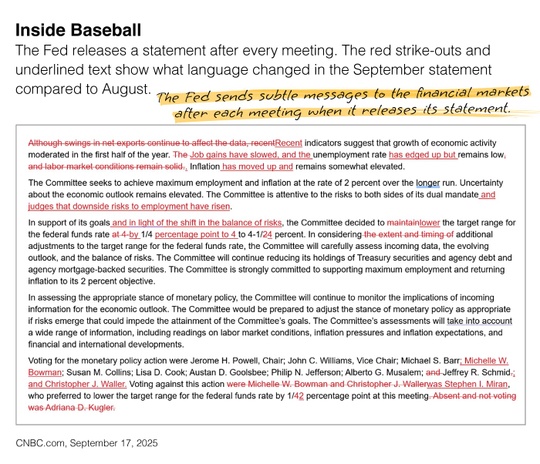
The Fed’s September rate cut signals a shift in monetary policy by the central bank. It was the first time the Fed lowered the benchmark rate in months. Fed Chair Jerome Powell indicated more adjustments were likely this year and into 2026 to address economic concerns, including a sluggish labor market.

So, while you may see a few benefits in the short term, more opportunities may present themselves in the longer term.

If you have any questions about the Fed’s decision, please don't hesitate to reach out. I’m always happy to hear from anyone who has questions about what’s next for interest rates, especially if it involves a buying decision.

Weekly Market Commentary

The Markets

The economy is all right.

Last week, revised economic figures showed the United States economy grew faster from April through June than previously thought. The upward revision was primarily due to a revised estimate for consumer spending over the period, according to Connor Smith of Barron’s.

“American consumers, the engine of the world's largest economy, have remained resilient in the face of tariffs and economic uncertainty…The continued strength in spending, which has defied worries about a slowdown, is in contrast to recent data showing a weakening labor market…But initial claims for unemployment insurance fell last week to their lowest level since July…in a sign that the jobs market might not be in as dire shape as other data have suggested,” reported Danielle Kay of the BBC.

The contrast between consumer spending and consumer sentiment was striking. Consumer sentiment moved lower again in September and is down more than 21 percent this year, according to the University of Michigan’s Consumer Sentiment Survey.

“Nationally, not only did macroeconomic expectations fall, particularly for labor markets and business conditions, but personal expectations did as well, with a softening outlook for [consumers’] own incomes and personal finances. Consumers continue to express frustration over the persistence of high prices, with 44 [percent] spontaneously mentioning that high prices are eroding their personal finances, the highest reading in a year,” wrote Surveys of Consumers Director Joanne Hsu.

The inflation picture did not improve in August. Prices, as measured by the personal consumption expenditures price index, were up 2.7 percent year over year. When volatile food and energy prices were excluded, prices rose 2.9 percent year over year. Both measures are well above the Federal Reserve’s two percent inflation target.

Last week, major U.S. stock indexes rallied on Friday, but were not able to recoup losses from earlier in the week, reported Sean Conlon of CNBC. Yields moved higher over the week for all but the longest maturities of U.S. Treasuries.

IT’S NOT THE NOBEL PRIZE. “Many scientists dream of winning a Nobel Prize, an accolade that brings worldwide recognition, prestige and a place in the pantheon of greatness alongside the likes of Albert Einstein, Marie Curie and Francis Crick. Then there are the other awards — the Ig Nobel prizes, which were devised to highlight research that makes people laugh, then think,” reported Chris Simms in the journal Nature.

The 35th First Annual Ig Nobel Prize ceremony took place in mid-September. This year’s awards included:

 Peace Prize. Fritz Renner, Inge Kersbergen, Matt Field, and Jessica Werthmann were recognized for investigating the effects of alcohol consumption on foreign language pronunciation among people who have just learned a language. Turns out, having a few drinks improves the foreign language skills of some people – but not their ability to self-rate their skills. The data were published in Dutch Courage? Effects of Acute Alcohol Consumption on Self-Ratings and Observer Ratings of Foreign Language Skills.

 Biology Prize. “Biting flies are the most damaging arthropod pests of cattle worldwide and the economic impact of biting flies on the United States cattle production was estimated at [$2.211 billion] per year,” according to a team of researchers in Japan who studied ways to address the issue. They found that disguising cows as zebras – by painting them with black and white stripes – greatly reduced the number of fly bites.

Engineering Design Prize. Vikash Kumar and Sarthak Mittal took home an Ig for their paper titled, Smelly Shoes – An Opportunity for Shoe Rack Re-Design. The pair explored how stinky shoes affect owner satisfaction with shoe racks in India. They concluded there is market potential for a new type of device with a built-in deodorizer.

Physics Prize. Cacio e pepe is one of those deceptively simple Italian sauces that can be quite challenging to prepare. Researchers from Spain, Italy, Germany, and Austria studied the cooking process to develop a scientific recipe. They explained, “A true Italian grandmother or a skilled home chef from Rome would never need a scientific recipe for Cacio e pepe, relying instead on instinct and years of experience. For everyone else, this guide offers a practical way to master the dish.” The recipe can be found in the paper, Phase behavior of Cacio e pepe sauce.

Prizes also were awarded in the fields of literature, psychology, nutrition, pediatrics, chemistry, and aviation.

WEEKLY FOCUS – THINK ABOUT IT
“The ‘silly’ question is the first intimation of some totally new development.”
– Alfred Whitehead, Mathematician and philosopher

6Lc_psgUAAAAAA9c7MediJBuq3wAxIyxDSt73c9j