The Cracking Foundation of the American Consumer

The Shifting Ground of the American Consumer: Finding Opportunity in Change
The economic landscape is undergoing a significant transformation, and understanding these shifts is key to positioning your portfolio for what comes next. While headline numbers often mask the details, a closer look at household finances reveals that the consumer environment is entering a new, more selective phase.
This financial recalibration is no longer just affecting a single demographic; it is moving across various income brackets as households adjust to a higher-for-longer interest rate environment. High inflation combined with restrictive interest rates has led even upper-middle-class households to reevaluate their balance sheets. For instance, stories are surfacing of professionals earning near $200,000 annually who are actively managing five-figure credit card balances with interest rates upwards of 26%. Rather than a crisis, this signals a broader trend of households adapting to the reality of more expensive capital.

Mapping the New Consumer Landscape
To navigate this market effectively, it helps to track exactly where household capital is flowing and where pressure points are developing:
As student loan obligations fully resume, the personal savings rate has normalized toward historic baselines. Consumers are still actively participating in the economy, but they are increasingly relying on strategic credit use to maintain their lifestyles.

Navigating the New Economic Balance
For decades, the standard financial playbook relied on low borrowing costs, rising asset values, and easy debt rollovers. What looked like pure economic resilience over the past year was often just an intentional use of leverage by consumers.
This credit-driven model naturally slows down when real interest rates remain positive. While leverage can sustain retail spending for a time, elevated interest costs eventually cause households to become more discerning with their cash flow. This transition typically follows a healthy, corrective path:
We are seeing this consumer mindfulness reflected in recent surveys. About 60% of Americans report that they are budgeting more carefully for leisure and summer travel, keeping a closer eye on restaurant and fuel costs. Rather than a complete pullback, this represents a healthy "flight to value" as families prioritize what matters most to them.

Portfolio Strategy: Pivoting Toward Resilience
This period of consolidation offers an excellent opportunity to fine-tune your investments. Because consumer spending represents roughly 70% of U.S. GDP, a more calculated consumer means the market will reward stability over pure speculation.
If equity markets experience a natural breather, protecting your accumulated gains becomes the top priority. In this environment, we favor shifting away from high-flying, momentum-driven segments that rely heavily on ultra-cheap credit.
Instead, look toward historically resilient sectors that tend to anchored during economic transitions. Assets like high-quality bonds, gold, consumer staples, defensive equity sectors, and the equal-weighted S&P 500 offer a compelling alternative to richly valued tech or speculative growth names. While a broader market shift affects all assets temporarily, these defensive sectors are structured to weather the noise remarkably well.
In a maturing market cycle, capturing steady, resilient growth and preserving your capital is far more rewarding than chasing the volatile tail-end of a risk rally.
Sources & Data References:

Explanation of current positions

Several clients have told us they are a little overwhelmed by many of the new ETFs, and what their business model and investment objectives are.   Below is a short summary of all the ETFs currently in the growth model as of today.  If you have any questions, please don't hesitate to respond.
 
DRAM:    global companies focused on computer memory, storage, high bandwidth memory (HBM), dynamic access memory (DRAM),and NAND task memory.
XME:    metals, mining, aluminum, copper, gold, silver, and steel
XBI:    biotech companies, drug research, agricultural; and industrial biological processes
SOXX:    semi-conductors, designers, manufacturers, and distributors of chips
DTCR:    physical foundation of global real estate that has technology hardware, data centers, cell towers, and fiber networks
XLE:    oil, natural gas, consumable fuel, energy, and equipment services
QQQ:    100 largest NON-financial stocks on the NASDAQ exchange
RPG:    64 S&P 500 companies classified as "growth"
SPY:    500 largest US stock exchange traded companies
XOVR:    invests in pre-IPO companies like Space X, Klarna, and Anduril
PDBC:    no K-1 commodities fund including energy, gold, silver, precious metals, industrial metals and agriculture land

Market Update: Navigating Geopolitical Uncertainty and Your Portfolio

In times of heightened global tension, we know that the daily news cycle can feel overwhelming, particularly when it comes to the safety of your hard-earned wealth. We are writing to you today to provide a brief update on the current market environment and to reassure you of the steps we are taking on your behalf.

Currently, the complex and deeply uncertain state of world politics is creating notable ripple effects across the global economy. Specifically, we are closely tracking Iran's recent threats toward shipping routes in the Strait of Hormuz. Because this region is a critical artery for global energy, these disruptions have already triggered a sharp increase in fuel costs. As energy prices are a foundational driver of broader economic trends, including inflation and consumer spending, these geopolitical tensions are introducing new volatility into the markets.

Please be assured that the team at Research Financial Strategies is actively monitoring these developments. We are constantly analyzing market indicators, evaluating supply chain impacts, and assessing real-time data to determine which way the markets are likely to head next.

While global events are outside of anyone's control, how we prepare and adjust your portfolio is not. We do not rely on reacting to the news; instead, we remain vigilant, looking for both defensive measures to shield your capital and tactical opportunities that may arise from the volatility.

Our primary mission at Research Financial Strategies is to look out for your investments. We are dedicated to actively managing your portfolio through these turbulent times so you can remain focused on your long-term financial goals with peace of mind.

If you have any specific questions about your accounts or how the current geopolitical landscape might impact your financial plan, please do not hesitate to reach out to us. We are always here to help.

Warm regards,

Jack Reutemann, Jr
The Team at Research Financial Strategies

Happy Thanksgiving

Happy Thanksgiving

Wishing You a Happy Thanksgiving

As Thanksgiving approaches, we pause to reflect on and appreciate the abundant blessings in our lives, especially the family and friends who enrich our days.

We look forward with great anticipation to the coming year and the entire holiday season—a special time that affords us moments to cherish the intangible gifts of love, faith, and meaningful relationships.

We wish you and yours a wonderful Thanksgiving and a peaceful, joyful holiday season.

Textbook example of the single stock risk!

CAVA: Post-CMG Price Action and Market Context

CAVA shares experienced an 11% decline this morning, a notable reaction tied to the recent earnings announcement from industry peer Chipotle (CMG). This price movement reflects speculative investor sentiment, as the market appears to be extrapolating CMG's results to the broader fast-casual restaurant sector.

Single Stock Risk and Consumer Headwinds

This dramatic market reaction serves as a textbook example of single stock risk in action. When a company's stock is highly correlated with its peers, sector-wide news—even if not directly related to the company's own operations—can cause disproportionate volatility.

The immediate pain is quantifiable: CMG is down approximately 15% today and has seen its value drop 45% year-to-date. In a similar vein, CAVA is down 50% year-to-date. These significant losses underscore the severe market pessimism regarding the quick-service restaurant sector.

This volatility is further fueled by current macroeconomic trends: investors are mindful that consumers are broadly cutting back on non-essential spending, choosing to buy more groceries and eat out less. The 11% dip suggests the market is pricing in the assumption that CAVA will face similar headwinds from tighter consumer budgets when it reports on November 4th.

This is precisely why our investment process at Research Financial Strategies involves trying to mitigate this risk by focusing on Exchange-Traded Funds (ETFs) instead of individual single stocks. This approach provides immediate diversification, helping to spread the risk across a basket of companies or sectors.

We note that CAVA has not yet reported its own third-quarter earnings; the company's official results are still scheduled for release on November 4th. This stock volatility warrants close observation ahead of the confirmation (or refutation) by their actual filing.


Data Source: Yahoo Finance

The Fed Cut Rates: What’s in It for Me?

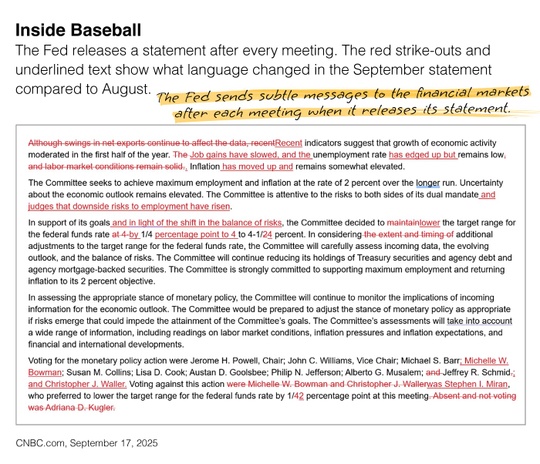
The Fed lowered short-term interest rates at its September 2025 meeting, but the question on most people’s minds is, “What’s in it for me?”

That’s a fair question, so here are some ideas to consider.

First-wave changes: Any loan considered “variable rate” can be expected to adjust relatively quickly, as with a home equity line of credit (HELOC). However, don’t get too excited. The change is likely to be relatively small.

Second-wave changes: If you’re buying a home, the Fed’s change may affect your mortgage rate. If you’re refinancing, you may also see rates change. If you’re shopping for a new car, you may see new advertised rates on car loans. 

Long-term changes: Credit card companies might adjust their interest rates, but it may take several payment cycles before you see any movement. Remember, if you have a fixed-rate mortgage, the interest rate will not change unless you refinance or sell your home.

The Fed’s September rate cut signals a shift in monetary policy by the central bank. It was the first time the Fed lowered the benchmark rate in months. Fed Chair Jerome Powell indicated more adjustments were likely this year and into 2026 to address economic concerns, including a sluggish labor market.

So, while you may see a few benefits in the short term, more opportunities may present themselves in the longer term.

If you have any questions about the Fed’s decision, please don't hesitate to reach out. I’m always happy to hear from anyone who has questions about what’s next for interest rates, especially if it involves a buying decision.

6Lc_psgUAAAAAA9c7MediJBuq3wAxIyxDSt73c9j