Mastering the Market: Re-Engineering Your Retirement Strategy

Planning for retirement is one of the most critical financial undertakings of your life, yet traditional "buy-and-hold" frameworks often leave investors exposed to unnecessary structural risks. In a market regime defined by sudden volatility shifts and macroeconomic divergence, navigating your golden years requires an active approach.

By identifying hidden technical blind spots and reordering your tactical priorities, you can build a resilient, alpha-generating strategy that preserves your nest egg. Here are 13 critical retirement missteps—reordered by strategic priority—along with the active solutions needed to fix them.


Phase 1: Portfolio Dynamics & Structural Mechanics

1. Failing to Account for Severe Market Drawdowns

  • The Pitfall: Traditional models assume markets always trend upward over a long enough horizon. However, entering retirement right at the beginning of a multi-year bear market can permanently cripple a passive portfolio if you are forced to liquidate assets at absolute price floors.

  • The Technical Solution: Utilize systematic trend filters (such as the 200-day moving average) and maintain a dedicated cash or short-duration liquidity buffer. This ensures you never have to sell your core growth equity positions during structural market corrections.

2. Allowing Asset Allocation to Drift Out of Balance

  • The Pitfall: Over time, winning sectors grow so large that they completely distort your intended risk profile, transforming a balanced portfolio into an accidentally over-concentrated, high-beta liability.

  • The Technical Solution: Implement a strict, calendar-based or boundary-based rebalancing schedule. Trimming assets at technical overhead resistance allows you to systematically lock in profits and rotate capital into emerging, low-correlation bases.

3. Misunderstanding the True Cost of Fees

  • The Pitfall: Overlooking minor expense ratios or hidden management fees can quietly strip six figures away from your compounded returns over a 25-year retirement horizon.

  • The Technical Solution: Demand total transparency. Audit your portfolio to replace high-cost, underperforming mutual funds with highly liquid, low-cost institutional ETFs that match your exact momentum and factor requirements.

4. Overlooking the Corrosive Effect of Inflation

  • The Pitfall: Failing to realize that a fixed cash balance is a guaranteed losing trade over time. Standard cost-of-living increases continuously erode your real purchasing power.

  • The Technical Solution: Allocate a portion of capital into hard assets and secular trend leaders—such as commodity ETFs, real estate infrastructure, or high relative-strength equities—that historically outpace consumer price index expansions.

5. Delaying the Deployment of Capital

  • The Pitfall: Paralyzed by market headlines, many investors sit on the sidelines waiting for the "perfect" day to invest, missing out on the exponential power of compounding momentum.

  • The Technical Solution: Remove human emotion through automated consistency. Establish systematic entry rules or dollar-cost averaging models to build positions at various market structures without trying to guess macro bottoms.


Phase 2: Income Distribution & Tactical Execution

6. Operating Without a Defined Liquid Reserve

  • The Pitfall: Lacking an emergency cash fund forces you to tap into long-term investment accounts during short-term personal crises, disrupting your compounding engine and breaking trade setups.

  • The Technical Solution: Keep three to six months of absolute living expenses completely decoupled from the market in high-yield, liquid vehicles to act as an operational shock absorber.

7. Lacking a Tactical Withdrawal Sequence

  • The Pitfall: Pulling distributions randomly from various accounts without a clear structural plan can accelerate the premature depletion of your capital.

  • The Technical Solution: Design a detailed distribution waterfall that outlines exactly which accounts (taxable vs. tax-advantaged) to draw from first, preserving your tax-shielded compounding engines for as long as possible.

8. Blindly Relying on Government Benefits

  • The Pitfall: Treating Social Security as a primary baseline income source rather than a minor supplementary piece. Government safety nets are rarely scaled to preserve a high-quality lifestyle.

  • The Technical Solution: View Social Security strictly as a minor cash-flow buffer. Build a diversified, multi-tiered independent stream of income through active trading models, dividend-growth vehicles, or private credit allocations.

9. Entering Retirement Saddled with High-Interest Debt

  • The Pitfall: Carrying consumer loans or variable-rate debt into retirement introduces a massive drag on your monthly cash flow, forcing you to take higher-risk market setups just to keep up.

  • The Technical Solution: Prioritize an aggressive deleveraging campaign before your target retirement date. Clearing liabilities dramatically lowers your monthly income requirements, giving your portfolio more breathing room during market volatility.


Phase 3: Wealth Preservation & Legacy Logistics

10. Ignoring the Impact of Capital Gains and Withdrawal Taxes

  • The Pitfall: Forgetting that Uncle Sam owns a percentage of your pre-tax retirement accounts. Blind withdrawals can easily push you into a higher marginal tax bracket.

  • The Technical Solution: Optimize the tax location of your assets—keeping high-turnover trading strategies in tax-sheltered accounts while utilizing tax-loss harvesting methods in your taxable brokerages to offset realized gains.

11. Disregarding Ever-Increasing Healthcare Overheads

  • The Pitfall: Failing to budget for the single largest variable expense in modern retirement: medical Care and long-term institutional support.

  • The Technical Solution: Proactively integrate dedicated healthcare buckets into your cash-flow models, utilizing tax-advantaged Health Savings Accounts (HSAs) or specific insurance wrappers to insulate your core portfolio from sudden medical liabilities.

12. Leaving Your Legacy Untied to an Estate Plan

  • The Pitfall: Neglecting to properly structure wills, trusts, and beneficiary designations, which ultimately hands your life's work over to probate court and state bureaucracy.

  • The Technical Solution: Formulate a rock-solid estate map. Review and update your legal frameworks and account beneficiaries bi-annually to ensure assets transfer seamlessly and tax-efficiently to your heirs.

13. Navigating Complex Market Structures Completely Alone

  • The Pitfall: Trying to act as a solo portfolio manager, analyst, tax strategist, and estate planner all at once, which frequently leads to emotional execution errors during market stress.

  • The Technical Solution: Partner with a specialized financial ally. An active wealth manager who understands price action, advanced risk metrics, and comprehensive financial architecture can help you steer clear of these pitfalls and keep your plan entirely aligned with your long-term vision.


Moving Your Strategy Forward

Navigating a volatile market regime requires a dynamic strategy built on hard rules, precise execution, and absolute risk management. If you want to stress-test your current portfolio against these 13 structural hazards, schedule a technical review with our active management team today.

GET IN TOUCH

We are dedicated to helping you protect and manage your assets, prepare for retirement and life’s events, and develop a legacy that benefits your loved ones and future generations. As your financial partner, we listen and respond to your needs using clear, simple language. We offer personal service, seek to develop innovative strategies, and pledge to lead you with great care along the path to pursuing your goals.

We offer a free, no-obligation consultation  to discuss your financial future.
The Federal Retiree’s Guide to Medicare: 10 Costly Pitfalls to Avoid

Navigating the intersection of the Federal Employees Health Benefits (FEHB) program and Medicare can feel like trying to solve a Rubik's Cube that also charges you monthly premiums. While the combination offers some of the best health coverage in the country, the rules are rigid, and a simple paperwork error can lead to lifelong financial penalties.

As we move through 2026, the options for federal retirees have expanded, particularly with the growth of Medicare Advantage (MA) plans within the FEHB ecosystem. Here is a restructured guide to avoiding the most expensive Medicare pitfalls.


1. The Redundancy Trap: Buying a Private Medigap Plan

One of the most frequent (and expensive) errors is a federal retiree purchasing a private "Medigap" or Medicare Supplement policy.

  • The Reality: Your FEHB plan already functions as your Medicare Supplement. When you have both, Medicare usually pays first, and your FEHB plan covers the remaining deductibles and coinsurance.

  • The Risk: Private Medigap plans can cost hundreds of dollars a month and often use medical underwriting. Paying for a private supplement while already paying FEHB premiums is essentially paying twice for the same "wraparound" protection.

2. Misunderstanding "Coordination of Benefits"

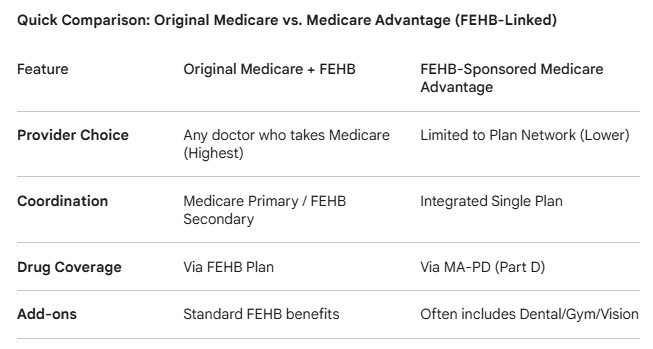
Many retirees fear they are "over-insured," but the synergy between FEHB and Original Medicare (Parts A and B) is powerful.

  • How it Works: Generally, Medicare becomes the primary payer, covering roughly $80\%$ of your outpatient costs. Your FEHB plan becomes the secondary payer.

  • The Benefit: In many cases, the coordination is so seamless that your out-of-pocket cost for a doctor’s visit or hospital stay drops to $0. This only works, however, if your providers accept "Medicare Assignment"—meaning they agree to the Medicare-approved price for services.

3. The "Small Print" in Medicare Advantage (MA)

Lately, OPM has encouraged carriers to offer Medicare Advantage "Part D" Employer Group Waiver Plans (MA-PD). These plans often offer "bells and whistles" like gym memberships, dental, and vision.

  • The Catch: These benefits often come with a restricted "provider network." If your favorite specialist isn't in that specific MA network, your costs could skyrocket.

  • The Decision: You can "suspend" FEHB to join a private MA plan, but most experts suggest staying within the FEHB-sponsored MA plans. Why? Because the government still pays roughly $72\%$ to $75\%$ of your premium, a subsidy you lose if you go to a purely private plan.

4. Part D and the 2026 Price Cap

As of 2026, the Inflation Reduction Act has significantly altered the landscape of prescription drug coverage (Part D).

  • Pertinent Info: The annual out-of-pocket cap for prescription drugs is now firmly set at $2,000.

  • The Error: Some retirees rush to sign up for a separate Part D plan, not realizing their FEHB drug coverage is already considered "creditable." If your current FEHB drug plan meets your needs, you might not need a separate Part D premium—unless you move to an MA-PD plan that includes it at no extra cost.


5. Timing: The Initial Enrollment Period (IEP)

You have a specific 7-month window to sign up for Medicare: the three months before you turn 65, your birth month, and the three months after.

  • The Penalty: If you miss this window and aren't still working, you may have to wait for the General Enrollment Period (January 1 – March 31).

  • The Sting: For every 12-month period you were eligible but didn't sign up for Part B, your premium increases by 10%—for the rest of your life.

6. Working Past 65: The Special Enrollment Period (SEP)

If you are still a "fed" at age 65, you don't have to sign up for Part B immediately. Your FEHB is considered primary coverage while you are an active employee.

  • The Window: Once you retire, you have an 8-month SEP to enroll in Part B without penalty.

  • Common Mistake: Retirees often confuse the "COBRA" rules with the "SEP" rules. For federal employees, the clock starts the moment you stop active service.

7. The IRMAA Surprise (Income-Related Adjustments)

The IRS and Medicare take a "look-back" at your tax returns from two years ago. If your income was high (e.g., from a large TSP withdrawal or a house sale), you may be hit with an Income-Related Monthly Adjustment Amount (IRMAA).

  • The Cost: This is a surcharge added to your Part B and Part D premiums. If you have a "life-changing event" (like retirement) that reduced your income, you can appeal this using Form SSA-44.

8. Ignoring "Medicare Assignment"

In Original Medicare, the price for a service is fixed.

  • Participating Providers: Agree to take exactly what Medicare pays.

  • Non-Participating Providers: Can charge up to an extra $15\%$ over the Medicare-approved amount (known as "excess charges").

  • The Error: Not checking if your doctor "accepts assignment" can result in you being billed for that extra $15\%$ out of your own pocket.

Financial Impact of Coinsurance

Under Original Medicare, your responsibility for Part B services is typically $20\%$.

$$\text{Patient Responsibility} = \text{Total Cost} \times 0.20$$

However, if your FEHB plan is active, it typically covers that $20\%$ for you, bringing your actual cost to $0.

Ultimately, securing your health benefits is only half the battle. Your Medicare strategy and your Thrift Savings Plan are deeply interconnected—one wrong withdrawal to pay a medical bill or a premium can accidentally trigger a higher tax bracket or an unwelcome IRMAA surcharge. Don't leave your hard-earned savings to chance or confusing fine print. At the end of the day, your retirement should be defined by the freedom you've earned, not the paperwork you've filed.


Ready to Optimize Your Federal Retirement?

If you want to ensure your TSP is working as hard as you did, let’s build a strategy that protects both your health and your wealth.

Contact us today for specialized TSP financial advice and let’s make sure your retirement strategy is as solid as your years of service.

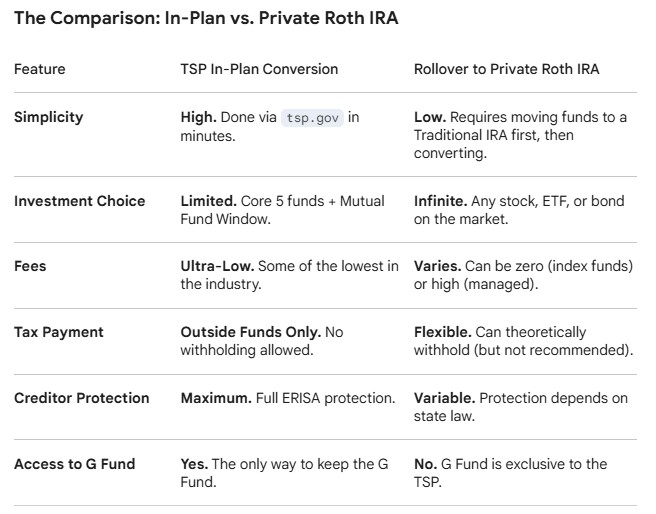
Pros and cons of a TSP “In-Plan Conversion” versus rolling out to a Roth IRA?

Recently, the retirement landscape for federal employees has changed dramatically. The introduction of In-Plan Roth Conversions within the TSP means you no longer have to move your money to an outside bank just to get it into a Roth account.

However, "easier" isn't always "better." Here is the breakdown of how the new in-plan option stacks up against the traditional "roll-out" strategy.

TSP vs IRA

The "In-Plan" Advantage (The New 2026 Way)

If you love the simplicity and safety of the TSP, this is your best bet.

  • Frequency: You can perform up to 26 conversions per year (once per pay period). This is perfect for "dollar-cost averaging" your tax bill—converting a small amount every two weeks to avoid jumping into a higher tax bracket.

  • The "Leave Behind" Rule: You must keep at least $500 in your traditional balance to keep that specific "source" account open.

  • No RMDs: Starting in 2024/2025, Roth TSP balances (including converted ones) are not subject to RMDs during your lifetime, matching the biggest benefit of Roth IRAs.

The "Roll-Out" Advantage (The Traditional Way)

If you want total control over your money, moving it to a private IRA (Fidelity, Vanguard, etc.) still has perks.

  • Asset Specificity: In the TSP, if you convert $10,000, it pulls pro-rata from all your funds (C, S, I, etc.). In a private IRA, you can choose to convert only your worst-performing asset or only your high-growth stock.

  • No $500 Minimums: You can drain a traditional IRA to zero without "closing" the account or dealing with minimum balance rules.

  • Better Heir Options: While the TSP is great for you, private IRAs often have more flexible "stretch" options or beneficiary tools for your children.


 Critical 2026 Update: The "Pro-Rata" Trap

One thing the new TSP conversion tool does not let you do is "cherry-pick" your tax-exempt money.

Example: if you have $10,000 in "Tax-Exempt" combat zone pay and $90,000 in "Traditional" pay, any conversion you do will be 90% taxable. You cannot choose to convert only the tax-exempt portion first.


Which one should you choose?

  • Stay in the TSP if: You want the G Fund, you value ERISA-level asset protection, and you want to automate your conversions every pay period.

  • Roll out to an IRA if: You want to invest in individual stocks, you have a complex estate plan, or you want to pick specific assets to convert.

Questions to ask your IRA custodian when transferring a TSP

Since it is 2026, the TSP has significantly updated its technology and services. Most notably, they now offer a Rollover Concierge Service and In-Plan Roth Conversions.

Here are two scripts tailored for the most common scenarios. Use the one that fits your current goal.


Scenario A: Moving Money OUT of the TSP (Into an IRA)

Use this if you are retired or separated and want to move your TSP funds to a private provider like Fidelity, Schwab, or Vanguard.

The Goal: Ensure the custodian accepts the check correctly so it isn't coded as a taxable withdrawal.

You: "Hi, I am a federal employee/retiree and I’m looking to perform a direct, trustee-to-trustee rollover from my Thrift Savings Plan (TSP) into my IRA here.

  1. Can you provide the exact 'Payable To' instructions for the check? (It should usually be [Custodian Name] FBO [Your Name]).

  2. What is the specific mailing address where the TSP should send the rollover check?

  3. Does your firm allow for electronic rollover deposits, or must the TSP mail a physical check?

  4. I have both Traditional and Roth balances in my TSP. Can you confirm that you have both a Traditional and Roth IRA open for me so we don't accidentally mix pre-tax and after-tax funds?"


Scenario B: Moving Money INTO the TSP (Consolidation)

Use this if you have an old 401(k) or a Traditional IRA and want to move it into the TSP for lower fees or simpler management.

The Goal: To get your custodian to release the funds without withholding the 20% tax.

You: "I’d like to initiate a direct rollover of my [IRA or 401k] assets into my Thrift Savings Plan account.

  1. I am working with the TSP Rollover Concierge. Do you have a specific department or phone number my TSP specialist should call to coordinate the paperwork?

  2. What forms do you require from your side to authorize a Trustee-to-Trustee transfer?

  3. Can you confirm that no federal taxes will be withheld from this distribution, since it is going directly to a qualified plan?

  4. (If moving an IRA): Can you verify how much of this balance is 'cost basis' (after-tax) versus pre-tax? The TSP only accepts pre-tax Traditional IRA funds."


3 Vital "Verification Questions" (To avoid the 10 Errors)

Before you hang up, ask these three questions to double-check the work of the representative:

  1. "To be 100% clear, this is being processed as a 'Direct Rollover' and NOT a 60-day 'Indirect Rollover,' correct?" (Avoids the 60-day deadline trap).

  2. "Will you be sending me a check, or will you be sending it directly to the other institution?" (If they send it to you, it must be made out to the institution, not you personally).

  3. "I am [Age]. Have my Required Minimum Distributions (RMDs) for this year already been satisfied?" (Avoids the error of rolling over an RMD).


2026 Update: The "In-Plan" Shortcut

If your goal was to move money from a Traditional TSP to a Roth IRA just to "convert" it, check your TSP "My Account" portal first. As of January 2026, the TSP now allows Roth In-Plan Conversions. You can now flip Traditional TSP funds to Roth TSP funds without ever moving the money out of the plan.

How to ensure a TSP direct transfer is handled correctly

Since you're ready to get organized, here is a "No-Mistakes" Checklist. Use this when you’re on the phone with a TSP representative or your IRA custodian to ensure the money moves safely from point A to point B without the IRS taking a cut.


The "Direct Rollover" Master Checklist

Phase 1: Preparation (Before You Call)

  • [ ] Locate Account Numbers: Have both your TSP account number and your destination IRA account number ready.

  • [ ] Verify Account Type: Confirm the "flavor" of the money. (e.g., Traditional TSP must go to a Traditional IRA; Roth TSP must go to a Roth IRA).

  • [ ] Check the "RMD" Status: If you are age 73+, calculate your Required Minimum Distribution first. You must take that distribution before you can roll over the remaining balance.

Phase 2: Communicating with the Institutions

  • [ ] Use the "Magic Words": Explicitly state, "I want to perform a Direct, Trustee-to-Trustee Rollover." (This prevents them from accidentally cutting a check in your name).

  • [ ] The "Payable To" Instruction: If they must mail a physical check, ensure it is made out to the institution, not you.

    • Example: "XYZ Brokerage, FBO [Your Name], Account #12345." (FBO stands for "For Benefit Of").

  • [ ] Confirm Tax Withholding: For a direct rollover, the federal tax withholding should be 0%. If they mention a 20% withholding, stop the process—they are likely processing an indirect rollover by mistake.

Phase 3: The TSP Specifics

  • [ ] Online Portal vs. Paper: Most TSP rollovers are now initiated through the TSP "My Account" portal. Check there first to see if you can generate the transfer electronically.

  • [ ] For Moving Money INTO the TSP: You will likely need Form TSP-60 (for Traditional) or Form TSP-60-R (for Roth). Your IRA custodian will need to sign a portion of this.

  • [ ] For Moving Money OUT of the TSP: Ensure your IRA custodian provides you with their "Transfer/Rollover In" instructions, including the specific mailing address for rollover checks.

Phase 4: Follow-Up

  • [ ] The 10-Day Check: If the money hasn't landed in 10 business days, start making calls.

  • [ ] Tax Form Verification: In January of next year, look for Form 1099-R from the sending institution.

    • Check Box 7: It should show Code G (Direct rollover to a qualified plan). If it doesn't, you'll need to contact them for a correction.


Pro-Tip: If you’re moving a large sum, ask the receiving institution if they have a "Rollover Specialist" who can jump on a three-way call with the TSP. It’s their job to make sure the money arrives safely!

10 Costly TSP and IRA Rollover Traps

Don’t Hand the IRS Your Retirement: 10 Costly TSP and IRA Rollover Traps

Managing your retirement funds as a federal employee can feel like navigating a minefield where the prizes are your own savings and the mines are IRS penalties. Whether you are moving funds between the Thrift Savings Plan (TSP) and an IRA, or just consolidating accounts, one wrong move can trigger a tax bill that bites into your future.

Here is a restructured and expanded guide to avoiding the most expensive pitfalls in the rollover process, updated with the latest legislative changes.


1. Understanding the "How": Direct vs. Indirect Rollovers

Before diving into errors, you must know the two ways money moves.

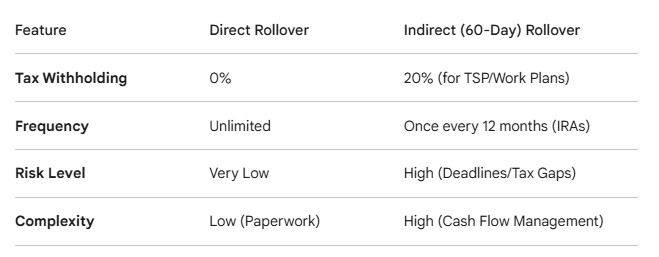
  • Direct Rollover (The Safe Path): The administrator of your current plan sends the money directly to your new plan or IRA. No taxes are withheld, and the IRS never considers the money "in your pocket."

  • Indirect Rollover (The 60-Day Scramble): You receive a check made out to you. You have exactly 60 days to deposit those funds into a new qualified account.

    • The Trap: For TSP distributions, the government automatically withholds 20% for federal taxes. To complete a full rollover, you must find outside cash to cover that 20% gap when you deposit the funds, or that 20% will be treated as a taxable distribution (and potentially hit with a 10% early withdrawal penalty).


2. Timing and Frequency Mistakes

The "One-Per-Year" Rule

You are only allowed one indirect (60-day) IRA-to-IRA rollover every 12 months. This is a rolling 365-day window, not a calendar year.

Note: This limit does not apply to direct "trustee-to-trustee" transfers or rollovers from the TSP to an IRA. It only polices the "check-in-hand" moves between IRAs.

Missing the 60-Day Deadline

If you take an indirect rollover and miss the 60-day window, the entire amount becomes taxable income for the year you received the money. If you’re under 59.5, add a 10% penalty on top. The IRS rarely grants waivers for "I forgot."

The "Same Property" Requirement

If you withdraw 100 shares of a specific stock from an IRA, you cannot deposit the cash equivalent into the new IRA. You must deposit the exact same property (the shares) that you took out. If you took cash, you must deposit cash.


3. The "Un-Rollables": Assets You Can't Move

Required Minimum Distributions (RMDs)

As of the SECURE Act 2.0, the RMD age has shifted to 73 (and will eventually hit 75). Once you reach the age where you must take RMDs, that money cannot be rolled over.

  • The Error: Many retirees try to "convert" their RMD by rolling it into a Roth IRA. The IRS views this as an "excess contribution," which carries a 6% penalty every year it remains in the account.

TSP Hardship Withdrawals

If you take a financial hardship withdrawal from your TSP, that money is yours to keep (and pay taxes on). It is legally ineligible for rollover.

After-Tax Assets in the TSP

While the TSP accepts "pre-tax" IRA money, it generally does not accept after-tax (nondeductible) contributions from a traditional IRA. If you have a "basis" in your IRA (tracked via IRS Form 8606), leave that portion out of your TSP rollover.


4. Structural and Legal Blunders

Direct Traditional TSP to Roth IRA

If you move money directly from a Traditional TSP to a Roth IRA, this is treated as a Roth Conversion. It is fully taxable in the year you do it. To avoid a massive, unintended tax bill, most experts suggest rolling the Traditional TSP to a Traditional IRA first, then converting to Roth in smaller, controlled "tranches" to manage your tax bracket.

The Divorce Distribution

In a divorce, if you simply withdraw IRA funds to pay an ex-spouse, you are the one stuck with the tax bill and the 10% penalty (if applicable).

  • The Fix: Use a "trustee-to-trustee" transfer as part of a Qualified Domestic Relations Order (QDRO) for the TSP, or a "transfer incident to divorce" for IRAs. This moves the tax liability to the person receiving the money.

Defaulted TSP Loans

If you leave federal service with an outstanding TSP loan, you must pay it back or "roll it over" (by depositing the equivalent amount into an IRA) within about 90 days. If you don't, the TSP declares a "deemed distribution," and you'll owe taxes on the unpaid balance.


5. Pertinent Updates & Modern Considerations

SECURE 2.0 and Roth TSP RMDs

New for 2024: Previously, Roth TSPs required RMDs even though Roth IRAs did not. Under the SECURE Act 2.0, Roth TSP accounts no longer require RMDs during the owner's lifetime. This removes a major reason people used to roll their Roth TSP into a Roth IRA.

Lost Accounts and Consolidation

Federal employees often have "zombie" 401(k)s from previous private-sector jobs.

  • Pro Tip: You can roll those old 401(k)s, 403(b)s, and even SEP IRAs into your TSP. This simplifies your "Required Minimum Distribution" math later in life and keeps your administrative fees low, as the TSP remains one of the lowest-cost plans available.

Qualified Longevity Annuity Contracts (QLACs)

You can now move up to $200,000 from your TSP or IRA into a QLAC. This is a "deferred annuity" that allows you to delay taking RMDs on that specific chunk of money until as late as age 85, providing a hedge against outliving your money.

TSP Advice
6Lc_psgUAAAAAA9c7MediJBuq3wAxIyxDSt73c9j