
Navigating the intersection of the Federal Employees Health Benefits (FEHB) program and Medicare can feel like trying to solve a Rubik's Cube that also charges you monthly premiums. While the combination offers some of the best health coverage in the country, the rules are rigid, and a simple paperwork error can lead to lifelong financial penalties.
As we move through 2026, the options for federal retirees have expanded, particularly with the growth of Medicare Advantage (MA) plans within the FEHB ecosystem. Here is a restructured guide to avoiding the most expensive Medicare pitfalls.
1. The Redundancy Trap: Buying a Private Medigap Plan
One of the most frequent (and expensive) errors is a federal retiree purchasing a private "Medigap" or Medicare Supplement policy.
-
The Reality: Your FEHB plan already functions as your Medicare Supplement. When you have both, Medicare usually pays first, and your FEHB plan covers the remaining deductibles and coinsurance.
-
The Risk: Private Medigap plans can cost hundreds of dollars a month and often use medical underwriting. Paying for a private supplement while already paying FEHB premiums is essentially paying twice for the same "wraparound" protection.
2. Misunderstanding "Coordination of Benefits"
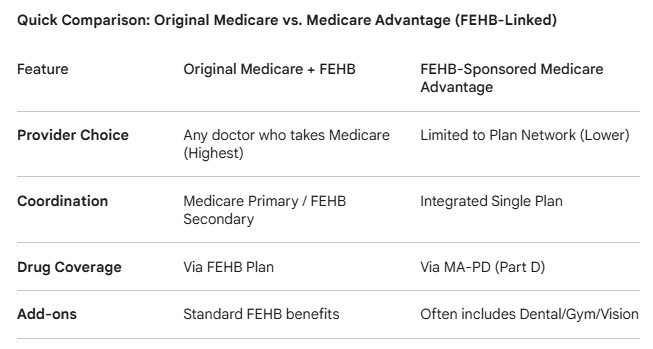
Many retirees fear they are "over-insured," but the synergy between FEHB and Original Medicare (Parts A and B) is powerful.
-
How it Works: Generally, Medicare becomes the primary payer, covering roughly $80\%$ of your outpatient costs. Your FEHB plan becomes the secondary payer.
-
The Benefit: In many cases, the coordination is so seamless that your out-of-pocket cost for a doctor’s visit or hospital stay drops to $0. This only works, however, if your providers accept "Medicare Assignment"—meaning they agree to the Medicare-approved price for services.
3. The "Small Print" in Medicare Advantage (MA)
Lately, OPM has encouraged carriers to offer Medicare Advantage "Part D" Employer Group Waiver Plans (MA-PD). These plans often offer "bells and whistles" like gym memberships, dental, and vision.
-
The Catch: These benefits often come with a restricted "provider network." If your favorite specialist isn't in that specific MA network, your costs could skyrocket.
-
The Decision: You can "suspend" FEHB to join a private MA plan, but most experts suggest staying within the FEHB-sponsored MA plans. Why? Because the government still pays roughly $72\%$ to $75\%$ of your premium, a subsidy you lose if you go to a purely private plan.
4. Part D and the 2026 Price Cap
As of 2026, the Inflation Reduction Act has significantly altered the landscape of prescription drug coverage (Part D).
-
Pertinent Info: The annual out-of-pocket cap for prescription drugs is now firmly set at $2,000.
-
The Error: Some retirees rush to sign up for a separate Part D plan, not realizing their FEHB drug coverage is already considered "creditable." If your current FEHB drug plan meets your needs, you might not need a separate Part D premium—unless you move to an MA-PD plan that includes it at no extra cost.
5. Timing: The Initial Enrollment Period (IEP)
You have a specific 7-month window to sign up for Medicare: the three months before you turn 65, your birth month, and the three months after.
-
The Penalty: If you miss this window and aren't still working, you may have to wait for the General Enrollment Period (January 1 – March 31).
-
The Sting: For every 12-month period you were eligible but didn't sign up for Part B, your premium increases by 10%—for the rest of your life.
6. Working Past 65: The Special Enrollment Period (SEP)
If you are still a "fed" at age 65, you don't have to sign up for Part B immediately. Your FEHB is considered primary coverage while you are an active employee.
-
The Window: Once you retire, you have an 8-month SEP to enroll in Part B without penalty.
-
Common Mistake: Retirees often confuse the "COBRA" rules with the "SEP" rules. For federal employees, the clock starts the moment you stop active service.
7. The IRMAA Surprise (Income-Related Adjustments)
The IRS and Medicare take a "look-back" at your tax returns from two years ago. If your income was high (e.g., from a large TSP withdrawal or a house sale), you may be hit with an Income-Related Monthly Adjustment Amount (IRMAA).
-
The Cost: This is a surcharge added to your Part B and Part D premiums. If you have a "life-changing event" (like retirement) that reduced your income, you can appeal this using Form SSA-44.
8. Ignoring "Medicare Assignment"
In Original Medicare, the price for a service is fixed.
-
Participating Providers: Agree to take exactly what Medicare pays.
-
Non-Participating Providers: Can charge up to an extra $15\%$ over the Medicare-approved amount (known as "excess charges").
-
The Error: Not checking if your doctor "accepts assignment" can result in you being billed for that extra $15\%$ out of your own pocket.
Financial Impact of Coinsurance
Under Original Medicare, your responsibility for Part B services is typically $20\%$.
However, if your FEHB plan is active, it typically covers that $20\%$ for you, bringing your actual cost to $0.
Ultimately, securing your health benefits is only half the battle. Your Medicare strategy and your Thrift Savings Plan are deeply interconnected—one wrong withdrawal to pay a medical bill or a premium can accidentally trigger a higher tax bracket or an unwelcome IRMAA surcharge. Don't leave your hard-earned savings to chance or confusing fine print. At the end of the day, your retirement should be defined by the freedom you've earned, not the paperwork you've filed.
Ready to Optimize Your Federal Retirement?
If you want to ensure your TSP is working as hard as you did, let’s build a strategy that protects both your health and your wealth.
Contact us today for specialized TSP financial advice and let’s make sure your retirement strategy is as solid as your years of service.