Weekly Market Insights | Wall Street Reacts to Middle East Conflict

Stocks ended a challenging week lower as investors' attention shifted from updates on ceasefire talks to concerns about the economic impact of a protracted conflict.

The Standard & Poor’s 500 Index lost 2.12 percent, while the Nasdaq Composite Index fell 3.23 percent. The Dow Jones Industrial Average slid 0.90 percent. The MSCI EAFE Index, which tracks developed overseas stock markets, ended the week flat (-0.05 percent).1,2

Challenging Week

Stocks opened higher to start the week as fresh optimism for a resolution to the Middle East conflict permeated market sentiment, and no further news on Iraq’s force majeure declaration appeared to help momentum. Both the Dow Industrials and S&P 500 booked their best day since early February as the White House reported "very good and productive conversations" to end hostilities.3

Markets were under pressure on Tuesday but staged a recovery rally midweek amid reports that Pakistan was mediating ceasefire talks. All three major averages posted solid gains, though it appeared that retail investors remained on the sidelines.4

The upbeat sentiment was short-lived. Markets were under steady pressure Thursday despite news after the close of trading that the White House was extending the previous pause on military strikes on Iranian energy infrastructure by an additional 10 days. The selling picked up on Friday. The Nasdaq and Dow Industrials fell into correction territory, while the S&P suffered its longest weekly losing streak in almost four years.5

Sector Spotlight

Some investors have turned to energy stocks during the volatility. At the close of trading, 19 energy stocks in the S&P 500 traded at their 52-week highs.6

This Week: Key Economic Data

Monday: New York Fed President John Williams speaks.

Tuesday: S&P/Case Shiller Home Price Index* (Jan.). Consumer Confidence. Job Openings. Fed speeches: Austan Goolsbee (Chicago), Michael Barr, Michelle Bowman. 

Wednesday: Retail Sales* (Feb.). ADP Employment Report. Business Inventories* (Jan.). PMI—Manufacturing. ISM Manufacturing. EIA Petroleum Status Report. Fed speeches: Alberto Musalem (St. Louis), Michael Barr.

Thursday:  Weekly Jobless Claims. Trade Deficit (Feb.). Fed official Lorie Logan speaks. Factory Orders. EIA Natural Gas Report. Motor Vehicle Sales. Fed Balance Sheet.

Friday:  Employment Report. PMI—Services.

* indicates federal data release delayed by the government shutdown 

Source: Investors Business Daily - Econoday economic calendar: March 27, 2026.
The Econoday economic calendar lists upcoming U.S. economic data releases (including key economic indicators), Federal Reserve policy meetings, and speaking engagements of Federal Reserve officials. The content is developed from sources believed to provide accurate information. The forecasts or forward-looking statements are based on assumptions and may not materialize. The forecasts are also subject to revision.

This Week: Companies Reporting Earnings

Wednesday: Nike, Inc. (NKE), McCormick & Company, Incorporated (MKC/MKC.V) 

Source: Zacks, March 27, 2026. Companies mentioned are for informational purposes only. It should not be considered a solicitation for the purchase or sale of the securities. Investing involves risks, and investment decisions should be based on your goals, time horizon, and risk tolerance. The return and principal value of investments will fluctuate as market conditions change. When sold, investments may be worth more or less than their original cost. Companies may reschedule their earnings reports without notice.

"Self-pity in its early stages is as snug as a feather mattress. Only when it hardens does it become uncomfortable."

– Maya Angelou

IRS Program Helps Seniors Prepare Taxes

The Internal Revenue Service (IRS) offers a Free File tool that provides online tax preparation, direct deposit of refunds, and electronic filing choices. This tool can be helpful for taxpayers on a fixed budget, including seniors and retirees. Here are some things to know about the tool:

IRS Free File is available at IRS.gov and features some of the biggest names in tax software.

To use the tool, taxpayers can browse multiple offers. 
The eligibility standards for Free File vary by tax partner but are usually based on income, age, and state residency. 
Free File has the most common forms needed to file your taxes. Even if you have a unique tax situation, you may still be able to use Free File. 
Some Free File products are available in Spanish.
You can also search for credits and deductions in Free File.
Some providers in Free File also offer state return preparation. You can use the lookup tool in Free File to find the tax partner that might be appropriate for your state requirements. 
Taxpayers can access Free File through their computers, smartphones, or tablets. The site is designed for mobile usage. 

This information is not a substitute for individualized tax advice. Please discuss your specific tax issues with a qualified tax professional.

Tip adapted from IRS.gov7

Aloe Vera: One Powerful Plant

Aloe vera is one of those medicinal plants that can be used for almost everything. It is a cactus-type plant that grows well in many climates and has thick, juicy leaves that store water. Because of this, aloe vera is loved for its hydrating properties. Let's look at aloe's many benefits and how you can include it in your daily routine.

The thick, sticky gel in aloe leaves contains powerful bioactive compounds, including vitamins, minerals, amino acids, and antioxidants. 

Aloe vera is also known for its healing properties. Its antibacterial, antiviral, and antiseptic properties may help heal wounds and treat skin problems. It can also be used as a topical treatment for first- and second-degree burns.  

Tip adapted from Medical News Today8

I sleep by day and fly by night, with no feathers to aid my flight. What am I? 

Last Week's Riddle: What comes at the end of a rainbow?   

Answer: The letter W.

Vanessa Virginiensis (American Lady Butterfly)

Eastampton, NJ, United States

Footnotes And Sources

1. WSJ.com, March 27, 2026
2. Investing.com, March 27, 2026
3. CNBC.com, March 16, 2026
4. CNBC.com, March 24, 2026
5. WSJ.com, March 27, 2026
6. CNBC.com, March 19, 2026
7. IRS.gov, June 23, 2025
8. Medicalnewstoday.com, August 27, 2025
The Federal Retiree’s Guide to Medicare: 10 Costly Pitfalls to Avoid

Navigating the intersection of the Federal Employees Health Benefits (FEHB) program and Medicare can feel like trying to solve a Rubik's Cube that also charges you monthly premiums. While the combination offers some of the best health coverage in the country, the rules are rigid, and a simple paperwork error can lead to lifelong financial penalties.

As we move through 2026, the options for federal retirees have expanded, particularly with the growth of Medicare Advantage (MA) plans within the FEHB ecosystem. Here is a restructured guide to avoiding the most expensive Medicare pitfalls.


1. The Redundancy Trap: Buying a Private Medigap Plan

One of the most frequent (and expensive) errors is a federal retiree purchasing a private "Medigap" or Medicare Supplement policy.

  • The Reality: Your FEHB plan already functions as your Medicare Supplement. When you have both, Medicare usually pays first, and your FEHB plan covers the remaining deductibles and coinsurance.

  • The Risk: Private Medigap plans can cost hundreds of dollars a month and often use medical underwriting. Paying for a private supplement while already paying FEHB premiums is essentially paying twice for the same "wraparound" protection.

2. Misunderstanding "Coordination of Benefits"

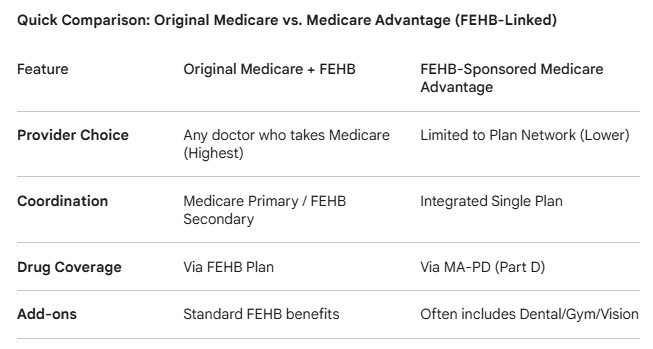
Many retirees fear they are "over-insured," but the synergy between FEHB and Original Medicare (Parts A and B) is powerful.

  • How it Works: Generally, Medicare becomes the primary payer, covering roughly $80\%$ of your outpatient costs. Your FEHB plan becomes the secondary payer.

  • The Benefit: In many cases, the coordination is so seamless that your out-of-pocket cost for a doctor’s visit or hospital stay drops to $0. This only works, however, if your providers accept "Medicare Assignment"—meaning they agree to the Medicare-approved price for services.

3. The "Small Print" in Medicare Advantage (MA)

Lately, OPM has encouraged carriers to offer Medicare Advantage "Part D" Employer Group Waiver Plans (MA-PD). These plans often offer "bells and whistles" like gym memberships, dental, and vision.

  • The Catch: These benefits often come with a restricted "provider network." If your favorite specialist isn't in that specific MA network, your costs could skyrocket.

  • The Decision: You can "suspend" FEHB to join a private MA plan, but most experts suggest staying within the FEHB-sponsored MA plans. Why? Because the government still pays roughly $72\%$ to $75\%$ of your premium, a subsidy you lose if you go to a purely private plan.

4. Part D and the 2026 Price Cap

As of 2026, the Inflation Reduction Act has significantly altered the landscape of prescription drug coverage (Part D).

  • Pertinent Info: The annual out-of-pocket cap for prescription drugs is now firmly set at $2,000.

  • The Error: Some retirees rush to sign up for a separate Part D plan, not realizing their FEHB drug coverage is already considered "creditable." If your current FEHB drug plan meets your needs, you might not need a separate Part D premium—unless you move to an MA-PD plan that includes it at no extra cost.


5. Timing: The Initial Enrollment Period (IEP)

You have a specific 7-month window to sign up for Medicare: the three months before you turn 65, your birth month, and the three months after.

  • The Penalty: If you miss this window and aren't still working, you may have to wait for the General Enrollment Period (January 1 – March 31).

  • The Sting: For every 12-month period you were eligible but didn't sign up for Part B, your premium increases by 10%—for the rest of your life.

6. Working Past 65: The Special Enrollment Period (SEP)

If you are still a "fed" at age 65, you don't have to sign up for Part B immediately. Your FEHB is considered primary coverage while you are an active employee.

  • The Window: Once you retire, you have an 8-month SEP to enroll in Part B without penalty.

  • Common Mistake: Retirees often confuse the "COBRA" rules with the "SEP" rules. For federal employees, the clock starts the moment you stop active service.

7. The IRMAA Surprise (Income-Related Adjustments)

The IRS and Medicare take a "look-back" at your tax returns from two years ago. If your income was high (e.g., from a large TSP withdrawal or a house sale), you may be hit with an Income-Related Monthly Adjustment Amount (IRMAA).

  • The Cost: This is a surcharge added to your Part B and Part D premiums. If you have a "life-changing event" (like retirement) that reduced your income, you can appeal this using Form SSA-44.

8. Ignoring "Medicare Assignment"

In Original Medicare, the price for a service is fixed.

  • Participating Providers: Agree to take exactly what Medicare pays.

  • Non-Participating Providers: Can charge up to an extra $15\%$ over the Medicare-approved amount (known as "excess charges").

  • The Error: Not checking if your doctor "accepts assignment" can result in you being billed for that extra $15\%$ out of your own pocket.

Financial Impact of Coinsurance

Under Original Medicare, your responsibility for Part B services is typically $20\%$.

$$\text{Patient Responsibility} = \text{Total Cost} \times 0.20$$

However, if your FEHB plan is active, it typically covers that $20\%$ for you, bringing your actual cost to $0.

Ultimately, securing your health benefits is only half the battle. Your Medicare strategy and your Thrift Savings Plan are deeply interconnected—one wrong withdrawal to pay a medical bill or a premium can accidentally trigger a higher tax bracket or an unwelcome IRMAA surcharge. Don't leave your hard-earned savings to chance or confusing fine print. At the end of the day, your retirement should be defined by the freedom you've earned, not the paperwork you've filed.


Ready to Optimize Your Federal Retirement?

If you want to ensure your TSP is working as hard as you did, let’s build a strategy that protects both your health and your wealth.

Contact us today for specialized TSP financial advice and let’s make sure your retirement strategy is as solid as your years of service.

Pros and cons of a TSP “In-Plan Conversion” versus rolling out to a Roth IRA?

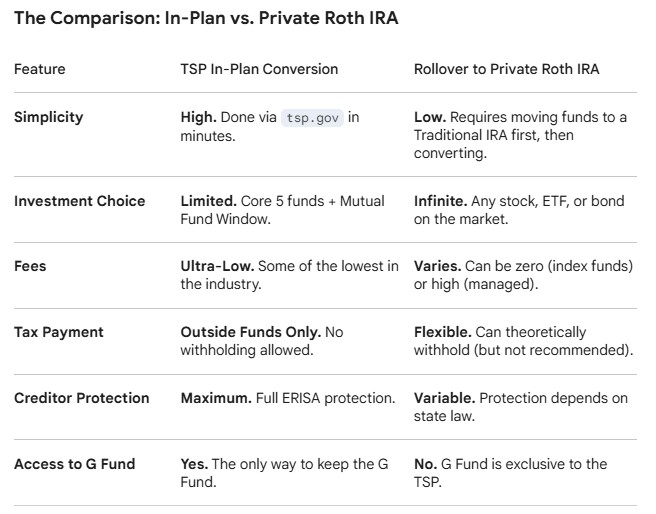
Recently, the retirement landscape for federal employees has changed dramatically. The introduction of In-Plan Roth Conversions within the TSP means you no longer have to move your money to an outside bank just to get it into a Roth account.

However, "easier" isn't always "better." Here is the breakdown of how the new in-plan option stacks up against the traditional "roll-out" strategy.

TSP vs IRA

The "In-Plan" Advantage (The New 2026 Way)

If you love the simplicity and safety of the TSP, this is your best bet.

  • Frequency: You can perform up to 26 conversions per year (once per pay period). This is perfect for "dollar-cost averaging" your tax bill—converting a small amount every two weeks to avoid jumping into a higher tax bracket.

  • The "Leave Behind" Rule: You must keep at least $500 in your traditional balance to keep that specific "source" account open.

  • No RMDs: Starting in 2024/2025, Roth TSP balances (including converted ones) are not subject to RMDs during your lifetime, matching the biggest benefit of Roth IRAs.

The "Roll-Out" Advantage (The Traditional Way)

If you want total control over your money, moving it to a private IRA (Fidelity, Vanguard, etc.) still has perks.

  • Asset Specificity: In the TSP, if you convert $10,000, it pulls pro-rata from all your funds (C, S, I, etc.). In a private IRA, you can choose to convert only your worst-performing asset or only your high-growth stock.

  • No $500 Minimums: You can drain a traditional IRA to zero without "closing" the account or dealing with minimum balance rules.

  • Better Heir Options: While the TSP is great for you, private IRAs often have more flexible "stretch" options or beneficiary tools for your children.


 Critical 2026 Update: The "Pro-Rata" Trap

One thing the new TSP conversion tool does not let you do is "cherry-pick" your tax-exempt money.

Example: if you have $10,000 in "Tax-Exempt" combat zone pay and $90,000 in "Traditional" pay, any conversion you do will be 90% taxable. You cannot choose to convert only the tax-exempt portion first.


Which one should you choose?

  • Stay in the TSP if: You want the G Fund, you value ERISA-level asset protection, and you want to automate your conversions every pay period.

  • Roll out to an IRA if: You want to invest in individual stocks, you have a complex estate plan, or you want to pick specific assets to convert.

Questions to ask your IRA custodian when transferring a TSP

Since it is 2026, the TSP has significantly updated its technology and services. Most notably, they now offer a Rollover Concierge Service and In-Plan Roth Conversions.

Here are two scripts tailored for the most common scenarios. Use the one that fits your current goal.


Scenario A: Moving Money OUT of the TSP (Into an IRA)

Use this if you are retired or separated and want to move your TSP funds to a private provider like Fidelity, Schwab, or Vanguard.

The Goal: Ensure the custodian accepts the check correctly so it isn't coded as a taxable withdrawal.

You: "Hi, I am a federal employee/retiree and I’m looking to perform a direct, trustee-to-trustee rollover from my Thrift Savings Plan (TSP) into my IRA here.

  1. Can you provide the exact 'Payable To' instructions for the check? (It should usually be [Custodian Name] FBO [Your Name]).

  2. What is the specific mailing address where the TSP should send the rollover check?

  3. Does your firm allow for electronic rollover deposits, or must the TSP mail a physical check?

  4. I have both Traditional and Roth balances in my TSP. Can you confirm that you have both a Traditional and Roth IRA open for me so we don't accidentally mix pre-tax and after-tax funds?"


Scenario B: Moving Money INTO the TSP (Consolidation)

Use this if you have an old 401(k) or a Traditional IRA and want to move it into the TSP for lower fees or simpler management.

The Goal: To get your custodian to release the funds without withholding the 20% tax.

You: "I’d like to initiate a direct rollover of my [IRA or 401k] assets into my Thrift Savings Plan account.

  1. I am working with the TSP Rollover Concierge. Do you have a specific department or phone number my TSP specialist should call to coordinate the paperwork?

  2. What forms do you require from your side to authorize a Trustee-to-Trustee transfer?

  3. Can you confirm that no federal taxes will be withheld from this distribution, since it is going directly to a qualified plan?

  4. (If moving an IRA): Can you verify how much of this balance is 'cost basis' (after-tax) versus pre-tax? The TSP only accepts pre-tax Traditional IRA funds."


3 Vital "Verification Questions" (To avoid the 10 Errors)

Before you hang up, ask these three questions to double-check the work of the representative:

  1. "To be 100% clear, this is being processed as a 'Direct Rollover' and NOT a 60-day 'Indirect Rollover,' correct?" (Avoids the 60-day deadline trap).

  2. "Will you be sending me a check, or will you be sending it directly to the other institution?" (If they send it to you, it must be made out to the institution, not you personally).

  3. "I am [Age]. Have my Required Minimum Distributions (RMDs) for this year already been satisfied?" (Avoids the error of rolling over an RMD).


2026 Update: The "In-Plan" Shortcut

If your goal was to move money from a Traditional TSP to a Roth IRA just to "convert" it, check your TSP "My Account" portal first. As of January 2026, the TSP now allows Roth In-Plan Conversions. You can now flip Traditional TSP funds to Roth TSP funds without ever moving the money out of the plan.

How to ensure a TSP direct transfer is handled correctly

Since you're ready to get organized, here is a "No-Mistakes" Checklist. Use this when you’re on the phone with a TSP representative or your IRA custodian to ensure the money moves safely from point A to point B without the IRS taking a cut.


The "Direct Rollover" Master Checklist

Phase 1: Preparation (Before You Call)

  • [ ] Locate Account Numbers: Have both your TSP account number and your destination IRA account number ready.

  • [ ] Verify Account Type: Confirm the "flavor" of the money. (e.g., Traditional TSP must go to a Traditional IRA; Roth TSP must go to a Roth IRA).

  • [ ] Check the "RMD" Status: If you are age 73+, calculate your Required Minimum Distribution first. You must take that distribution before you can roll over the remaining balance.

Phase 2: Communicating with the Institutions

  • [ ] Use the "Magic Words": Explicitly state, "I want to perform a Direct, Trustee-to-Trustee Rollover." (This prevents them from accidentally cutting a check in your name).

  • [ ] The "Payable To" Instruction: If they must mail a physical check, ensure it is made out to the institution, not you.

    • Example: "XYZ Brokerage, FBO [Your Name], Account #12345." (FBO stands for "For Benefit Of").

  • [ ] Confirm Tax Withholding: For a direct rollover, the federal tax withholding should be 0%. If they mention a 20% withholding, stop the process—they are likely processing an indirect rollover by mistake.

Phase 3: The TSP Specifics

  • [ ] Online Portal vs. Paper: Most TSP rollovers are now initiated through the TSP "My Account" portal. Check there first to see if you can generate the transfer electronically.

  • [ ] For Moving Money INTO the TSP: You will likely need Form TSP-60 (for Traditional) or Form TSP-60-R (for Roth). Your IRA custodian will need to sign a portion of this.

  • [ ] For Moving Money OUT of the TSP: Ensure your IRA custodian provides you with their "Transfer/Rollover In" instructions, including the specific mailing address for rollover checks.

Phase 4: Follow-Up

  • [ ] The 10-Day Check: If the money hasn't landed in 10 business days, start making calls.

  • [ ] Tax Form Verification: In January of next year, look for Form 1099-R from the sending institution.

    • Check Box 7: It should show Code G (Direct rollover to a qualified plan). If it doesn't, you'll need to contact them for a correction.


Pro-Tip: If you’re moving a large sum, ask the receiving institution if they have a "Rollover Specialist" who can jump on a three-way call with the TSP. It’s their job to make sure the money arrives safely!

6Lc_psgUAAAAAA9c7MediJBuq3wAxIyxDSt73c9j