10 Costly TSP and IRA Rollover Traps

Don’t Hand the IRS Your Retirement: 10 Costly TSP and IRA Rollover Traps

Managing your retirement funds as a federal employee can feel like navigating a minefield where the prizes are your own savings and the mines are IRS penalties. Whether you are moving funds between the Thrift Savings Plan (TSP) and an IRA, or just consolidating accounts, one wrong move can trigger a tax bill that bites into your future.

Here is a restructured and expanded guide to avoiding the most expensive pitfalls in the rollover process, updated with the latest legislative changes.


1. Understanding the "How": Direct vs. Indirect Rollovers

Before diving into errors, you must know the two ways money moves.

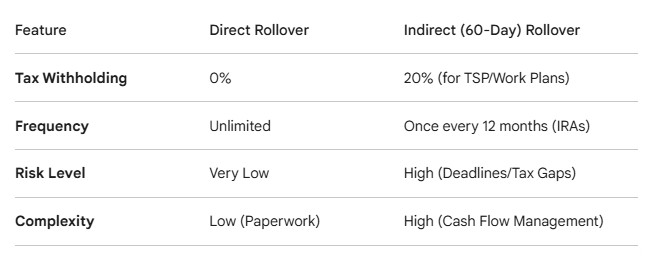
  • Direct Rollover (The Safe Path): The administrator of your current plan sends the money directly to your new plan or IRA. No taxes are withheld, and the IRS never considers the money "in your pocket."

  • Indirect Rollover (The 60-Day Scramble): You receive a check made out to you. You have exactly 60 days to deposit those funds into a new qualified account.

    • The Trap: For TSP distributions, the government automatically withholds 20% for federal taxes. To complete a full rollover, you must find outside cash to cover that 20% gap when you deposit the funds, or that 20% will be treated as a taxable distribution (and potentially hit with a 10% early withdrawal penalty).


2. Timing and Frequency Mistakes

The "One-Per-Year" Rule

You are only allowed one indirect (60-day) IRA-to-IRA rollover every 12 months. This is a rolling 365-day window, not a calendar year.

Note: This limit does not apply to direct "trustee-to-trustee" transfers or rollovers from the TSP to an IRA. It only polices the "check-in-hand" moves between IRAs.

Missing the 60-Day Deadline

If you take an indirect rollover and miss the 60-day window, the entire amount becomes taxable income for the year you received the money. If you’re under 59.5, add a 10% penalty on top. The IRS rarely grants waivers for "I forgot."

The "Same Property" Requirement

If you withdraw 100 shares of a specific stock from an IRA, you cannot deposit the cash equivalent into the new IRA. You must deposit the exact same property (the shares) that you took out. If you took cash, you must deposit cash.


3. The "Un-Rollables": Assets You Can't Move

Required Minimum Distributions (RMDs)

As of the SECURE Act 2.0, the RMD age has shifted to 73 (and will eventually hit 75). Once you reach the age where you must take RMDs, that money cannot be rolled over.

  • The Error: Many retirees try to "convert" their RMD by rolling it into a Roth IRA. The IRS views this as an "excess contribution," which carries a 6% penalty every year it remains in the account.

TSP Hardship Withdrawals

If you take a financial hardship withdrawal from your TSP, that money is yours to keep (and pay taxes on). It is legally ineligible for rollover.

After-Tax Assets in the TSP

While the TSP accepts "pre-tax" IRA money, it generally does not accept after-tax (nondeductible) contributions from a traditional IRA. If you have a "basis" in your IRA (tracked via IRS Form 8606), leave that portion out of your TSP rollover.


4. Structural and Legal Blunders

Direct Traditional TSP to Roth IRA

If you move money directly from a Traditional TSP to a Roth IRA, this is treated as a Roth Conversion. It is fully taxable in the year you do it. To avoid a massive, unintended tax bill, most experts suggest rolling the Traditional TSP to a Traditional IRA first, then converting to Roth in smaller, controlled "tranches" to manage your tax bracket.

The Divorce Distribution

In a divorce, if you simply withdraw IRA funds to pay an ex-spouse, you are the one stuck with the tax bill and the 10% penalty (if applicable).

  • The Fix: Use a "trustee-to-trustee" transfer as part of a Qualified Domestic Relations Order (QDRO) for the TSP, or a "transfer incident to divorce" for IRAs. This moves the tax liability to the person receiving the money.

Defaulted TSP Loans

If you leave federal service with an outstanding TSP loan, you must pay it back or "roll it over" (by depositing the equivalent amount into an IRA) within about 90 days. If you don't, the TSP declares a "deemed distribution," and you'll owe taxes on the unpaid balance.


5. Pertinent Updates & Modern Considerations

SECURE 2.0 and Roth TSP RMDs

New for 2024: Previously, Roth TSPs required RMDs even though Roth IRAs did not. Under the SECURE Act 2.0, Roth TSP accounts no longer require RMDs during the owner's lifetime. This removes a major reason people used to roll their Roth TSP into a Roth IRA.

Lost Accounts and Consolidation

Federal employees often have "zombie" 401(k)s from previous private-sector jobs.

  • Pro Tip: You can roll those old 401(k)s, 403(b)s, and even SEP IRAs into your TSP. This simplifies your "Required Minimum Distribution" math later in life and keeps your administrative fees low, as the TSP remains one of the lowest-cost plans available.

Qualified Longevity Annuity Contracts (QLACs)

You can now move up to $200,000 from your TSP or IRA into a QLAC. This is a "deferred annuity" that allows you to delay taking RMDs on that specific chunk of money until as late as age 85, providing a hedge against outliving your money.
TSP Advice

TSP Optimization

This checklist is designed to help you and your advisor audit your account for the 2026 plan year. With the launch of in-plan Roth conversions and the Super Catch-Up, your "set it and forget it" strategy from last year may no longer be optimal.

✅ 2026 TSP Optimization Checklist

  • [ ] Verify Your 2025 Wages (Box 3 of W-2): If your 2025 wages exceeded $150,000, the IRS now requires all of your 2026 catch-up contributions to be Roth. Ensure your payroll settings are updated to avoid rejected contributions.

  • [ ] Adjust for the "Super Catch-Up" (Ages 60–63): If you turn 60, 61, 62, or 63 in 2026, you are eligible for the $11,250 catch-up limit. Check your automated contributions to ensure you aren't leaving this extra $3,250 in tax-advantaged space on the table.

  • [ ] Set Your "Max-Out" Number: To hit the new $24,500 limit perfectly across 26 pay periods, set your contribution to $943. If you are 50+ (but not in the 60–63 bracket), aim for $1,250 per paycheck to hit the $32,500 total limit.

  • [ ] Perform a "Roth Conversion Analysis": Log in to your TSP "My Account" and use the new Roth In-Plan Conversion tool. Determine if converting a portion of your Traditional balance (including your agency match) into Roth makes sense for your current tax bracket.

    Note: You must have at least $500 in your account and leave a $500 "balance behind" in each source to use this feature.

  • [ ] Plan for Tax Liquidity: If you plan to use the new Roth conversion feature, ensure you have cash set aside in a taxable account (like a high-yield savings account) to pay the resulting tax bill. Do not use TSP funds to pay the conversion tax, as this will trigger penalties.

  • [ ] Review Your "Spillover" Settings: Double-check that your catch-up contributions are set to "spill over" automatically once you hit the $24,500 mark. This ensures you get your full agency match without interruption.

  • [ ] Update Your Beneficiaries: With the elimination of Roth RMDs, your TSP is now a more powerful legacy tool. Review your designated beneficiaries to ensure your tax-free wealth passes to your heirs as intended.

TSP Audit Checklist

1. Contribution & Matching Audit

  • [ ] Verify the 5% Floor: Ensure you are contributing at least 5% of your basic pay to capture the full 4% agency match and 1% automatic contribution. Don't leave free money on the table.

  • [ ] Recalculate Your Paycheck Math: If you want to hit the new 2026 limit of $24,500 exactly over 26 pay periods, update your payroll deduction to $943 per paycheck.

  • [ ] Check Catch-Up Eligibility: If you are age 50 or older (or will turn 50 this year), are you utilizing the standard $8,000 catch-up? If you are between 60 and 63, are you utilizing the $11,250 "Super Catch-Up"?

2. Tax & Roth Strategy Audit

  • [ ] The High-Earner Rule: If your 2025 wages were over $150,000, confirm that your 2026 catch-up contributions are being routed to the Roth TSP (as now required by the IRS).

  • [ ] Evaluate In-Plan Conversions: Look at your current Traditional TSP balance and determine if initiating an In-Plan Roth Conversion makes sense for your tax bracket this year.

  • [ ] Check Your Tax Bucket Mix: Are you actively splitting your contributions between Traditional (pre-tax) and Roth (after-tax) to give yourself "tax flexibility" in retirement?

3. Investment & Diversification Audit

  • [ ] Review Your Asset Allocation: Are you too conservative for your age? Use the rule of thumb ($120 - \text{Your Age}$) to see if your exposure to the C, S, and I stock funds matches your timeline.

  • [ ] The Lifecycle (L) Fund Check: If you are in an L Fund, does it still match your personal tolerance for risk? Or has it shifted too conservatively, too quickly for your liking?

  • [ ] Rebalance Your Portfolio: If market shifts over the last year have left you too heavy in one sector, reset your target allocations to smooth out your ride.

4. Legacy & Paperwork Audit

  • [ ] Verify Your Beneficiaries: Life changes (marriage, divorce, births). Log into your TSP account and ensure your Form TSP-3 (Designation of Beneficiary) is completely up-to-date. (Remember, your Will does not override your TSP beneficiary designations!).

  • [ ] Consolidate Old Accounts: Do you have orphan 401(k)s or 403(b)s sitting with old employers? Consider rolling them into your current TSP to keep your investment tracking simple and your fees low.

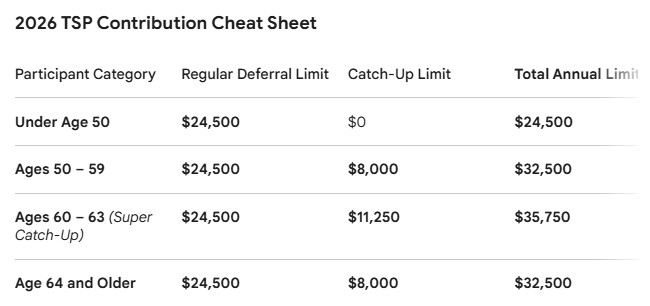
2026 TSP Contribution Cheat Sheet

Here is a 2026 TSP Contribution Cheat Sheet designed to be easily scannable for your readers. This is a high-value resource they can save or print to ensure they are maximizing their benefits under the latest SECURE 2.0 regulations.

2026 TSP Contribution

3 Critical Rules for 2026

  1. The $150k Roth Mandate: If your prior-year (2025) wages exceeded $150,000, the IRS now requires all catch-up contributions to be made to the Roth TSP. You can no longer make pre-tax catch-up contributions if you are in this high-earner bracket.

       2. No More Roth RMDs: Starting in 2024 and continuing through 2026, you are no longer required to take Required Minimum Distributions (RMDs) from your Roth TSP balance while you are alive. This allows your tax-free bucket to grow indefinitely.

        3. In-Plan Conversions: You now have the ability to move existing Traditional TSP balances into a Roth balance via an In-Plan Roth Conversion. This is a powerful "tax-locking" tool, but it must be handled carefully to avoid a massive tax bill in a single year.

Pro Tip: To hit the $24,500 limit exactly over 26 pay periods, set your contribution to $943 per paycheck. If you are 50+ and want to hit the full $32,500, aim for $1,250 per paycheck.


2026 TSP Frequently Asked Questions

2026 TSP Frequently Asked Questions: Navigating the New Rules

The Thrift Savings Plan is undergoing its most significant transformation in years. Here are the answers to the most common questions federal employees are asking in 2026.

What are the TSP contribution limits for 2026?
For the 2026 calendar year, the elective deferral limit has increased to $24,500. If you are age 50 or older, you can contribute an additional $8,000 in catch-up TSP contributions, bringing your total potential savings to $32,500.

How does the TSP "Super Catch-Up" work for ages 60–63?
Under SECURE 2.0, participants who turn 60, 61, 62, or 63 in 2026 are eligible for a higher catch-up limit of $11,250. When combined with the standard TSP limit, these "Super Catch-Up" eligible employees can contribute a total of $35,750 this year. Once you turn 64, your limit reverts to the standard catch-up amount.

I heard TSP catch-up contributions must be Roth now. Is that true?
Only for high earners. Starting in 2026, if your wages from the previous year (2025) exceeded $150,000, the law requires your catch-up contributions to be made to the Roth (after-tax) TSP. If you earn below this threshold, you can still choose between Traditional or Roth for your catch-up funds.

Can I finally move my Traditional TSP balance into a Roth account?
Yes! As of late January 2026, the TSP has officially launched In-Plan Roth Conversions. You can now move money from your Traditional (pre-tax) balance to your Roth (after-tax) balance without leaving the TSP.

  • The Catch: You must pay ordinary income tax on the converted amount in the year of the move, and you cannot use TSP funds to pay that tax bill—it must come from outside savings.


    Are Roth TSP balances subject to Required Minimum Distributions (RMDs)?
    No. One of the best changes for 2026 is that Roth TSP balances are no longer subject to RMDs during the owner’s lifetime. This allows your Roth money to stay in the plan and continue growing tax-free for as long as you live, mirroring the rules for private Roth IRAs.


What happens to my Agency TSP Match?
FERS and BRS participants still receive the 1% automatic and 4% matching contributions. A new feature for 2026 is the ability to convert your agency matching funds into Roth via the in-plan conversion tool, though these matches initially land in your Traditional balance first for tax-reporting purposes.

6Lc_psgUAAAAAA9c7MediJBuq3wAxIyxDSt73c9j