Market Commentary – July 8, 2019

What will the Federal Reserve do now?

There was unexpected economic news last week. On Friday, the Bureau of Labor Statistics announced 224,000 new jobs were added in June, which was more than analysts had anticipated. The gains were offset a bit by reductions in April and May employment estimates. However, overall, the pace of jobs growth during second quarter was fairly consistent with jobs growth during the first quarter, reported Matthew Klein of Barron’s.

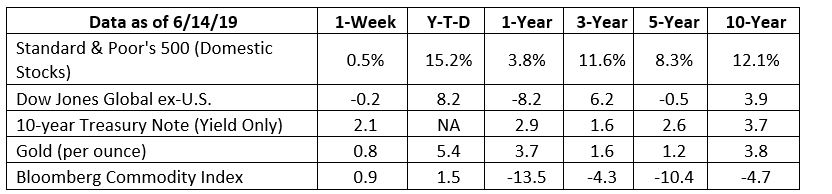
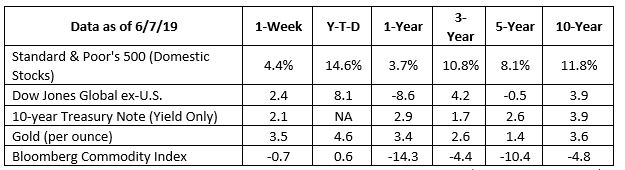
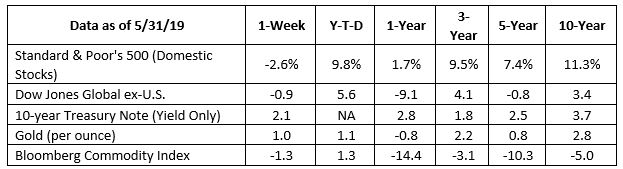
Strong employment numbers invigorated some investors. As a result, the Standard & Poor’s 500 Index, Dow Jones Industrial Average, and Nasdaq Composite finished the week near record highs.

Not everyone was jumping for joy, however.

The performance of the bond market continued to indicate some investors are worried about the possibility of recession. The yield curve remained inverted last week with the 10-year Treasury note trading at lower yields than 3-month Treasury bills. Yield curve inversions have been harbingers of recession in the past, reported Ben Levisohn of Barron’s.

Time may provide greater clarity about the strength of the American economy. April Joyner of Reuters reported,  “It will likely take several months of economic data – along with results from the corporate earnings season later this month – to clarify the picture, investors say. In contrast to Friday’s upbeat employment report, data earlier this week showed U.S. manufacturing and service activity in June declined to multi-year lows… Future data…may end up either confirming recession fears or altogether dashing the hopes for interest-rate cuts that have buoyed stocks.”

In its July meeting, the Federal Reserve will examine economic data and decide whether to lower rates. Investors have been anticipating a rate cut, reported Greg Robb of MarketWatch. If it doesn’t happen, stock markets could be a bit volatile.

Succumbing to the power of digital persuasion or not. A lot has been written about Americans and smartphones – the crowd favorite among mobile devices. Eighty-five percent of U.S. participants in the 2018 Deloitte Global Mobile Survey owned smartphones and checked their phones about 14 billion times a day.

Which amounts to approximately 52 times each. If you figure Americans are awake about 960 minutes each day, they check their phones every 18 minutes.

Almost three-in-ten Americans say that what they see on social media influences their decisions to buy or not buy. The percent rises to five-in-ten for millennials, according to the UPS Pulse of the Online Shopper Survey™.

It is little wonder social media influencers have become a staple of digital marketing.

What are influencers? The Influencer Marketing Hub describes an influencer like this:
“An influencer is an individual who has the power to affect purchase decisions of others because of his/her authority, knowledge, position or relationship with his/her audience.”

Influencing has become a bona fide career path, a job with has its own set of Federal Trade Commission guidelines. For example, truth in advertising requires influencers to indicate when they’ve being paid to promote a product and also when they’ve received the product for free. Consumers should see the letters #ad before a comment or tweet when the influencer is promoting a brand or product.

Not everyone is impressed with the influence of influencers. CBC reported the owner of a Los Angeles ice cream truck got fed up with requests for free ice cream in exchange for online exposure. His solution was to start charging influencers twice the going rate.

The lesson may be that influence should be used judiciously.

Weekly Focus – Think About It
“One thing I’ve learned through all the ups and downs is that if you’re doing things right, then you have a core group of people. Not just a core group like your homies or your buddies, but a group of people that has a good influence on you, who you respect and admire, and you know that if they’re on your side, you’re doing something right.”
–Hope Solo, former United States national soccer team goalkeeper

Best regards,

John F. Reutemann, Jr., CLU, CFP®


P.S.  Please feel free to forward this commentary to family, friends, or colleagues. If you would like us to add them to the list, please reply to this email with their email address and we will ask for their permission to be added.

Investment advice offered through Research Financial Strategies, a registered investment advisor.
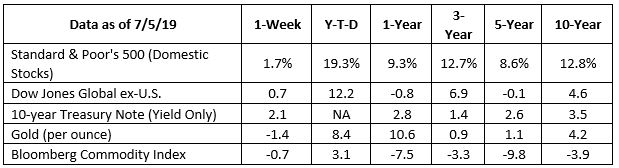
S&P 500, Dow Jones Global ex-US, Gold, Bloomberg Commodity Index returns exclude reinvested dividends (gold does not pay a dividend) and the three-, five-, and 10-year returns are annualized; the DJ Equity All REIT Total Return Index does include reinvested dividends and the three-, five-, and 10-year returns are annualized; and the 10-year Treasury Note is simply the yield at the close of the day on each of the historical time periods.
Sources: Yahoo! Finance, Barron’s, djindexes.com, London Bullion Market Association.
Past performance is no guarantee of future results. Indices are unmanaged and cannot be invested into directly. N/A means not applicable.

Most Popular Financial Stories

The Cracking Foundation of the American Consumer

The Shifting Ground of the American Consumer: Finding Opportunity in Change The economic landscape is undergoing a significant transformation, and understanding these shifts is key to positioning your portfolio for what comes next. While headline numbers often mask…

read more…

Explanation of current positions

Several clients have told us they are a little overwhelmed by many of the new ETFs, and what their business model and investment objectives are.   Below is a short summary of all the ETFs currently in the growth model as of today.  If you have any questions, please…

read more…

Rate Cut Ahead: Is Your Income Strategy Ready?

Rate Cut Ahead: Is Your Income Strategy Ready? With the Federal Reserve now signaling an 87% chance of cutting interest rates at its upcoming meeting, it is crucial to assess how this shift could impact your financial future—especially if you rely on your portfolio…

read more…

Happy Thanksgiving

Wishing You a Happy Thanksgiving As Thanksgiving approaches, we pause to reflect on and appreciate the abundant blessings in our lives, especially the family and friends who enrich our days. We look forward with great anticipation to the coming year and the entire…

read more…

Textbook example of the single stock risk!

CAVA: Post-CMG Price Action and Market Context CAVA shares experienced an 11% decline this morning, a notable reaction tied to the recent earnings announcement from industry peer Chipotle (CMG). This price movement reflects speculative investor sentiment, as the…

read more…

* Government bonds and Treasury Bills are guaranteed by the United States government as to the timely payment of principal and interest and, if held to maturity, offer a fixed rate of return and fixed principal value.  However, the value of fund shares is not guaranteed and will fluctuate.
* Corporate bonds are considered higher risk than government bonds but normally offer a higher yield and are subject to market, interest rate and credit risk as well as additional risks based on the quality of issuer coupon rate, price, yield, maturity, and redemption features.
* The Standard & Poor’s 500 (S&P 500) is an unmanaged group of securities considered to be representative of the stock market in general. You cannot invest directly in this index.
* All indexes referenced are unmanaged. Unmanaged index returns do not reflect fees, expenses, or sales charges. Index performance is not indicative of the performance of any investment.
* The Dow Jones Global ex-U.S. Index covers approximately 95% of the market capitalization of the 45 developed and emerging countries included in the Index.
* The 10-year Treasury Note represents debt owed by the United States Treasury to the public. Since the U.S. Government is seen as a risk-free borrower, investors use the 10-year Treasury Note as a benchmark for the long-term bond market.
* Gold represents the afternoon gold price as reported by the London Bullion Market Association. The gold price is set twice daily by the London Gold Fixing Company at 10:30 and 15:00 and is expressed in U.S. dollars per fine troy ounce.
* The Bloomberg Commodity Index is designed to be a highly liquid and diversified benchmark for the commodity futures market. The Index is composed of futures contracts on 19 physical commodities and was launched on July 14, 1998.
* The Dow Jones Industrial Average (DJIA), commonly known as “The Dow,” is an index representing 30 stock of companies maintained and reviewed by the editors of The Wall Street Journal.
* The NASDAQ Composite is an unmanaged index of securities traded on the NASDAQ system.
* International investing involves special risks such as currency fluctuation and political instability and may not be suitable for all investors. These risks are often heightened for investments in emerging markets.
* Yahoo! Finance is the source for any reference to the performance of an index between two specific periods.
* Opinions expressed are subject to change without notice and are not intended as investment advice or to predict future performance.
* Economic forecasts set forth may not develop as predicted and there can be no guarantee that strategies promoted will be successful.
* Past performance does not guarantee future results. Investing involves risk, including loss of principal.
* You cannot invest directly in an index.
* Stock investing involves risk including loss of principal.
* The foregoing information has been obtained from sources considered to be reliable, but we do not guarantee it is accurate or complete.
* There is no guarantee a diversified portfolio will enhance overall returns or outperform a non-diversified portfolio. Diversification does not protect against market risk.
* Asset allocation does not ensure a profit or protect against a loss.
* Consult your financial professional before making any investment decision.
* To unsubscribe from the Weekly Market Commentary please reply to this e-mail with “Unsubscribe” in the subject.

Sources:
https://www.barrons.com/articles/what-the-june-jobs-report-really-says-about-the-u-s-economy-51562334857?mod=hp_DAY_2 (or go to https://peakcontent.s3-us-west-2.amazonaws.com/+Peak+Commentary/07-08-19_What_the_Jobs_Report_Really_Says_About_The+Economy.pdf)
https://www.bls.gov/news.release/empsit.nr0.htm
https://www.barrons.com/articles/s-p-500-rallies-as-trade-truce-conquers-all-51562375561?mod=hp_LATEST (or go to s3://peakcontent/ Peak Commentary/07-08-19_The+S&P_500_Soared_Last_Weel_Because_A_Trade_Truce_Conguers_All.pdf)
https://www.reuters.com/article/us-usa-stocks-weekahead/buoyant-u-s-stocks-at-odds-with-downbeat-market-signals-idUSKCN1U01Q6
https://www.marketwatch.com/story/its-hallucinatory-to-expect-a-half-point-fed-rate-cut-now-but-economists-still-expect-a-quarter-point-reduction-2019-07-05
https://www2.deloitte.com/us/en/pages/technology-media-and-telecommunications/articles/global-mobile-consumer-survey-us-edition.html [Click on download executive summary] (or go to https://peakcontent.s3-us-west-2.amazonaws.com/+Peak+Commentary/07-08-19_2018_Global_Mobile_Consumer_Survey_US_Edition.pdf)
https://solutions.ups.com/rs/935-KKE-240/images/UPS-Pulse-of-the-Online-Shopper-2017-Volume-3_Channel_Dynamics.pdf [Page 21]
https://influencermarketinghub.com/what-is-an-influencer/
https:/www.ftc.gov/tips-advice/business-center/guidance/ftcs-endorsement-guides-what-people-are-asking
https://www.cbc.ca/radio/asithappens/as-it-happens-wednesday-edition-1.5198437/this-ice-cream-truck-owner-is-so-fed-up-with-influencers-he-s-charging-them-double-1.5198500
https://www.brainyquote.com/quotes/hope_solo_567369?src=t_influence
Market Commentary – July 1, 2019

In the infamous words of Mortimer Snerd, “Who’d a thunk it?”
After U.S. stocks dropped sharply during the last weeks of December 2018, investors were not optimistic about the future. Early in January 2019, the State Street Investor Confidence Index dropped to its lowest point since 2012, and the American Association of Individual Investors (AAII) Sentiment Survey showed just about 31.6 percent of investors as bullish. The long-term average for bullishness is 38.2 percent.

How things have changed!

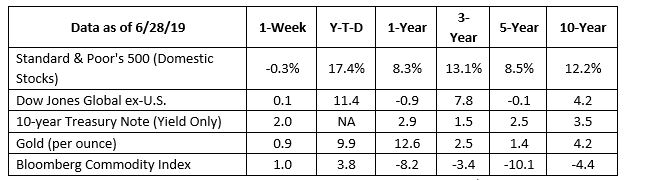
The Standard & Poor’s 500 Index finished the second quarter up about 17 percent year-to-date, according to Ben Levisohn of Barron’s. The index gained 6.9 percent in June, its best performance since 1955.

Stocks weren’t the only market delivering gains. Bond markets did well, too. Corrie Driebusch of The Wall Street Journal reported the yield on 10-year Treasuries finished the quarter at 2 percent. That was significantly below its yield at the end of March 2019. Remember, when bond yields fall, bond prices rise.

The strong performance of both markets owes much to changing policies at the Federal Reserve. Randall Forsyth of Barron’s reported,

“The first half of 2019 was terrific for financial markets, regardless of whether you were a stock or bond investor…a good first six months largely reflects the pivot by the Federal Reserve from its stance last year, when it indicated that it would raise short-term rates multiple times. In early January, Fed Chairman Jerome Powell said the central bank would be “patient” in boosting rates and then, in late spring, shifted to indicate that the next move is likely to be a cut.”

Stocks didn’t follow a steady upward trajectory during the second quarter, reported Forbes. Signs the U.S. economy could be softening combined with trade tensions between the United States and China caused major U.S. indices to lose ground in May before climbing higher again in June.

On Saturday, following the G20 Summit – a confab between leaders of 19 countries and the European Union, as well as representatives from the International Monetary Fund, and the World Bank – China and the United States agreed to restart trade talks, reported Reuters. President Trump indicated current tariffs on China will remain in place, but additional tariffs will not be assessed, according to CBS News.

While it appears to be positive news, managing director of the International Monetary Fund Christine Lagarde stated, “While the resumption of trade talks between the United States and China is welcome, tariffs already implemented are holding back the global economy, and unresolved issues carry a great deal of uncertainty about the future,”

Last week, the S&P 500 was down slightly, as were yields on 10-year Treasuries.

Hold onto your hats. We could see some volatility during the second half of the year.

Still confused about tariffs? The United States and China have resumed trade talks, but it could be a while before things settle – and all tariffs may not be removed even if talks are successful. Since, there is a lot of misinformation floating around about tariffs, we want to review the basics.

When the United States puts tariffs on Chinese goods, China does not pay the tariff. American companies that import goods from China pay the tariffs. These companies may absorb the cost or pass the cost on to consumers by raising prices.

In some cases, manufacturers of complementary goods have raised the prices on items which aren’t subject to tariffs. (Complementary goods are products typically sold together like flashlights and batteries, printers and ink cartridges, or washers and dryers.)

Greg Rosalsky of Planet Money reported on tariff research from the Becker Friedman Institute for Economics at The University of Chicago reported the phenomenon. Rosalsky wrote,  “In early 2018…the Trump administration implemented tariffs on washing machines imported from all over the world. It’s a 20 percent tariff on the first 1.2 million washing machines sold a year and a 50 percent tariff on every one after that…New washing machines in America got about 12 percent more expensive…dryers also got more expensive even though they weren’t subject to the tariff. That’s because washers and dryers…are typically bought at the same time…so the full effect of tariffs on prices is only visible after factoring in the price of the complementary good – dryers.”

When it happens in reverse and China puts tariffs on the United States, the United States does not pay the tariff. Chinese companies importing the goods from the United States pay the tariff, and which may cause Chinese companies to buy goods from countries that are not assessed tariffs. Reuters reported,  “American farmers have been among the hardest hit so far. China is the top market for many of their biggest crops and Beijing hit those crops with retaliatory tariffs…The single biggest agricultural export from the United States are soybean sales, most of which went to China before the trade war.”

So, when you boil it down, American companies and consumers are paying U.S. tariffs on Chinese goods. Chinese companies and consumers are paying Chinese tariffs on U.S. goods. Companies in both nations may be looking for alternative suppliers so they can keep prices low.

Weekly Focus – Think About It
“To argue against the global economy is like stating opposition to the weather – it continues whether you like it or not.”
–John McCain, American politician

Best regards,

John F. Reutemann, Jr., CLU, CFP®

P.S.  Please feel free to forward this commentary to family, friends, or colleagues. If you would like us to add them to the list, please reply to this email with their email address and we will ask for their permission to be added.

Investment advice offered through Research Financial Strategies, a registered investment advisor.

S&P 500, Dow Jones Global ex-US, Gold, Bloomberg Commodity Index returns exclude reinvested dividends (gold does not pay a dividend) and the three-, five-, and 10-year returns are annualized; the DJ Equity All REIT Total Return Index does include reinvested dividends and the three-, five-, and 10-year returns are annualized; and the 10-year Treasury Note is simply the yield at the close of the day on each of the historical time periods.
Sources: Yahoo! Finance, Barron’s, djindexes.com, London Bullion Market Association.
Past performance is no guarantee of future results. Indices are unmanaged and cannot be invested into directly. N/A means not applicable.

Most Popular Financial Stories

The Cracking Foundation of the American Consumer

The Shifting Ground of the American Consumer: Finding Opportunity in Change The economic landscape is undergoing a significant transformation, and understanding these shifts is key to positioning your portfolio for what comes next. While headline numbers often mask…

read more…

Explanation of current positions

Several clients have told us they are a little overwhelmed by many of the new ETFs, and what their business model and investment objectives are.   Below is a short summary of all the ETFs currently in the growth model as of today.  If you have any questions, please…

read more…

Rate Cut Ahead: Is Your Income Strategy Ready?

Rate Cut Ahead: Is Your Income Strategy Ready? With the Federal Reserve now signaling an 87% chance of cutting interest rates at its upcoming meeting, it is crucial to assess how this shift could impact your financial future—especially if you rely on your portfolio…

read more…

Happy Thanksgiving

Wishing You a Happy Thanksgiving As Thanksgiving approaches, we pause to reflect on and appreciate the abundant blessings in our lives, especially the family and friends who enrich our days. We look forward with great anticipation to the coming year and the entire…

read more…

* Government bonds and Treasury Bills are guaranteed by the U.S. government as to the timely payment of principal and interest and, if held to maturity, offer a fixed rate of return and fixed principal value.  However, the value of fund shares is not guaranteed and will fluctuate.
* Corporate bonds are considered higher risk than government bonds but normally offer a higher yield and are subject to market, interest rate and credit risk as well as additional risks based on the quality of issuer coupon rate, price, yield, maturity, and redemption features.
* The Standard & Poor’s 500 (S&P 500) is an unmanaged group of securities considered to be representative of the stock market in general. You cannot invest directly in this index.
* All indexes referenced are unmanaged. Unmanaged index returns do not reflect fees, expenses, or sales charges. Index performance is not indicative of the performance of any investment.
* The Dow Jones Global ex-U.S. Index covers approximately 95percent of the market capitalization of the 45 developed and emerging countries included in the Index.
* The 10-year Treasury Note represents debt owed by the United States Treasury to the public. Since the U.S. Government is seen as a risk-free borrower, investors use the 10-year Treasury Note as a benchmark for the long-term bond market.
* Gold represents the afternoon gold price as reported by the London Bullion Market Association. The gold price is set twice daily by the London Gold Fixing Company at 10:30 and 15:00 and is expressed in U.S. dollars per fine troy ounce.
* The Bloomberg Commodity Index is designed to be a highly liquid and diversified benchmark for the commodity futures market. The Index is composed of futures contracts on 19 physical commodities and was launched on July 14, 1998.
* The Dow Jones Industrial Average (DJIA), commonly known as “The Dow,” is an index representing 30 stock of companies maintained and reviewed by the editors of The Wall Street Journal.
* The NASDAQ Composite is an unmanaged index of securities traded on the NASDAQ system.
* International investing involves special risks such as currency fluctuation and political instability and may not be suitable for all investors. These risks are often heightened for investments in emerging markets.
* Yahoo! Finance is the source for any reference to the performance of an index between two specific periods.
* Opinions expressed are subject to change without notice and are not intended as investment advice or to predict future performance.
* Economic forecasts set forth may not develop as predicted and there can be no guarantee that strategies promoted will be successful.
* Past performance does not guarantee future results. Investing involves risk, including loss of principal.
* You cannot invest directly in an index.
* Stock investing involves risk including loss of principal.
* The foregoing information has been obtained from sources considered to be reliable, but we do not guarantee it is accurate or complete.
* There is no guarantee a diversified portfolio will enhance overall returns or outperform a non-diversified portfolio. Diversification does not protect against market risk.
* Asset allocation does not ensure a profit or protect against a loss.
* Consult your financial professional before making any investment decision.
* To unsubscribe from the Weekly Market Commentary please reply to this e-mail with “Unsubscribe” in the subject.

Sources:
http://snarkygrammarguide.blogspot.com/2012/09/thought-vs-thunk-irregular-or-ignorant.html
http://www.statestreet.com/content/dam/statestreet/documents/ici/ICI_HistData_Eng_Jun19.pdf
https://www.aaii.com/sentimentsurvey [or go to https://peakcontent.s3-us-west-2.amazonaws.com/+Peak+Commentary/7-01-19_AAII_Sentiment_Survey_data.pdf provide e-mail address to read more. Click on download historic data at bottom of the page.]
https://www.barrons.com/articles/the-s-p-500-just-had-its-best-june-since-1955-51561767202?mod=hp_DAY_4 (or go to https://peakcontent.s3-us-west-2.amazonaws.com/+Peak+Commentary/7-01-19_The_S%26P_500_Just_Had_its_Best_June_Since_1955.pdf)
https://www.wsj.com/articles/asian-stocks-slip-as-g-20-begins-11561708211 (or go to https://peakcontent.s3-us-west-2.amazonaws.com/+Peak+Commentary/7-01-19_S%26P_500_Posts_Best_First_Half_in_22_Years.pdf)
https://www.investopedia.com/terms/b/bond-yield.asp
https://www.barrons.com/articles/whats-ahead-for-stocks-after-a-great-first-half-51561766305?mod=hp_DAY_1 (or go to https://peakcontent.s3-us-west-2.amazonaws.com/+Peak+Commentary/7-01-19_What’s_Ahead_for_Stocks_After_A_Great_First+Half.pdf)
https://www.forbes.com/sites/jjkinahan/2019/06/28/stocks-hit-positive-streak-in-june/#2170d0b864ce/
https://g20.org/en/summit/about/
https://www.reuters.com/article/us-g20-summit-communique-final/g20-stops-short-of-denouncing-protectionism-warns-of-global-slowdown-idUSKCN1TU07T
https://www.cbsnews.com/news/us-china-trade-talks-restarted-trump-suspends-new-tariffs-today-2019-06-29/
https://www.npr.org/sections/money/2019/05/21/725135293/more-tariffs-on-china-more-head-scratching-from-economists
https://bfi.uchicago.edu/working-paper/the-production-relocation-and-price-effects-of-us-trade-policy-the-case-of-washing-machines/
https://www.reuters.com/article/us-usa-trade-china-costs-factbox/factbox-from-phone-makers-to-farmers-the-toll-of-trumps-trade-wars-idUSKCN1TS3DX
https://www.reuters.com/article/us-usa-trade-chiaana-levers-explainer/explainer-u-s-china-trade-war-the-levers-they-can-pull-idUSKCN1T62KY
https://www.brainyquote.com/topics/global_economy

Market Commentary – June 24, 2019

Everything went up – and that’s unusual.
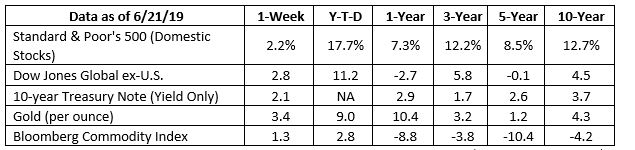
Randall Forsyth of Barron’s explained, “Like our major political parties, the stock and bond markets seem to live in two different worlds these days. The former sits at record levels, suggesting we live in the best of all possible worlds. The latter sees things as bad and only getting worse.”

Here’s what happened last week:
The Federal Open Market Committee met last week (they decide whether the central bank of the United States should push rates higher or move them lower). It left rates unchanged, but indicated a willingness to lower rates in support of economic expansion. That was music to the ears of some investors and the Standard & Poor’s 500 Index rose to a record high, reported Sue Chang and Mark DeCambre of MarketWatch.

The Fed’s song was the same as the one already playing across the world. Central bankers in Europe and Japan had signaled they were willing to encourage economic growth by easing rates lower and using other tools available, reported Leika Kihara and Daniel Leussink of Reuters. Their attitude helped push world stock markets higher.

Last week, the U.S. bond market gained value, too, as interest rates moved lower. Falling interest rates suggested bond investors were hearing a different tune. When investors are willing to accept lower yields, it suggests they’re worried about what may happen and are seeking safety. In some parts of Europe, investors are accepting negative yields – taking small losses to own government bonds they perceive to be safe – because they are pessimistic about the future.

There is plenty to be concerned about, including ongoing trade issues and conflict in the Middle East. Only time will tell how recent events will affect the U.S. and world economies.

A land without time. You may have heard: Sommaroey Island in Norway may do away with time. Residents of the island don’t experience time as people elsewhere do. From May to July, the sun doesn’t set on Sommaroey. From November to January, it doesn’t rise.

Proponents of a time-free island zone say it would reduce stress. “…the change would not mean that shops are open 24/7, but that residents could make better use of the daylight,” reported ABC News.

Living without time is an astonishing idea.

In modern life, time is a critical organizational tool. We divide our experience into centuries, years, daytime and nighttime, hours and minutes. Our actions are informed by schedules. We need to arrive at class, at work, at the bus stop, at a restaurant, or at a ballgame at a specific time.

However, time is not nearly as straightforward as it seems.

In a review of Why Time Flies: A Mostly Scientific Investigation, The Economist opined, “Time is such a slippery thing. It ticks away, neutrally, yet it also flies and collapses, and is more often lost than found. Days can feel eternal but a month can gallop past. So, is time ever perceived objectively? Is this experience innate or is it learned? And how long is ‘now,’ anyway? Such questions have puzzled philosophers and scientists for over 2,000 years.”

Residents of Sommaroey have been pondering life without time and whether it is actually possible. The leader of the move to abolish time told ABC News, living without time, ‘is a great solution but we likely won’t become an entirely time-free zone as it will be too complex.’

Weekly Focus – Think About It
“How did it get so late so soon?”
–Dr. Seuss, American author

Best regards,
John F. Reutemann, Jr., CLU, CFP®

P.S.  Please feel free to forward this commentary to family, friends, or colleagues. If you would like us to add them to the list, please reply to this email with their email address and we will ask for their permission to be added.

Investment advice offered through Research Financial Strategies, a registered investment advisor.

S&P 500, Dow Jones Global ex-US, Gold, Bloomberg Commodity Index returns exclude reinvested dividends (gold does not pay a dividend) and the three-, five-, and 10-year returns are annualized; the DJ Equity All REIT Total Return Index does include reinvested dividends and the three-, five-, and 10-year returns are annualized; and the 10-year Treasury Note is simply the yield at the close of the day on each of the historical time periods.
Sources: Yahoo! Finance, Barron’s, djindexes.com, London Bullion Market Association.
Past performance is no guarantee of future results. Indices are unmanaged and cannot be invested into directly. N/A means not applicable.

Most Popular Financial Stories

The Cracking Foundation of the American Consumer

The Shifting Ground of the American Consumer: Finding Opportunity in Change The economic landscape is undergoing a significant transformation, and understanding these shifts is key to positioning your portfolio for what comes next. While headline numbers often mask…

read more…

Explanation of current positions

Several clients have told us they are a little overwhelmed by many of the new ETFs, and what their business model and investment objectives are.   Below is a short summary of all the ETFs currently in the growth model as of today.  If you have any questions, please…

read more…

Rate Cut Ahead: Is Your Income Strategy Ready?

Rate Cut Ahead: Is Your Income Strategy Ready? With the Federal Reserve now signaling an 87% chance of cutting interest rates at its upcoming meeting, it is crucial to assess how this shift could impact your financial future—especially if you rely on your portfolio…

read more…

Happy Thanksgiving

Wishing You a Happy Thanksgiving As Thanksgiving approaches, we pause to reflect on and appreciate the abundant blessings in our lives, especially the family and friends who enrich our days. We look forward with great anticipation to the coming year and the entire…

read more…

* Government bonds and Treasury Bills are guaranteed by the U.S. government as to the timely payment of principal and interest and, if held to maturity, offer a fixed rate of return and fixed principal value.  However, the value of fund shares is not guaranteed and will fluctuate.
* Corporate bonds are considered higher risk than government bonds but normally offer a higher yield and are subject to market, interest rate and credit risk as well as additional risks based on the quality of issuer coupon rate, price, yield, maturity, and redemption features.
* The Standard & Poor’s 500 (S&P 500) is an unmanaged group of securities considered to be representative of the stock market in general. You cannot invest directly in this index.
* All indexes referenced are unmanaged. Unmanaged index returns do not reflect fees, expenses, or sales charges. Index performance is not indicative of the performance of any investment.
* The Dow Jones Global ex-U.S. Index covers approximately 95% of the market capitalization of the 45 developed and emerging countries included in the Index.
* The 10-year Treasury Note represents debt owed by the United States Treasury to the public. Since the U.S. Government is seen as a risk-free borrower, investors use the 10-year Treasury Note as a benchmark for the long-term bond market.
* Gold represents the afternoon gold price as reported by the London Bullion Market Association. The gold price is set twice daily by the London Gold Fixing Company at 10:30 and 15:00 and is expressed in U.S. dollars per fine troy ounce.
* The Bloomberg Commodity Index is designed to be a highly liquid and diversified benchmark for the commodity futures market. The Index is composed of futures contracts on 19 physical commodities and was launched on July 14, 1998.
* The Dow Jones Industrial Average (DJIA), commonly known as “The Dow,” is an index representing 30 stock of companies maintained and reviewed by the editors of The Wall Street Journal.
* The NASDAQ Composite is an unmanaged index of securities traded on the NASDAQ system.
* International investing involves special risks such as currency fluctuation and political instability and may not be suitable for all investors. These risks are often heightened for investments in emerging markets.
* Yahoo! Finance is the source for any reference to the performance of an index between two specific periods.
* Opinions expressed are subject to change without notice and are not intended as investment advice or to predict future performance.
* Economic forecasts set forth may not develop as predicted and there can be no guarantee that strategies promoted will be successful.
* Past performance does not guarantee future results. Investing involves risk, including loss of principal.
* You cannot invest directly in an index.
* Stock investing involves risk including loss of principal.
* The foregoing information has been obtained from sources considered to be reliable, but we do not guarantee it is accurate or complete.
* There is no guarantee a diversified portfolio will enhance overall returns or outperform a non-diversified portfolio. Diversification does not protect against market risk.
* Asset allocation does not ensure a profit or protect against a loss.
* Consult your financial professional before making any investment decision.
* To unsubscribe from the Weekly Market Commentary please reply to this e-mail with “Unsubscribe” in the subject.


Sources:
https://www.barrons.com/articles/low-interest-rates-could-have-surprising-benefits-51561165445?mod=hp_DAY_1 (or go to https://peakcontent.s3-us-west-2.amazonaws.com/+Peak+Commentary/06-24-19_Barrons-Stocks_Soar_Yields_Sink_Whats_Next-Footnote_1.pdf)
https://www.marketwatch.com/story/dow-poised-to-surge-to-highest-level-in-812-months-gold-hits-5-year-high-as-fed-signals-cuts-2019-06-20
https://www.reuters.com/article/us-japan-economy-boj/bank-of-japan-joins-fed-in-signaling-easing-if-needed-keeps-policy-steady-for-now-idUSKCN1TL06C
https://finance.yahoo.com/news/global-stocks-rally-bond-yields-010510813.html
https://www.abc.net.au/news/2019-06-20/norwegian-island-sommaroey-wants-abolish-time/11230200
https://www.economist.com/books-and-arts/2017/02/09/clock-watching (or go to https://peakcontent.s3-us-west-2.amazonaws.com/+Peak+Commentary/06-24-19_TheEconomist-Clock_Watching-Footnote_6.pdf)
https://www.goodreads.com/quotes/tag/time

Market Commentary – June 17, 2019

Are we on the cusp of change?
The United States is doing quite well. Randall Forsyth of Barron’s reported: “…the U.S. economy and stock market both seem to be doing better than OK, thank you, as the expansion and bull market celebrate their 10th anniversaries. Unemployment is around the lowest level in a half-century. The worst thing seems to be that inflation continues to run slightly below the Fed’s 2 percent target, a problem that might strike some as similar to being too rich or too thin.”

The economic facts are encouraging, but recent events have potential to knock the U.S. economy off its tracks. The most significant threat may be a second round of oil tanker explosions in the Gulf of Oman. The U.S. accused Iran and Iran denied responsibility, reported The Economist. Tensions in the region are on the rise.

U.S.-China trade rhetoric heated up, too, which has some analysts concerned. It’s difficult to discern what’s truly happening, though. Reuters reported the United States stopped the World Trade Organization investigation of China’s treatment of intellectual property in early June. Some believe the action signaled a thaw in trade relations.

This week new concerns may rise to the fore. The Federal Reserve’s Open Market Committee meets Tuesday and Wednesday. Some hope it will decide to lower rates, while others believe a rate cut is unnecessary.

Major U.S. stock indices gained value last week, despite a spate of bad news, but change may be coming.

Plastic goes where few have gone before. In 2012, filmmaker James Cameron brought attention to the Mariana Trench, the deepest point on Earth (6.8 miles down), when he took a solo dive into its depths. The seafloor of the abyss also has been visited by at least one plastic bag, according to the Deep Sea Debris Database on ScienceDirect.

The Mariana Trench is just one of many unlikely places where plastic has been found. Jesse Li of Axios reported, “A marine biologist found 373,000 toothbrushes and 975,000 shoes on the beaches of a remote string of islands in the Indian Ocean.” In addition, the manmade material has made the trip to Point Nemo, the most remote location on Earth. Point Nemo is more than 1,000 miles from civilization in every direction – the farthest a person can get from dry land without heading into space, according to Atlas Obscura.

The pervasiveness of plastic is not too surprising. There is a lot of it in the world. Globally, almost 400 million tons of plastic were produced in 2015. Fifty-five percent of it was discarded, 25 percent was incinerated, and 20 percent was recycled, according to Our World in Data.

The glut of plastic pollution inspired Canada to ban single-use plastics last week. The goal is to eliminate use by 2021. The European Union has taken similar steps. As plastic use ebbs, new packaging materials are being developed. Biodegradable seaweed bubbles may replace plastic water bottles. Paper made from stone may wrap food products and fresh fruit may arrive to market wrapped in palm leaves.

Innovation creates opportunities for investors.

Weekly Focus – Think About It
“Growth for the sake of growth is the ideology of the cancer cell.”
–Edward Abbey, American author and essayist

Best regards,
John F. Reutemann, Jr., CLU, CFP®

P.S.  Please feel free to forward this commentary to family, friends, or colleagues. If you would like us to add them to the list, please reply to this email with their email address and we will ask for their permission to be added.

Investment advice offered through Research Financial Strategies, a registered investment advisor.

S&P 500, Dow Jones Global ex-US, Gold, Bloomberg Commodity Index returns exclude reinvested dividends (gold does not pay a dividend) and the three-, five-, and 10-year returns are annualized; the DJ Equity All REIT Total Return Index does include reinvested dividends and the three-, five-, and 10-year returns are annualized; and the 10-year Treasury Note is simply the yield at the close of the day on each of the historical time periods.
Sources: Yahoo! Finance, Barron’s, djindexes.com, London Bullion Market Association.
Past performance is no guarantee of future results. Indices are unmanaged and cannot be invested into directly. N/A means not applicable.

Most Popular Financial Stories

The Cracking Foundation of the American Consumer

The Shifting Ground of the American Consumer: Finding Opportunity in Change The economic landscape is undergoing a significant transformation, and understanding these shifts is key to positioning your portfolio for what comes next. While headline numbers often mask…

read more…

Explanation of current positions

Several clients have told us they are a little overwhelmed by many of the new ETFs, and what their business model and investment objectives are.   Below is a short summary of all the ETFs currently in the growth model as of today.  If you have any questions, please…

read more…

Rate Cut Ahead: Is Your Income Strategy Ready?

Rate Cut Ahead: Is Your Income Strategy Ready? With the Federal Reserve now signaling an 87% chance of cutting interest rates at its upcoming meeting, it is crucial to assess how this shift could impact your financial future—especially if you rely on your portfolio…

read more…

Happy Thanksgiving

Wishing You a Happy Thanksgiving As Thanksgiving approaches, we pause to reflect on and appreciate the abundant blessings in our lives, especially the family and friends who enrich our days. We look forward with great anticipation to the coming year and the entire…

read more…

* Government bonds and Treasury Bills are guaranteed by the U.S. government as to the timely payment of principal and interest and, if held to maturity, offer a fixed rate of return and fixed principal value.  However, the value of fund shares is not guaranteed and will fluctuate.
* Corporate bonds are considered higher risk than government bonds but normally offer a higher yield and are subject to market, interest rate and credit risk as well as additional risks based on the quality of issuer coupon rate, price, yield, maturity, and redemption features.
* The Standard & Poor’s 500 (S&P 500) is an unmanaged group of securities considered to be representative of the stock market in general. You cannot invest directly in this index.
* All indexes referenced are unmanaged. Unmanaged index returns do not reflect fees, expenses, or sales charges. Index performance is not indicative of the performance of any investment.
* The Dow Jones Global ex-U.S. Index covers approximately 95% of the market capitalization of the 45 developed and emerging countries included in the Index.
* The 10-year Treasury Note represents debt owed by the United States Treasury to the public. Since the U.S. Government is seen as a risk-free borrower, investors use the 10-year Treasury Note as a benchmark for the long-term bond market.
* Gold represents the afternoon gold price as reported by the London Bullion Market Association. The gold price is set twice daily by the London Gold Fixing Company at 10:30 and 15:00 and is expressed in U.S. dollars per fine troy ounce.
* The Bloomberg Commodity Index is designed to be a highly liquid and diversified benchmark for the commodity futures market. The Index is composed of futures contracts on 19 physical commodities and was launched on July 14, 1998.
* The Dow Jones Industrial Average (DJIA), commonly known as “The Dow,” is an index representing 30 stock of companies maintained and reviewed by the editors of The Wall Street Journal.
* The NASDAQ Composite is an unmanaged index of securities traded on the NASDAQ system.
* International investing involves special risks such as currency fluctuation and political instability and may not be suitable for all investors. These risks are often heightened for investments in emerging markets.
* Yahoo! Finance is the source for any reference to the performance of an index between two specific periods.
* Opinions expressed are subject to change without notice and are not intended as investment advice or to predict future performance.
* Economic forecasts set forth may not develop as predicted and there can be no guarantee that strategies promoted will be successful.
* Past performance does not guarantee future results. Investing involves risk, including loss of principal.
* You cannot invest directly in an index.
* Stock investing involves risk including loss of principal.
* The foregoing information has been obtained from sources considered to be reliable, but we do not guarantee it is accurate or complete.
* There is no guarantee a diversified portfolio will enhance overall returns or outperform a non-diversified portfolio. Diversification does not protect against market risk.
* Asset allocation does not ensure a profit or protect against a loss.
* Consult your financial professional before making any investment decision.
* To unsubscribe from the Weekly Market Commentary please reply to this e-mail with “Unsubscribe” in the subject. 

Sources:
https://www.barrons.com/articles/the-rate-cut-the-economy-doesnt-need-but-the-markets-do-51560557553?mod=hp_DAY_1 (or go to https://peakcontent.s3-us-west-2.amazonaws.com/+Peak+Commentary/06-17-19_Barrons-The_Rate_Cut_the_Economy_Doesnt_Need_but_the_Markets_Do-Footnote_1.pdf)
https://www.economist.com/middle-east-and-africa/2019/06/13/who-is-blowing-up-ships-in-the-gulf (or go to https://peakcontent.s3-us-west-2.amazonaws.com/+Peak+Commentary/06-17-19_TheEconomist-Who_is_Blowing_Up_Ships_in_the_Gulf-Footnote_2.pdf)
https://www.reuters.com/article/us-usa-trade-china-wto/united-states-and-china-suspend-intellectual-property-litigation-at-wto-idUSKCN1TF1ER
https://www.barrons.com/articles/dow-jones-industrial-average-gains-as-interest-rate-decision-looms-51560555002?mod=hp_DAY_3 (or go to https://peakcontent.s3-us-west-2.amazonaws.com/+Peak+Commentary/06-17-19_Barrons-The_Dow_Gains_Again_as_a_Decision_Looms_for_the_Federal_Reserve-Footnote_4.pdf)
https://news.nationalgeographic.com/news/2012/03/120325-james-cameron-mariana-trench-challenger-deepest-returns-science-sub/
https://www.sciencedirect.com/science/article/pii/S0308597X17305195
https://www.axios.com/plastics-places-found-608053d3-eb2d-4fc3-9ffc-8c66eda65ed6.html
https://www.atlasobscura.com/places/point-nemo
https://ourworldindata.org/plastic-pollution
https://www.nationalgeographic.com/environment/2019/06/canada-single-use-plastics-ban-2021/
https://www.innovationexcellence.com/blog/2018/07/02/13-plastic-packaging-alternatives/
https://www.goodreads.com/quotes/21664-growth-for-the-sake-of-growth-is-the-ideology-of

Market Commentary – June 10, 2019

Surprise! It was a great week for markets.
Since the U.S.-China trade conflict resumed in early May, investors have been off balance. The possibility of escalating tariffs on Mexico heightened economic uncertainty. Then, last week’s unemployment report arrived with less than stellar news – just 75,000 jobs were created in May. The number was well below expectations. The Bureau of Labor Statistics revised March and April employment numbers downward, too.1, 2, 3

We know investors hate uncertainty. So, why did major U.S. indices rally?

The answer may be hope. There was hope negotiations with Mexico would produce results and tariffs would be avoided. There was hope trade issues with China, in tandem with less-than-stellar economic news, would encourage the Federal Reserve to cut rates. There was hope lower rates would stimulate the economy and lift share prices higher.4, 5

Investors were right about Mexico and tariffs.

On Saturday, The Wall Street Journal reported the United States and Mexico reached a last-minute agreement on immigration that takes tariffs off the table for now.6 It was good news. Before the agreement was reached, the vice president of the Center for Automotive Research told PBS NewsHour, “…the cost of a vehicle, a new vehicle in the U.S. is going to go up somewhere between $1,100 and $5,400 a vehicle…It will hit GDP, up to [a] $34 billion hit to GDP. And we would see almost 400,000 American jobs disappear.”7

Investors may be right about interest rates, too. Expectations for Fed rate cuts are rising. MarketWatch reported, “The fed fund futures market now show traders see a 72 percent chance of a rate cut at the Fed’s July 31 meeting, and an around 23 percent probability of a rate cut in the June 19 meeting.”8

Last week, the Dow Jones Industrial Average and Standard & Poor’s 500 Index each gained more than 4 percent. The Nasdaq Composite was up 3.9 percent.4

How much is the wedding going to cost you? You may not have noticed, but the average cost of weddings has risen sharply – and not just for the bride and groom and their parents. Costs have also increased for members of the wedding party and guests.9

One reason for rising costs is the popularity of destination weddings. One-quarter of weddings take place far from home, as couples opt for sunset weddings on the beach in the Virgin Islands or nuptials shared under blossoming cherry trees in Washington, D.C. and Japan. TripSaavvy.com reported:10, 11

  • The average destination wedding has a budget of $28,000 for 48 guests.
  • Guests spend almost $700 to attend. Of course, international venues may have a higher price tag.
  • The honeymoon cost for a destination wedding averages about $8,200.

In a Fox News opinion article, Liberty Vittert, Professor of Practical Data Science at Washington University, offered her thoughts:9

“Yes, we all know that the cost of weddings has become ridiculously exorbitant, at an average cost of $33,391 per wedding (that’s almost $240 per guest). Meanwhile, the median household income in the United States is $59,039. It is so common to see this preposterous amount of money spent that it doesn’t really faze me anymore…As a wedding guest to an in-town wedding, you need to account for clothing, transportation, gift, and (potentially) booze. That can easily amount to $300. If it is out of town, hold your horses. By adding in travel and accommodation costs, you can easily be up to $700…If you are in the wedding, just throw your wallet in the toilet and flush.”

If you have relatives you’d rather not see, having your wedding on a mountaintop in Patagonia may be a sound choice. More than one-half of those surveyed said cost would prevent them from attending destination weddings.10

There are other options. Couples could have small weddings near home or elope to exotic destinations and then have celebratory parties when they get home. Whoever is footing the bill would be able to bank the savings as an investment in the future.

Weekly Focus – Think About It
“Love recognizes no barriers. It jumps hurdles, leaps fences, penetrates walls to arrive at its destination full of hope.”
–Maya Angelou, Poet and author12

Best regards,
John F. Reutemann, Jr., CLU, CFP®

P.S.  Please feel free to forward this commentary to family, friends, or colleagues. If you would like us to add them to the list, please reply to this email with their email address and we will ask for their permission to be added.

Investment advice offered through Research Financial Strategies, a registered investment advisor.

S&P 500, Dow Jones Global ex-US, Gold, Bloomberg Commodity Index returns exclude reinvested dividends (gold does not pay a dividend) and the three-, five-, and 10-year returns are annualized; the DJ Equity All REIT Total Return Index does include reinvested dividends and the three-, five-, and 10-year returns are annualized; and the 10-year Treasury Note is simply the yield at the close of the day on each of the historical time periods.
Sources: Yahoo! Finance, Barron’s, djindexes.com, London Bullion Market Association.
Past performance is no guarantee of future results. Indices are unmanaged and cannot be invested into directly. N/A means not applicable.

Most Popular Financial Stories

The Cracking Foundation of the American Consumer

The Shifting Ground of the American Consumer: Finding Opportunity in Change The economic landscape is undergoing a significant transformation, and understanding these shifts is key to positioning your portfolio for what comes next. While headline numbers often mask…

read more…

Explanation of current positions

Several clients have told us they are a little overwhelmed by many of the new ETFs, and what their business model and investment objectives are.   Below is a short summary of all the ETFs currently in the growth model as of today.  If you have any questions, please…

read more…

Rate Cut Ahead: Is Your Income Strategy Ready?

Rate Cut Ahead: Is Your Income Strategy Ready? With the Federal Reserve now signaling an 87% chance of cutting interest rates at its upcoming meeting, it is crucial to assess how this shift could impact your financial future—especially if you rely on your portfolio…

read more…

Happy Thanksgiving

Wishing You a Happy Thanksgiving As Thanksgiving approaches, we pause to reflect on and appreciate the abundant blessings in our lives, especially the family and friends who enrich our days. We look forward with great anticipation to the coming year and the entire…

read more…

* Government bonds and Treasury Bills are guaranteed by the U.S. government as to the timely payment of principal and interest and, if held to maturity, offer a fixed rate of return and fixed principal value.  However, the value of fund shares is not guaranteed and will fluctuate.
* Corporate bonds are considered higher risk than government bonds but normally offer a higher yield and are subject to market, interest rate and credit risk as well as additional risks based on the quality of issuer coupon rate, price, yield, maturity, and redemption features.
* The Standard & Poor’s 500 (S&P 500) is an unmanaged group of securities considered to be representative of the stock market in general. You cannot invest directly in this index.
* All indexes referenced are unmanaged. Unmanaged index returns do not reflect fees, expenses, or sales charges. Index performance is not indicative of the performance of any investment.
* The Dow Jones Global ex-U.S. Index covers approximately 95% of the market capitalization of the 45 developed and emerging countries included in the Index.
* The 10-year Treasury Note represents debt owed by the United States Treasury to the public. Since the U.S. Government is seen as a risk-free borrower, investors use the 10-year Treasury Note as a benchmark for the long-term bond market.
* Gold represents the afternoon gold price as reported by the London Bullion Market Association. The gold price is set twice daily by the London Gold Fixing Company at 10:30 and 15:00 and is expressed in U.S. dollars per fine troy ounce.
* The Bloomberg Commodity Index is designed to be a highly liquid and diversified benchmark for the commodity futures market. The Index is composed of futures contracts on 19 physical commodities and was launched on July 14, 1998.
* The Dow Jones Industrial Average (DJIA), commonly known as “The Dow,” is an index representing 30 stock of companies maintained and reviewed by the editors of The Wall Street Journal.
* The NASDAQ Composite is an unmanaged index of securities traded on the NASDAQ system.
* International investing involves special risks such as currency fluctuation and political instability and may not be suitable for all investors. These risks are often heightened for investments in emerging markets.
* Yahoo! Finance is the source for any reference to the performance of an index between two specific periods.
* Opinions expressed are subject to change without notice and are not intended as investment advice or to predict future performance.
* Economic forecasts set forth may not develop as predicted and there can be no guarantee that strategies promoted will be successful.
* Past performance does not guarantee future results. Investing involves risk, including loss of principal.
* You cannot invest directly in an index.
* Stock investing involves risk including loss of principal.
* The foregoing information has been obtained from sources considered to be reliable, but we do not guarantee it is accurate or complete.
* There is no guarantee a diversified portfolio will enhance overall returns or outperform a non-diversified portfolio. Diversification does not protect against market risk.
* Asset allocation does not ensure a profit or protect against a loss.
* Consult your financial professional before making any investment decision.
* To unsubscribe from the Weekly Market Commentary please reply to this e-mail with “Unsubscribe” in the subject.

Sources:
1 https://www.reuters.com/article/us-usa-economy/weak-us-employment-report-raises-red-flag-on-economy-idUSKCN1T8086
2 https://www.theguardian.com/business/live/2019/may/31/markets-trump-shock-mexico-tariffs-trade-war-china-brexit-ftse-100-business-live?page=with:block-5cf0f8d38f082f7da1f2b3e0#block-5cf0f8d38f082f7da1f2b3e0
3 https://www.bls.gov/news.release/empsit.nr0.htm
4 https://www.barrons.com/articles/dow-jones-industrial-average-rally-51559957870?mod=hp_DAY_3 (or go to https://peakcontent.s3-us-west-2.amazonaws.com/+Peak+Commentary/06-10-19_Barrons-The_Dows_Big_Rally_was_Scary_and_Not_in_a_Good_Way-Footnote_4.pdf)
5 https://www.stlouisfed.org/publications/inside-the-vault/spring-2011/low-interest-rates-have-benefits-and-costs
6 https://www.wsj.com/articles/trump-says-u-s-has-reached-deal-with-mexico-11559954306 (or go to https://peakcontent.s3-us-west-2.amazonaws.com/+Peak+Commentary/06-10-19_WSJ-US_Mexico_Reach_Deal_to_Avoid_Tariffs-Footnote_6.pdf)
7 https://www.pbs.org/newshour/show/trumps-mexico-tariffs-would-affect-u-s-consumers-would-they-also-slow-immigration
8 https://www.marketwatch.com/story/traders-now-see-75-chance-of-fed-rate-cut-in-july-2019-06-05
9 https://www.foxnews.com/opinion/liberty-vittert-millennials-weddings-spending
10 https://www.tripsavvy.com/wedding-statistics-and-honeymoon-facts-1860546
11 https://www.tripsavvy.com/what-is-a-destination-wedding-1864077
12 https://www.goodreads.com/quotes/126888-love-recognizes-no-barriers-it-jumps-hurdles-leaps-fences-penetrates

Market Commentary – June 3, 2019

Tariff trouble.
Just two weeks ago, the U.S. government lifted tariffs on Mexico and Canada. So, it was a surprise last week when President Trump tweeted the United States would impose an escalating tariff on all goods imported from Mexico until the flow of migrants to the United States’ southern border stops.

The pending tariffs have potential to hurt both American and Mexican economies, reported The Economist. “Two-thirds of American imports from Mexico are between related parties, where one partner owns at least 10 percent of the other, so any tariff will cause problems along tightly integrated supply chains.”

In 2018, Mexico was the second largest supplier of imported goods to the United States. It provided 13.6 percent of U.S. imports. In addition, Mexico was the second largest importer of U.S. goods. The country took in 15.9 percent of overall U.S. exports, including machinery, electrical machinery, mineral fuels, vehicles, and plastics, according to the Office of the United States Trade Representative.

The new tariffs (a.k.a. import taxes) may increase costs for ordinary Americans. Last week, Liberty Street Economics explained the costs associated with Chinese tariffs:

“U.S. purchasers of imports from China must now pay the import tax in addition to the base price. Thus, if a firm (or consumer) is importing goods for $100 a unit from China, a 10 percent tariff will cause the domestic price to rise to $110 per unit…it is not a true cost for the U.S. economy because the money is simply transferred from buyers of imports to government coffers and thus could, in principle, be rebated.”

A different type of cost occurs when companies find new suppliers. For example, a company that chooses not to pay tariffs can buy goods elsewhere. They might choose to pay a Vietnamese firm $109 for a product rather than pay a Chinese firm $110 ($100 plus a 10 percent tariff). In this situation, the consumer pays a higher price and there is no tariff revenue that could be rebated. This is called a deadweight loss.

In total, Liberty Street Economics estimated the cost of 2018 tariffs on Chinese goods at $419 a year for the typical household ($132 in deadweight loss). The tariffs imposed in 2019 are expected to cost $831 a year ($620 in deadweight loss).

Liberty Street Economics did not estimate the potential consumer cost of new tariffs on Mexico.

Major U.S. stock indices finished lower last week. Yields on U.S. Treasuries moved lower, too, suggesting investors may have been seeking safe havens.

Let’s hear it for the Dogs. Some people love cats. Some people love dogs. Some people believe your preference offers insight to your personality. You have probably heard variations on this idea. WebMD offered the example that cat owners are open, curious, creative thinkers, while dog owners are outgoing, enthusiastic, self-disciplined planners.

Recently, a bit of data emerged that may please dog owners in Britain. It seems canines in the United Kingdom are outstanding personal trainers. A University of Liverpool study, published in April in Scientific Reports, found:

“The odds of [dog owners] meeting current physical activity guidelines of 150 minutes per week were four times greater than for [people who don’t own dogs]. Children with dogs reported more minutes of walking and free-time (unstructured) activity. Dog ownership is associated with more recreational walking and considerably greater odds of meeting [physical activity] guidelines…It is recommended that adults undertake at least 150 minutes of moderate-to-vigorous intensity physical (MVPA) activity per week.”

British dogs are better at ensuring their owners get enough exercise than American and Australian dogs. In both the United States and Australia, a significant number of dog owners reported their dogs live outside and exercise on their own.

Few cats are willing be leashed and taken for walks, so cat ownership is less likely to help owners meet physical activity goals. Regardless, cat owners may realize some health benefits. A University of Minnesota study found cat owners were 30 percent less likely to die from heart attacks or strokes than non-cat owners. It remains unclear whether cats help lower stress and anxiety or cat owners tend to have low-stress personalities.

Weekly Focus – Think About It
“Owners of dogs will have noticed that, if you provide them with food and water and shelter and affection, they will think you are god. Whereas owners of cats are compelled to realize that, if you provide them with food and water and shelter and affection, they draw the conclusion that they are gods.”
–Christopher Hitchens, Author and columnist

Best regards,
John F. Reutemann, Jr., CLU, CFP®

P.S.  Please feel free to forward this commentary to family, friends, or colleagues. If you would like us to add them to the list, please reply to this email with their email address and we will ask for their permission to be added.

Investment advice offered through Research Financial Strategies, a registered investment advisor.

S&P 500, Dow Jones Global ex-US, Gold, Bloomberg Commodity Index returns exclude reinvested dividends (gold does not pay a dividend) and the three-, five-, and 10-year returns are annualized; the DJ Equity All REIT Total Return Index does include reinvested dividends and the three-, five-, and 10-year returns are annualized; and the 10-year Treasury Note is simply the yield at the close of the day on each of the historical time periods.
Sources: Yahoo! Finance, Barron’s, djindexes.com, London Bullion Market Association.
Past performance is no guarantee of future results. Indices are unmanaged and cannot be invested into directly. N/A means not applicable.

Most Popular Financial Stories

The Cracking Foundation of the American Consumer

The Shifting Ground of the American Consumer: Finding Opportunity in Change The economic landscape is undergoing a significant transformation, and understanding these shifts is key to positioning your portfolio for what comes next. While headline numbers often mask…

read more…

Explanation of current positions

Several clients have told us they are a little overwhelmed by many of the new ETFs, and what their business model and investment objectives are.   Below is a short summary of all the ETFs currently in the growth model as of today.  If you have any questions, please…

read more…

Rate Cut Ahead: Is Your Income Strategy Ready?

Rate Cut Ahead: Is Your Income Strategy Ready? With the Federal Reserve now signaling an 87% chance of cutting interest rates at its upcoming meeting, it is crucial to assess how this shift could impact your financial future—especially if you rely on your portfolio…

read more…

Happy Thanksgiving

Wishing You a Happy Thanksgiving As Thanksgiving approaches, we pause to reflect on and appreciate the abundant blessings in our lives, especially the family and friends who enrich our days. We look forward with great anticipation to the coming year and the entire…

read more…

* Government bonds and Treasury Bills are guaranteed by the U.S. government as to the timely payment of principal and interest and, if held to maturity, offer a fixed rate of return and fixed principal value.  However, the value of fund shares is not guaranteed and will fluctuate.
* Corporate bonds are considered higher risk than government bonds but normally offer a higher yield and are subject to market, interest rate and credit risk as well as additional risks based on the quality of issuer coupon rate, price, yield, maturity, and redemption features.
* The Standard & Poor’s 500 (S&P 500) is an unmanaged group of securities considered to be representative of the stock market in general. You cannot invest directly in this index.
* All indexes referenced are unmanaged. Unmanaged index returns do not reflect fees, expenses, or sales charges. Index performance is not indicative of the performance of any investment.
* The Dow Jones Global ex-U.S. Index covers approximately 95% of the market capitalization of the 45 developed and emerging countries included in the Index.
* The 10-year Treasury Note represents debt owed by the United States Treasury to the public. Since the U.S. Government is seen as a risk-free borrower, investors use the 10-year Treasury Note as a benchmark for the long-term bond market.
* Gold represents the afternoon gold price as reported by the London Bullion Market Association. The gold price is set twice daily by the London Gold Fixing Company at 10:30 and 15:00 and is expressed in U.S. dollars per fine troy ounce.
* The Bloomberg Commodity Index is designed to be a highly liquid and diversified benchmark for the commodity futures market. The Index is composed of futures contracts on 19 physical commodities and was launched on July 14, 1998.
* The Dow Jones Industrial Average (DJIA), commonly known as “The Dow,” is an index representing 30 stock of companies maintained and reviewed by the editors of The Wall Street Journal.
* The NASDAQ Composite is an unmanaged index of securities traded on the NASDAQ system.
* International investing involves special risks such as currency fluctuation and political instability and may not be suitable for all investors. These risks are often heightened for investments in emerging markets.
* Yahoo! Finance is the source for any reference to the performance of an index between two specific periods.
* Opinions expressed are subject to change without notice and are not intended as investment advice or to predict future performance.
* Economic forecasts set forth may not develop as predicted and there can be no guarantee that strategies promoted will be successful.
* Past performance does not guarantee future results. Investing involves risk, including loss of principal.
* You cannot invest directly in an index.
* Stock investing involves risk including loss of principal.
* The foregoing information has been obtained from sources considered to be reliable, but we do not guarantee it is accurate or complete.
* There is no guarantee a diversified portfolio will enhance overall returns or outperform a non-diversified portfolio. Diversification does not protect against market risk.
* Asset allocation does not ensure a profit or protect against a loss.
* Consult your financial professional before making any investment decision.
* To unsubscribe from the Weekly Market Commentary please reply to this e-mail with “Unsubscribe” in the subject.

Sources:
https://www.npr.org/2019/05/17/724357441/u-s-to-lift-tariffs-on-canadas-and-mexico-s-steel-and-aluminum
https://twitter.com/realdonaldtrump/status/1134240653926232064
https://www.economist.com/finance-and-economics/2019/05/31/donald-trump-vows-to-use-tariffs-to-punish-mexico-for-migrants (or go to https://peakcontent.s3-us-west-2.amazonaws.com/+Peak+Commentary/06-03-19_TheEconomist-Donald_Trump_Vows_to_Use_Tariffs_to_Punish_Mexico_for+Migrants-Footnote_3.pdf)
https://ustr.gov/countries-regions/americas/mexico
https://libertystreeteconomics.newyorkfed.org/2019/05/new-china-tariffs-increase-costs-to-us-households.html
https://www.barrons.com/articles/dow-jones-industrial-average-drops-for-sixth-straight-week-on-tariff-tumult-51559351582?mod=hp_DAY_4 (or go to https://peakcontent.s3-us-west-2.amazonaws.com/+Peak+Commentary/06-03-19_Barrons-Dow_Drops_for_Sixth_Week_Because_Tariffs_Arent_Just_for_China_Anymore-Footnote_6.pdf)
https://www.marketwatch.com/story/2-year-treasury-yield-slumps-to-2-after-trump-wields-tariff-threat-against-mexico-2019-05-31
https://pets.webmd.com/ss/slideshow-truth-about-cat-people-and-dog-people
https://www.nature.com/articles/s41598-019-41254-6
https://www.medicalnewstoday.com/articles/98432.php
https://www.goodreads.com/quotes/tag/pets

6Lc_psgUAAAAAA9c7MediJBuq3wAxIyxDSt73c9j