Market Commentary – September 23, 2019

There’s a new theory in town.
Renowned economist Robert Shiller’s new book suggests investors may be able to predict and prepare for economic events by tracking popular stories.

Applying the theory might have been a challenge last week. There were so many stories with potential to move markets and affect the economy it was difficult to guess which would be the most influential.

In the end, on-again-off-again trade negotiations provided the spark that drove markets lower. Barron’s explained:

“The S&P 500 would have finished flat for the week – except it decided to drop 0.5 percent after reports that China had canceled a visit to Montana hit the newswires…That’s not what we would have expected, given all of the week’s excitement. Saudi Arabia’s oil infrastructure was attacked. The Federal Reserve cut interest rates by a quarter-point. U.S. money markets went crazy and forced the Fed to intervene, setting off comparisons to the collapse of Lehman Brothers in 2008. And, yet, a Montana junket was the ultimate determinant of whether the market finished up or down.”

On Saturday, reports from U.S. trade representatives and China’s state-run news agency emphasized trade discussions were ‘constructive’ and ‘productive’ and would continue in October, reported The New York Times.

Last week, Federal Reserve Chair Jerome Powell mentioned trade wars 20 times in his news conference, reported The Wall Street Journal. “Other geopolitical risks figured less prominently or not at all. Mr. Powell mentioned Brexit once, and tensions in Hong Kong and Saudi Arabia didn’t come up.”

The Fed chair emphasized the Fed is using the tools at its disposal to support demand and counteract economic weakness. However, it has no way to resolve trade issues. He pointed out uncertainty about trade has reduced business investment across the United States and could hurt economic growth.

Until an agreement is reached, stories told about U.S.-China trade issues are likely to remain influential.

What’s your gig?
In a 2018 issue of the Harvard Business Review, an independent consultant compared working in the gig economy (a labor market characterized by the prevalence of short-term contracts or freelance work as opposed to permanent jobs) to being a trapeze artist. Independent work requires concentration and discipline. There is a stomach-dropping void between assignments and exhilaration when a new assignment is landed.

When you consider the risks of gig work, it’s remarkable so many people work independently. About 20 to 30 percent of the working population in the United States and Western Europe are gig workers, according to the McKinsey Global Institute.

People work independently for a variety of reasons. Forty-four percent derive their primary income from gig work (although 14 percent of these people would prefer traditional employment). Fifty-six percent earn supplemental income from independent work (16 percent of these people are financially strapped).

The most popular gigs, according to appjobs, are:

  • Delivery work
  • Freelance work (editing, translating, photography, art, copywriting, design, and consulting)
  • Pet sitting
  • Cleaning
  • Driving

The most lucrative gigs include:

  • Massage therapy
  • Freelance work
  • Home cooking
  • Teaching
  • Delivery work

The gig economy is growing. However, there are issues that make it less attractive, such as lack of benefits, income insecurity, and lack of training and credentialing. These issues may create opportunities for entrepreneurs.

Weekly Focus – Think About It
“You have brains in your head. You have feet in your shoes. You can steer yourself any direction you choose. You’re on your own. And you know what you know. And YOU are the one who’ll decide where to go…”
–Dr. Seuss, American children’s author


Best regards,

John F. Reutemann, Jr., CLU, CFP®

P.S.  Please feel free to forward this commentary to family, friends, or colleagues. If you would like us to add them to the list, please reply to this email with their email address and we will ask for their permission to be added.

Investment advice offered through Research Financial Strategies, a registered investment advisor.

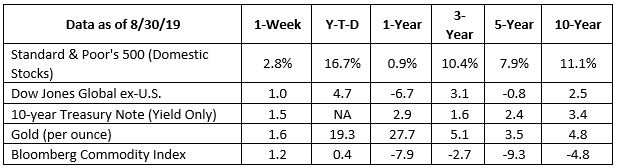
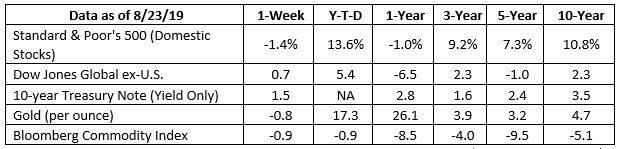
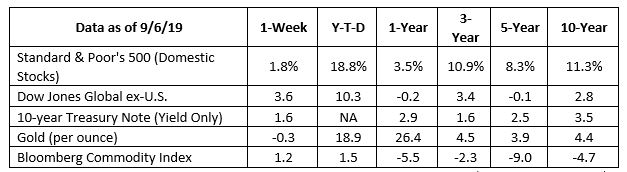
S&P 500, Dow Jones Global ex-US, Gold, Bloomberg Commodity Index returns exclude reinvested dividends (gold does not pay a dividend) and the three-, five-, and 10-year returns are annualized; the DJ Equity All REIT Total Return Index does include reinvested dividends and the three-, five-, and 10-year returns are annualized; and the 10-year Treasury Note is simply the yield at the close of the day on each of the historical time periods.
Sources: Yahoo! Finance, Barron’s, djindexes.com, London Bullion Market Association.
Past performance is no guarantee of future results. Indices are unmanaged and cannot be invested into directly. N/A means not applicable.

Most Popular Financial Stories
Financial Advisor

Explanation of current positions

Several clients have told us they are a little overwhelmed by many of the new ETFs, and what their business model and investment objectives are.   Below is a short summary…

read more…
Happy Thanksgiving

Happy Thanksgiving

Wishing You a Happy Thanksgiving As Thanksgiving approaches, we pause to reflect on and appreciate the abundant blessings in our lives, especially the family and friends who…

read more…

* This newsletter and commentary expressed should not be construed as investment advice.
* Government bonds and Treasury Bills are guaranteed by the U.S. government as to the timely payment of principal and interest and, if held to maturity, offer a fixed rate of return and fixed principal value.  However, the value of fund shares is not guaranteed and will fluctuate.
* Corporate bonds are considered higher risk than government bonds but normally offer a higher yield and are subject to market, interest rate and credit risk as well as additional risks based on the quality of issuer coupon rate, price, yield, maturity, and redemption features.
* The Standard & Poor’s 500 (S&P 500) is an unmanaged group of securities considered to be representative of the stock market in general. You cannot invest directly in this index.
* All indexes referenced are unmanaged. Unmanaged index returns do not reflect fees, expenses, or sales charges. Index performance is not indicative of the performance of any investment.
* The Dow Jones Global ex-U.S. Index covers approximately 95% of the market capitalization of the 45 developed and emerging countries included in the Index.
* The 10-year Treasury Note represents debt owed by the United States Treasury to the public. Since the U.S. Government is seen as a risk-free borrower, investors use the 10-year Treasury Note as a benchmark for the long-term bond market.
* Gold represents the afternoon gold price as reported by the London Bullion Market Association. The gold price is set twice daily by the London Gold Fixing Company at 10:30 and 15:00 and is expressed in U.S. dollars per fine troy ounce.
* The Bloomberg Commodity Index is designed to be a highly liquid and diversified benchmark for the commodity futures market. The Index is composed of futures contracts on 19 physical commodities and was launched on July 14, 1998.
* The Dow Jones Industrial Average (DJIA), commonly known as “The Dow,” is an index representing 30 stock of companies maintained and reviewed by the editors of The Wall Street Journal.
* The NASDAQ Composite is an unmanaged index of securities traded on the NASDAQ system.
* International investing involves special risks such as currency fluctuation and political instability and may not be suitable for all investors. These risks are often heightened for investments in emerging markets.
* Yahoo! Finance is the source for any reference to the performance of an index between two specific periods.
* Opinions expressed are subject to change without notice and are not intended as investment advice or to predict future performance.
* Economic forecasts set forth may not develop as predicted and there can be no guarantee that strategies promoted will be successful.
* Past performance does not guarantee future results. Investing involves risk, including loss of principal.
* You cannot invest directly in an index.
* Stock investing involves risk including loss of principal.
* The foregoing information has been obtained from sources considered to be reliable, but we do not guarantee it is accurate or complete.
* There is no guarantee a diversified portfolio will enhance overall returns or outperform a non-diversified portfolio. Diversification does not protect against market risk.
* Asset allocation does not ensure a profit or protect against a loss.
* Consult your financial professional before making any investment decision.
* To unsubscribe from the Weekly Market Commentary please reply to this e-mail with “Unsubscribe” in the subject.

Sources:
https://www.amazon.com/Narrative-Economics-Stories-Economic-Events/dp/0691182299/ref=sr_1_1?keywords=shiller&qid=1569084112&sr=8-1
https://www.barrons.com/articles/the-dow-jones-industrial-average-falls-for-week-despite-interest-rate-cut-51569026025?mod=hp_DAY_3 (or go to https://peakcontent.s3-us-west-2.amazonaws.com/+Peak+Commentary/09-23-19_Barrons-The_Dow_Falls_as_Markets_Try_to_Figure_Out_What_Really_Matters-Footnote_2.pdf)
https://www.nytimes.com/2019/09/21/business/united-states-china-trade.html
https://www.wsj.com/articles/analysis-powells-subtle-messaging-to-trump-on-trade-fight-11568971800 (or go to https://peakcontent.s3-us-west-2.amazonaws.com/+Peak+Commentary/09-23-19_WSJ-Analysis-Powells_Subtle_Messaging_to_Trump_on_Trade_Fight-Footnote_4.pdf)
https://hbr.org/2018/03/thriving-in-the-gig-economy
https://www.mckinsey.com/featured-insights/employment-and-growth/independent-work-choice-necessity-and-the-gig-economy
https://www.appjobs.com/blog/the-rise-of-gig-economy-the-top-side-hustles-in-the-us?utm_source=newsletter&utm_medium=email&utm_campaign=newsletter_axiosmarkets&stream=business
https://www.goodreads.com/quotes/22842-you-have-brains-in-your-head-you-have-feet-in

Market Commentary – September 16, 2019

Where’s inflation?
If you enjoy searching for Waldo, the visual nemesis in a red-striped sweater and cap, you may appreciate the quandary of central bankers in many wealthy nations. For almost a decade, they’ve been they’ve been trying to find inflation.

Last week, there were reports of a sighting in the United States.

The core U.S. Consumer Price Index (CPI) measures changes in the prices Americans pay for goods. The Index rose 0.3 percent from July to August. It was up 2.4 percent year-to-year, reflecting the fastest annual growth rate since July 2018, reported The Wall Street Journal.

Rising healthcare costs were one reason for inflation gains, reported CNBC. In addition, Axios reported:

“The costs of the U.S. tariffs on Chinese imports clearly made an impact on the [inflation] reading, but wages also picked up notably last month as seen in the government’s jobs report. The reading may indicate that inflation is making a sustained comeback.”

Central banks don’t want inflation to be too high, as it has been in Argentina (22.4 percent year-to-date). They also don’t want it to be too low, because low inflation can be a sign of economic weakness.

The Federal Reserve (Fed), which is our central bank, considers 2 percent inflation to be consistent with a healthy economy, reported The Wall Street Journal.

If you were reading carefully, you may have noted the CPI was above 2 percent. While the CPI measures inflation, it’s not the Fed’s favorite inflation gauge. Fed officials prefer the Personal Consumption and Expenditures Price Index (PCE), which estimated inflation at 1.4 percent in July. The PCE was up 0.2 percent for the month.

U.S. stocks moved higher again last week on solid retail sales and positive trade news.

What would you choose?
Americans spend a lot of time at work. The Bureau of Labor Statistics’ 2018 American Time Use Survey reported people employed full-time worked 8-1/2 hours on weekdays, on average, and almost 5-1/2 hours on weekend days (when they worked on weekends).

If you estimate 8 hours of sleep a night and two weeks of vacation, at least one-third of awake-time is spent at work. That may explain why some people have strong opinions about dress codes and workspaces. How would you answer these questions?

 If your employer gave you the choice, would you prefer to wear casual clothes to the office or receive a $5,000 salary bump?
Dress casual has become the new norm in many workplaces. A significant percentage of employees participating in a recent Randstad US survey (33 percent) like it so much, they would sacrifice a $5,000 salary increase to keep it that way.

Imagine that. One-third of workers would give up $25,000, assuming they stayed with their employer for five years, to avoid pantyhose and neckties.

In the same survey, one-third of participants said they would turn down a job offer or quit, if the employer insisted on a conservative dress code.

Interestingly, some psychology studies have found more formal clothing may affect: 1) the way others perceive you, 2) how you perceive yourself, and 3) how you make decisions.

If you were given the choice, would you opt for a totally open, a totally private, or a shared workspace?
Four-of-10 American workers get to choose where they work within their offices. Preferences vary significantly. The top choices for 2019, according to a Western Office survey were:

  • 28 percent: Mostly open space, just a few walls and private space available on-demand.
  • 23 percent: Mostly private space, an agglomeration of shared offices and team rooms.
  • 20 percent: Somewhat open, a combination of offices and cubicles.

The survey suggested having a workspace that suits employees’ preferences can improve efficiency, making companies more productive and profitable.

Weekly Focus – Think About It
“I am awfully greedy; I want everything from life. I want to be a woman and to be a man, to have many friends and to have loneliness, to work much and write good books, to travel and enjoy myself, to be selfish and to be unselfish…You see, it is difficult to get all which I want. And then when I do not succeed, I get mad with anger.”
–Simone de Beauvoir, writer and philosopher

Best regards,

John F. Reutemann, Jr., CLU, CFP®

P.S.  Please feel free to forward this commentary to family, friends, or colleagues. If you would like us to add them to the list, please reply to this email with their email address and we will ask for their permission to be added.

Investment advice offered through Research Financial Strategies, a registered investment advisor.

S&P 500, Dow Jones Global ex-US, Gold, Bloomberg Commodity Index returns exclude reinvested dividends (gold does not pay a dividend) and the three-, five-, and 10-year returns are annualized; the DJ Equity All REIT Total Return Index does include reinvested dividends and the three-, five-, and 10-year returns are annualized; and the 10-year Treasury Note is simply the yield at the close of the day on each of the historical time periods.
Sources: Yahoo! Finance, Barron’s, djindexes.com, London Bullion Market Association.
Past performance is no guarantee of future results. Indices are unmanaged and cannot be invested into directly. N/A means not applicable.

Most Popular Financial Stories

Financial Advisor

Explanation of current positions

Several clients have told us they are a little overwhelmed by many of the new ETFs, and what their business model and investment objectives are.   Below is a short summary…

read more…
Happy Thanksgiving

Happy Thanksgiving

Wishing You a Happy Thanksgiving As Thanksgiving approaches, we pause to reflect on and appreciate the abundant blessings in our lives, especially the family and friends who…

read more…

* This newsletter and commentary expressed should not be construed as investment advice.
* Government bonds and Treasury Bills are guaranteed by the U.S. government as to the timely payment of principal and interest and, if held to maturity, offer a fixed rate of return and fixed principal value.  However, the value of fund shares is not guaranteed and will fluctuate.
* Corporate bonds are considered higher risk than government bonds but normally offer a higher yield and are subject to market, interest rate and credit risk as well as additional risks based on the quality of issuer coupon rate, price, yield, maturity, and redemption features.
* The Standard & Poor’s 500 (S&P 500) is an unmanaged group of securities considered to be representative of the stock market in general. You cannot invest directly in this index.
* All indexes referenced are unmanaged. Unmanaged index returns do not reflect fees, expenses, or sales charges. Index performance is not indicative of the performance of any investment.
* The Dow Jones Global ex-U.S. Index covers approximately 95% of the market capitalization of the 45 developed and emerging countries included in the Index.
* The 10-year Treasury Note represents debt owed by the United States Treasury to the public. Since the U.S. Government is seen as a risk-free borrower, investors use the 10-year Treasury Note as a benchmark for the long-term bond market.
* Gold represents the afternoon gold price as reported by the London Bullion Market Association. The gold price is set twice daily by the London Gold Fixing Company at 10:30 and 15:00 and is expressed in U.S. dollars per fine troy ounce.
* The Bloomberg Commodity Index is designed to be a highly liquid and diversified benchmark for the commodity futures market. The Index is composed of futures contracts on 19 physical commodities and was launched on July 14, 1998.
* The Dow Jones Industrial Average (DJIA), commonly known as “The Dow,” is an index representing 30 stock of companies maintained and reviewed by the editors of The Wall Street Journal.
* The NASDAQ Composite is an unmanaged index of securities traded on the NASDAQ system.
* International investing involves special risks such as currency fluctuation and political instability and may not be suitable for all investors. These risks are often heightened for investments in emerging markets.
* Yahoo! Finance is the source for any reference to the performance of an index between two specific periods.
* Opinions expressed are subject to change without notice and are not intended as investment advice or to predict future performance.
* Economic forecasts set forth may not develop as predicted and there can be no guarantee that strategies promoted will be successful.
* Past performance does not guarantee future results. Investing involves risk, including loss of principal.
* You cannot invest directly in an index.
* Stock investing involves risk including loss of principal.
* The foregoing information has been obtained from sources considered to be reliable, but we do not guarantee it is accurate or complete.
* There is no guarantee a diversified portfolio will enhance overall returns or outperform a non-diversified portfolio. Diversification does not protect against market risk.
* Asset allocation does not ensure a profit or protect against a loss.
* Consult your financial professional before making any investment decision.
* To unsubscribe from the Weekly Market Commentary please reply to this e-mail with “Unsubscribe” in the subject.

Sources:
https://econofact.org/whats-the-problem-with-low-inflation
https://www.wsj.com/articles/u-s-consumer-prices-rose-0-1-in-august-11568292160 (or go to https://peakcontent.s3-us-west-2.amazonaws.com/+Peak+Commentary/09-16-19_WSJ-Weak_Energy_Prices_Held_Down_Overall_Inflation_in_August-Footnote_2.pdf)
https://www.cnbc.com/2019/08/13/consumer-price-index-july-2019.html
https://www.axios.com/inflation-cpi-federal-reserve-interest-rates-321171db-ae71-4587-b482-14d90e640a44.html
https://www.reuters.com/article/us-argentina-data-inflation/argentina-inflation-cools-for-third-straight-month-in-june-idUSKCN1UB2FL
https://www.bea.gov/news/2019/personal-income-and-outlays-july-2019
https://www.marketwatch.com/story/dow-and-sp-500-on-the-brink-of-fresh-all-time-highs-ahead-of-retail-sales-other-data-2019-09-13
https://www.bls.gov/news.release/pdf/atus.pdf
https://rlc.randstadusa.com/press-room/press-releases/randstad-us-survey-finds-casual-dress-is-almost-always-in-fashion-in-todays-workplace?hs_ungate__cos_renderer_combine_all_css_disable=true&hs_ungate__cos_renderer_coverage_css_enable=false&hsVerifyCssCombining=false
http://www.columbia.edu/~ms4992/Publications/2015_Slepian-Ferber-Gold-Rutchick_Clothing-Formality_SPPS.pdf
https://www.westernoffice.com/files/gensler-us-workplace-survey-2019_15776.pdf
https://www.goodreads.com/quotes/tag/work

Market Commentary – September 9, 2019

Remember the movie Groundhog Day?
Bill Murray’s character is a crotchety newsman who lives the same day over and over again. After exhausting other options, he chooses self-improvement and eventually escapes the cycle.

The movie came to mind last week when the United States and China headed to the negotiating table. Again.

Global stocks rallied on the news. Again.

The U.S.-China trade war has had a significant impact on stock market performance during the past two years. Since the trade war began, U.S. stock markets have rallied when trade talks are announced and retreated when trade talks fail. In 2018, MarketWatch reported:  “Trade issues have been at the center of Wall Street’s concerns because they have the potential to ripple into every other issue that has been besieging investors, if [the trade war] escalates. That includes the growth outlook for U.S. corporations, an economic slowdown in China, the pace of rate hikes, and the health of the U.S. economy and stock market…”

Last week, Fox News pointed out U.S. companies and consumers are feeling the effects of tariffs and that could be detrimental to U.S. economic growth, especially if consumer spending slows.

Regardless, major U.S. indices posted gains last week after the United States and China agreed to a new round of trade talks. Ben Levisohn of Barron’s explained:  “Why did the market soar? Not because of the economic data, which still paints the picture of a decelerating U.S. economy. August’s payrolls report came in light, and would have been even worse if not for a big boost from census hiring. The Institute for Supply Management’s manufacturing index fell below 50, signaling a full-blown contraction in industrial activity. But the United States and China finally set a date to go back to the bargaining table on trade – and that was more than enough good news to last the week.”

Maybe, this time around, trade talks will deliver a trade agreement.

If not, be prepared for more possible volatility.

Group outings? gift requests? Let’s talk money etiquette. If you’re of the generation that believes money is a taboo topic, stop reading. If you’ve encountered some perplexing money issues and want to learn more about money-related social etiquette, read on.

Issue: The bride and groom would prefer cash to gifts. Is it okay to request cash?
Answer: It is not okay to ask invited guests to give you cash, writes Carolyn Hax of The Washington Post. “There’s no polite way to bill guests for liking you, pat their pockets for loose change, or coerce them into paying your bills. So, please don’t try. Thank you.”

Issue: You’re organizing a group gift, outing, or trip. How do you avoid money conflicts?
Answer: BuzzFeed Finance recommends avoiding group texts, which “…are a breeding ground for peer pressure and anxiety. Suddenly, everyone agrees that $50 is a reasonable birthday amount, while one person had budgeted to spend around $20 and now feels too awkward to speak up. If you’re the person organizing a joint gift, it’s worth reaching out to people separately to gauge interest and a reasonable dollar amount.”

Issue: You’re raising money for several charities. How often can you ask the same person for a donation?
Answer: It depends, say the editors at Real Simple. It’s okay to approach immediate family for every cause, but limit requests to distant relatives, friends, and acquaintances to a couple of times a year. “You’ll get better results – and keep more friends – by targeting your solicitations, rather than blasting your entire address book.”

Issue: Your girlfriend broke up with you on a peer-to-peer (P2P) payment app. All your friends saw it.
Answer: The default setting for most P2P payment apps is ‘public.’ As a result, people you know – and anyone else using the platform – can see who you paid, when you paid, and (sometimes) what you purchased. Consumer Reports suggests, “Make all your P2P settings the most private possible to ensure the least sharing of your personal data.”

When it comes to money, every generation faces unique challenges.

Weekly Focus – Think About It
“Etiquette is all human social behavior. If you’re a hermit on a mountain, you don’t have to worry about etiquette; if somebody comes up the mountain, then you’ve got a problem. It matters because we want to live in reasonably harmonious communities.”
–Judith Martin (a.k.a. Miss Manners)

Best regards,

John F. Reutemann, Jr., CLU, CFP®

P.S.  Please feel free to forward this commentary to family, friends, or colleagues. If you would like us to add them to the list, please reply to this email with their email address and we will ask for their permission to be added.

Investment advice offered through Research Financial Strategies, a registered investment advisor.

S&P 500, Dow Jones Global ex-US, Gold, Bloomberg Commodity Index returns exclude reinvested dividends (gold does not pay a dividend) and the three-, five-, and 10-year returns are annualized; the DJ Equity All REIT Total Return Index does include reinvested dividends and the three-, five-, and 10-year returns are annualized; and the 10-year Treasury Note is simply the yield at the close of the day on each of the historical time periods.
Sources: Yahoo! Finance, Barron’s, djindexes.com, London Bullion Market Association.
Past performance is no guarantee of future results. Indices are unmanaged and cannot be invested into directly. N/A means not applicable.

Most Popular Financial Stories

Financial Advisor

Explanation of current positions

Several clients have told us they are a little overwhelmed by many of the new ETFs, and what their business model and investment objectives are.   Below is a short summary…

read more…
Happy Thanksgiving

Happy Thanksgiving

Wishing You a Happy Thanksgiving As Thanksgiving approaches, we pause to reflect on and appreciate the abundant blessings in our lives, especially the family and friends who…

read more…

* This newsletter and commentary expressed should not be construed as investment advice.
* Government bonds and Treasury Bills are guaranteed by the U.S. government as to the timely payment of principal and interest and, if held to maturity, offer a fixed rate of return and fixed principal value.  However, the value of fund shares is not guaranteed and will fluctuate.
* Corporate bonds are considered higher risk than government bonds but normally offer a higher yield and are subject to market, interest rate and credit risk as well as additional risks based on the quality of issuer coupon rate, price, yield, maturity, and redemption features.
* The Standard & Poor’s 500 (S&P 500) is an unmanaged group of securities considered to be representative of the stock market in general. You cannot invest directly in this index.
* All indexes referenced are unmanaged. Unmanaged index returns do not reflect fees, expenses, or sales charges. Index performance is not indicative of the performance of any investment.
* The Dow Jones Global ex-U.S. Index covers approximately 95% of the market capitalization of the 45 developed and emerging countries included in the Index.
* The 10-year Treasury Note represents debt owed by the United States Treasury to the public. Since the U.S. Government is seen as a risk-free borrower, investors use the 10-year Treasury Note as a benchmark for the long-term bond market.
* Gold represents the afternoon gold price as reported by the London Bullion Market Association. The gold price is set twice daily by the London Gold Fixing Company at 10:30 and 15:00 and is expressed in U.S. dollars per fine troy ounce.
* The Bloomberg Commodity Index is designed to be a highly liquid and diversified benchmark for the commodity futures market. The Index is composed of futures contracts on 19 physical commodities and was launched on July 14, 1998.
* The Dow Jones Industrial Average (DJIA), commonly known as “The Dow,” is an index representing 30 stock of companies maintained and reviewed by the editors of The Wall Street Journal.
* The NASDAQ Composite is an unmanaged index of securities traded on the NASDAQ system.
* International investing involves special risks such as currency fluctuation and political instability and may not be suitable for all investors. These risks are often heightened for investments in emerging markets.
* Yahoo! Finance is the source for any reference to the performance of an index between two specific periods.
* Opinions expressed are subject to change without notice and are not intended as investment advice or to predict future performance.
* Economic forecasts set forth may not develop as predicted and there can be no guarantee that strategies promoted will be successful.
* Past performance does not guarantee future results. Investing involves risk, including loss of principal.
* You cannot invest directly in an index.
* Stock investing involves risk including loss of principal.
* The foregoing information has been obtained from sources considered to be reliable, but we do not guarantee it is accurate or complete.
* There is no guarantee a diversified portfolio will enhance overall returns or outperform a non-diversified portfolio. Diversification does not protect against market risk.
* Asset allocation does not ensure a profit or protect against a loss.
* Consult your financial professional before making any investment decision.
* To unsubscribe from the Weekly Market Commentary please reply to this e-mail with “Unsubscribe” in the subject.

Sources:
https://www.cnn.com/2019/09/06/business/us-china-trade-war-talks/index.html
https://www.marketwatch.com/story/this-chart-shows-why-trade-war-fears-are-the-biggest-catalyst-for-the-stock-market-2018-11-02
https://www.foxbusiness.com/economy/us-china-trade-war-economy-recession-impact
https://www.barrons.com/articles/s-p-500-notches-second-week-of-gains-and-sets-itself-up-for-more-51567817597?mod=hp_DAY_3 (or go to https://peakcontent.s3-us-west-2.amazonaws.com/+Peak+Commentary/09-09-19_Barrons-The_S_and_P_500_Finally_Busts_Out_and_Sets_Itself_Up_for_More_Gains-Footnote_4.pdf)
https://www.washingtonpost.com/lifestyle/style/carolyn-hax-wedding-etiquette-advice-on-gift-requests-family-dramas/2013/01/29/6c21c966-64db-11e2-b84d-21c7b65985ee_story.html
https://www.buzzfeed.com/gyanyankovich/money-etiquette-rules-for-2018
https://www.realsimple.com/work-life/money/money-etiquette-advice
https://www.consumerreports.org/digital-payments/p2p-payment-etiquette/
https://www.thespruce.com/quotes-about-good-manners-1216528

Market Commentary – September 3, 2019

What, me worry?
About this time last year, Time Magazine reported on anxiety in America. Almost 40 percent of Americans reported being more anxious than they were the previous year.

The performance of stock and bond markets this summer may have pushed those numbers higher.

Last week finally brought some relief. It was the best week for major U.S. stock indices since June. The Standard & Poor’s 500 Index, Dow Jones Industrial Average, and Nasdaq Composite all gained between 2 and 3 percent, reported Ben Levisohn of Barron’s.

How can investors cope if volatility continues?
Barron’s Randall Forsyth offered a recommendation, “When the stock market is this crazy, you should just invest lazy.” It’s important to note that Forsyth’s definition of ‘managing lazy’ is building a diversified portfolio aimed at achieving your financial goals and leaving it alone.

Marketplace’s Andie Corban and Kai Ryssdal offered a pretty good argument for lazy investing, too. In the audio report, Ryssdal discussed trading algorithms with Joe Gits of Social Market Analytics: “Gits: So these [algorithms] are reading the president’s tweet using natural language processing [NLP], and our current president’s tweets are pretty easy to read with NLP, and they are either going long or going short.

Ryssdal: I’m going to ask you to make a value judgment here, then. Entirely apart from making money, are these algorithms – and the outsized effect that they have on movement of the markets – are they a good thing or a bad thing?

Gits: I think they’re a bad thing in general, because I think the volatility causes a lot of panic by buying and selling and I think the average investor gets hurt.”

Staying calm in the face of volatility isn’t easy, but it’s an important skill for investors to hone. If it helps, remember volatility can be computer-driven.

Imagine Money with an expiration date. At the turn of the 19th century, some economists thought negative interest rates made sense, according to The Economist.

In 1916, Silvio Gesell published The Natural Economic Order, a pamphlet promoting the idea of negative interest rates. A self-taught economist, Gesell lost faith in money after living through a financial crash in Argentina during the 1890s.

Planet Money reported:  “The problem, Gesell believed, was that money served two roles that often came into conflict: It was a way for people to store wealth, and it was the thing everybody needed to conduct business. The fact that money could store wealth meant its holders had a reason to cling to it, especially in crises like the one he saw in Argentina, when opportunities to safely put that money elsewhere looked grim. It was a typical story. When people got scared, they hoarded cash and brought business to a standstill.”

Gesell suggested a solution: negative interest rates on money. If money continuously lost value, people would not hoard it. They would, in fact, have an incentive to spend it.

How do you make money lose value?
Gesell proposed a tax. Every year, money would expire and lose all value unless the money holder purchased a stamp. The stamp wouldn’t be free, reported Financial Times. There would be a fee for the stamp.

For example, if a person held a $100 bill and paid a $1 fee after holding it for a year, the after-stamp value of the money would be $99. After five years of paying fees, $100 would be worth $95.

Gesell believed people would, in effect, earn negative interest rates if they held onto money. As a result, they would be eager to spend, and that would keep the economy healthy, and possibly help prevent future depressions and improve prosperity.

It’s a thought-provoking theory that earned Gesell a number of nicknames, some flattering and some not.

Weekly Focus – Think About It
“The ultimate purpose of economics, of course, is to understand and promote the enhancement of well-being.”
–Ben Bernanke, Former Chair U.S. Federal Reserve

Best regards,

John F. Reutemann, Jr., CLU, CFP®

P.S.  Please feel free to forward this commentary to family, friends, or colleagues. If you would like us to add them to the list, please reply to this email with their email address and we will ask for their permission to be added.

Investment advice offered through Research Financial Strategies, a registered investment advisor.

S&P 500, Dow Jones Global ex-US, Gold, Bloomberg Commodity Index returns exclude reinvested dividends (gold does not pay a dividend) and the three-, five-, and 10-year returns are annualized; the DJ Equity All REIT Total Return Index does include reinvested dividends and the three-, five-, and 10-year returns are annualized; and the 10-year Treasury Note is simply the yield at the close of the day on each of the historical time periods.
Sources: Yahoo! Finance, Barron’s, djindexes.com, London Bullion Market Association.
Past performance is no guarantee of future results. Indices are unmanaged and cannot be invested into directly. N/A means not applicable.

Most Popular Financial Stories

Financial Advisor

Explanation of current positions

Several clients have told us they are a little overwhelmed by many of the new ETFs, and what their business model and investment objectives are.   Below is a short summary…

read more…
Happy Thanksgiving

Happy Thanksgiving

Wishing You a Happy Thanksgiving As Thanksgiving approaches, we pause to reflect on and appreciate the abundant blessings in our lives, especially the family and friends who…

read more…

* This newsletter and commentary expressed should not be construed as investment advice.
* Government bonds and Treasury Bills are guaranteed by the U.S. government as to the timely payment of principal and interest and, if held to maturity, offer a fixed rate of return and fixed principal value.  However, the value of fund shares is not guaranteed and will fluctuate.
* Corporate bonds are considered higher risk than government bonds but normally offer a higher yield and are subject to market, interest rate and credit risk as well as additional risks based on the quality of issuer coupon rate, price, yield, maturity, and redemption features.
* The Standard & Poor’s 500 (S&P 500) is an unmanaged group of securities considered to be representative of the stock market in general. You cannot invest directly in this index.
* All indexes referenced are unmanaged. Unmanaged index returns do not reflect fees, expenses, or sales charges. Index performance is not indicative of the performance of any investment.
* The Dow Jones Global ex-U.S. Index covers approximately 95% of the market capitalization of the 45 developed and emerging countries included in the Index.
* The 10-year Treasury Note represents debt owed by the United States Treasury to the public. Since the U.S. Government is seen as a risk-free borrower, investors use the 10-year Treasury Note as a benchmark for the long-term bond market.
* Gold represents the afternoon gold price as reported by the London Bullion Market Association. The gold price is set twice daily by the London Gold Fixing Company at 10:30 and 15:00 and is expressed in U.S. dollars per fine troy ounce.
* The Bloomberg Commodity Index is designed to be a highly liquid and diversified benchmark for the commodity futures market. The Index is composed of futures contracts on 19 physical commodities and was launched on July 14, 1998.
* The Dow Jones Industrial Average (DJIA), commonly known as “The Dow,” is an index representing 30 stock of companies maintained and reviewed by the editors of The Wall Street Journal.
* The NASDAQ Composite is an unmanaged index of securities traded on the NASDAQ system.
* International investing involves special risks such as currency fluctuation and political instability and may not be suitable for all investors. These risks are often heightened for investments in emerging markets.
* Yahoo! Finance is the source for any reference to the performance of an index between two specific periods.
* Opinions expressed are subject to change without notice and are not intended as investment advice or to predict future performance.
* Economic forecasts set forth may not develop as predicted and there can be no guarantee that strategies promoted will be successful.
* Past performance does not guarantee future results. Investing involves risk, including loss of principal.
* You cannot invest directly in an index.
* Stock investing involves risk including loss of principal.
* The foregoing information has been obtained from sources considered to be reliable, but we do not guarantee it is accurate or complete.
* There is no guarantee a diversified portfolio will enhance overall returns or outperform a non-diversified portfolio. Diversification does not protect against market risk.
* Asset allocation does not ensure a profit or protect against a loss.
* Consult your financial professional before making any investment decision.
* To unsubscribe from the Weekly Market Commentary please reply to this e-mail with “Unsubscribe” in the subject.

Sources:
https://time.com/5269371/americans-anxiety-poll/
https://www.barrons.com/articles/stocks-rally-3-ending-a-bad-month-on-a-good-note-51567212639?mod=hp_DAY_3 (or go to https://peakcontent.s3-us-west-2.amazonaws.com/+Peak+Commentary/09-03-19_Barrons-Stocks_Rally_3_Percent_Ending_a_Bad_Month_on_a_Good_Note-Footnote_2.pdf)
https://www.barrons.com/articles/when-the-stock-market-is-this-crazy-you-should-just-invest-lazy-51567213413?mod=hp_DAY_1 (or go to https://peakcontent.s3-us-west-2.amazonaws.com/+Peak+Commentary/09-03-19_Barrons-When_the_Stock_Market_is_This_Crazy_You_Should_Just_Invest_Lazy-Footnote_3.pdf)
https://www.marketplace.org/2019/08/29/meet-the-algorithms-connecting-trump-tweets-and-the-stock-market/
https://www.npr.org/sections/money/2019/08/27/754323652/the-strange-unduly-neglected-prophet (or go to https://peakcontent.s3-us-west-2.amazonaws.com/+Peak+Commentary/09-03-19_NPR-Planet_Money-The_Strange_Unduly_Neglected_Prophet-Footnote_5.pdf)
https://www.economist.com/finance-and-economics/2018/02/03/why-sub-zero-interest-rates-are-neither-unfair-nor-unnatural (or go to https://peakcontent.s3-us-west-2.amazonaws.com/+Peak+Commentary/09-03-19_TheEconomist-Why_Sub-Zero_Interest_Rates_are_Neither_Unfair_Nor_Unnatural-Footnote_6.pdf)
http://ftalphaville.ft.com/2015/02/02/2103032/negative-rates-and-gesell-taxes-how-low-are-we-talking-here/ (or go to https://peakcontent.s3-us-west-2.amazonaws.com/+Peak+Commentary/09-03-19_FinancialTimes-Negative_Rates_and_Gesell_Taxes-How_Low_are_We_Talking_Here-Footnote_7.pdf)
https://www.brainyquote.com/quotes/ben_bernanke_704771

How important labor still is today

Happy Labor Day! 

As you know, this holiday is for celebrating the Labor Movement and the contributions workers have made to our nation’s history. But in recent years, as our society has grown ever more automated and modernized, we sometimes think we forget how important labor still is.

Each month seems to bring new stories about the latest innovations in artificial intelligence, robotics, or digital technology. But there are so many things we could not function without – things we often take for granted – that wouldn’t exist without laborers.

As financial advisors, we work a white-collar job. Every day we rely on computers to do what we do best. And yet, we could not perform our jobs without labor. The roads we drive on to get to work are made by laborers. The food we eat is grown, harvested, and prepared by laborers. The clothes on our back, the shoes on our feet, the roof we live under – it’s all thanks to hard work and no small amount of skill.

Laborers harness the power of the Earth, the sun, the wind, and the oceans to provide the energy we consume each day. They mine the elements that go into everything from streetlights to the smartphone in our pockets. They build, repair, and reuse. Laborers keep our cities clean and functioning smoothly. They even plant the trees we rely on both for oxygen and for natural beauty! We often don’t notice them, because they work behind the scenes, or at night, or even in faraway lands. But the fact remains that we still rely on the sweat and skill of workers around the world.

As another Labor Day rolls around, it’s important to remember that. It’s important to be grateful for the things we take for granted. It’s important to remember that many laborers still work backbreaking jobs, in harsh working conditions, for very little pay. It’s important to remember that the labor movement – the cause to ensure workers are treated fairly, safely, and humanely – is still going on today. So, while we celebrate another Labor Day, let’s remember how important labor is and always will be. Our civilization would be nothing without it.

On behalf of everyone here at Research Financial Strategies, we wish you a safe and happy Labor Day!

Most Popular Financial Stories

Financial Advisor

Explanation of current positions

Several clients have told us they are a little overwhelmed by many of the new ETFs, and what their business model and investment objectives are.   Below is a short summary…

read more…
Happy Thanksgiving

Happy Thanksgiving

Wishing You a Happy Thanksgiving As Thanksgiving approaches, we pause to reflect on and appreciate the abundant blessings in our lives, especially the family and friends who…

read more…

Market Commentary – August 26, 2019

Have you ever watched a lake in a thunderstorm?

Heavy rain pummels the surface. Dark clouds drop the sky closer to the water. Gusty winds crash waves ashore. Up top, on land, damage may occur. Underneath, in the deeper water, things often remain pretty much the same.

Last week’s stock market volatility was like a thunderstorm on a lake. Markets were doing well until the squall brewed up on Friday. Ben Levisohn of Barron’s described it like this:

“The fun started on Friday morning, when China announced new tariffs on $75 billion of U.S. goods and a resumption of penalties on U.S. cars. Surprisingly, the market handled it pretty well. U.S. futures markets dipped into the red, but only a bit, and the market appeared ready to shrug off the news, particularly after [Federal Reserve Chair] Powell stuck to his message: The Fed will ‘act as appropriate to sustain the expansion’…That wasn’t enough for the president…he turned his wrath on China and ‘ordered’ U.S. companies to ‘immediately start looking for an alternative to China.’ Now that’s escalation – even if it’s unclear whether the president can legally do that.”

Unsettled, stock markets seethed and stormed. By the end of the day, major U.S. stock indices were lower, and that’s how they finished the week.

The U.S. economy, which is the deep water under the U.S. stock market, continued along as usual. On Friday, The Economist reported, “…economic data do not suggest that America is sliding into recession. Although inflation remains low and manufacturing activity is weakening, consumers keep spending and there is little sign that unemployment is about to rise.”

The economy isn’t moving fast, but it’s moving steady. Stock markets, on the other hand, are suffering the storms of investor sentiment and anxiety.

Happy anniversary!
You’ve probably been hearing and reading a lot about Woodstock, the iconic 1969 music festival. Americans have been celebrating the event’s 50th anniversary. In August 1969, Woodstock staged 32 acts, attracted 400,000 attendees (without social media), and featured intermittent downpours.

Rain-soaked performers, including The Who, Janis Joplin, Creedence Clearwater Revival, Joe Cocker, Sly and the Family Stone, Jimi Hendrix, and Crosby, Stills, Nash and Young, braved “…the danger of electrical shocks and general backstage anarchy,” wrote Rolling Stone Magazine.

Woodstock made Rolling Stone’s 2004 list of 50 Moments That Changed Rock and Roll, along with the evolution of Chess Records, the death of John Lennon, and the invention of the iPod.

Since 1969, music festivals have become a staple of summertime entertainment. Planet Money reported about 100 events will have been scheduled in the United States this year. Most will have production standards far superior to those at Woodstock.

They also cost a lot more.

If festival ticket prices increased with inflation, they would cost about five times what they did in the late 70s, reported The Economist. Instead, tickets cost about 50 times more.

Attendees are getting a lot more for their money. A festival organizer in Britain said arranging a music festival is akin to setting up a small town with scaffolding and a crew to build it. Festivalgoers need water, food, drinks, Wi-Fi, security, and bathrooms.

Oh! And music.

The economics of the music industry have changed dramatically. At one time, performers made most of their money selling records and would tour to promote newly released songs. Today, artists make most of their money going on tour and new releases are a way to attract fans to a show.

Today, succeeding in the music industry is all about making the fan experience worth the price.

Weekly Focus – Think About It
“We feared that the music which had given us sustenance was in danger of spiritual starvation. We feared it losing its sense of purpose, we feared it falling into fattened hands, we feared it floundering in a mire of spectacle, finance, and vapid technical complexity. We would call forth in our minds the image of Paul Revere, riding through the American night, petitioning the people to wake up, to take up arms. We, too, would take up arms, the arms of our generation, the electric guitar and the microphone.”
–Patti Smith, Singer and songwriter

Best regards,

John F. Reutemann, Jr., CLU, CFP®

P.S.  Please feel free to forward this commentary to family, friends, or colleagues. If you would like us to add them to the list, please reply to this email with their email address and we will ask for their permission to be added.

Investment advice offered through Research Financial Strategies, a registered investment advisor.

S&P 500, Dow Jones Global ex-US, Gold, Bloomberg Commodity Index returns exclude reinvested dividends (gold does not pay a dividend) and the three-, five-, and 10-year returns are annualized; the DJ Equity All REIT Total Return Index does include reinvested dividends and the three-, five-, and 10-year returns are annualized; and the 10-year Treasury Note is simply the yield at the close of the day on each of the historical time periods.
Sources: Yahoo! Finance, Barron’s, djindexes.com, London Bullion Market Association.
Past performance is no guarantee of future results. Indices are unmanaged and cannot be invested into directly. N/A means not applicable.

Most Popular Financial Stories

Financial Advisor

Explanation of current positions

Several clients have told us they are a little overwhelmed by many of the new ETFs, and what their business model and investment objectives are.   Below is a short summary…

read more…
Happy Thanksgiving

Happy Thanksgiving

Wishing You a Happy Thanksgiving As Thanksgiving approaches, we pause to reflect on and appreciate the abundant blessings in our lives, especially the family and friends who…

read more…

* This newsletter and commentary expressed should not be construed as investment advice.
* Government bonds and Treasury Bills are guaranteed by the U.S. government as to the timely payment of principal and interest and, if held to maturity, offer a fixed rate of return and fixed principal value.  However, the value of fund shares is not guaranteed and will fluctuate.
* Corporate bonds are considered higher risk than government bonds but normally offer a higher yield and are subject to market, interest rate and credit risk as well as additional risks based on the quality of issuer coupon rate, price, yield, maturity, and redemption features.
* The Standard & Poor’s 500 (S&P 500) is an unmanaged group of securities considered to be representative of the stock market in general. You cannot invest directly in this index.
* All indexes referenced are unmanaged. Unmanaged index returns do not reflect fees, expenses, or sales charges. Index performance is not indicative of the performance of any investment.
* The Dow Jones Global ex-U.S. Index covers approximately 95% of the market capitalization of the 45 developed and emerging countries included in the Index.
* The 10-year Treasury Note represents debt owed by the United States Treasury to the public. Since the U.S. Government is seen as a risk-free borrower, investors use the 10-year Treasury Note as a benchmark for the long-term bond market.
* Gold represents the afternoon gold price as reported by the London Bullion Market Association. The gold price is set twice daily by the London Gold Fixing Company at 10:30 and 15:00 and is expressed in U.S. dollars per fine troy ounce.
* The Bloomberg Commodity Index is designed to be a highly liquid and diversified benchmark for the commodity futures market. The Index is composed of futures contracts on 19 physical commodities and was launched on July 14, 1998.
* The Dow Jones Industrial Average (DJIA), commonly known as “The Dow,” is an index representing 30 stock of companies maintained and reviewed by the editors of The Wall Street Journal.
* The NASDAQ Composite is an unmanaged index of securities traded on the NASDAQ system.
* International investing involves special risks such as currency fluctuation and political instability and may not be suitable for all investors. These risks are often heightened for investments in emerging markets.
* Yahoo! Finance is the source for any reference to the performance of an index between two specific periods.
* Opinions expressed are subject to change without notice and are not intended as investment advice or to predict future performance.
* Economic forecasts set forth may not develop as predicted and there can be no guarantee that strategies promoted will be successful.
* Past performance does not guarantee future results. Investing involves risk, including loss of principal.
* You cannot invest directly in an index.
* Stock investing involves risk including loss of principal.
* The foregoing information has been obtained from sources considered to be reliable, but we do not guarantee it is accurate or complete.
* There is no guarantee a diversified portfolio will enhance overall returns or outperform a non-diversified portfolio. Diversification does not protect against market risk.
* Asset allocation does not ensure a profit or protect against a loss.
* Consult your financial professional before making any investment decision.
* To unsubscribe from the Weekly Market Commentary please reply to this e-mail with “Unsubscribe” in the subject.

Sources:
https://www.barrons.com/articles/dow-jones-industrial-average-drops-as-donald-trump-tweets-spook-market-51566607558?mod=hp_DAY_3 (or go to https://peakcontent.s3-us-west-2.amazonaws.com/+Peak+Commentary/08-26-19_Barrons-The_Dows_Week_Turned_Ugly_After_Trump_Sparred_with_China_and_Powell-Footnote_1.pdf)
https://www.economist.com/finance-and-economics/2019/08/23/now-donald-trump-calls-the-feds-chairman-an-enemy (or go to https://peakcontent.s3-us-west-2.amazonaws.com/+Peak+Commentary/08-26-19_TheEconomist-Now_Donald_Trump_Calls_the_Feds_Chairman_an_Enemy-Footnote_2.pdf)
https://www.washingtonpost.com/outlook/2019/08/22/this-month-people-are-remembering-woodstock-long-forgotten-music-festival-had-more-impact/?noredirect=on
https://en.wikipedia.org/wiki/Woodstock
https://web.archive.org/web/20070209163601/http://www.rollingstone.com/news/story/6085488/woodstock_in_1969
https://www.today.com/news/greatest-moments-rock-n-roll-history-wbna5156694
https://www.npr.org/templates/transcript/transcript.php?storyId=753506457
https://www.youtube.com/watch?v=PMfkO3Pv4VQ (Timestamp 0:35 through 2:18 minutes)
https://www.goodreads.com/quotes/tag/rock-and-roll

6Lc_psgUAAAAAA9c7MediJBuq3wAxIyxDSt73c9j