Market Update: Navigating Geopolitical Uncertainty and Your Portfolio

In times of heightened global tension, we know that the daily news cycle can feel overwhelming, particularly when it comes to the safety of your hard-earned wealth. We are writing to you today to provide a brief update on the current market environment and to reassure you of the steps we are taking on your behalf.

Currently, the complex and deeply uncertain state of world politics is creating notable ripple effects across the global economy. Specifically, we are closely tracking Iran's recent threats toward shipping routes in the Strait of Hormuz. Because this region is a critical artery for global energy, these disruptions have already triggered a sharp increase in fuel costs. As energy prices are a foundational driver of broader economic trends, including inflation and consumer spending, these geopolitical tensions are introducing new volatility into the markets.

Please be assured that the team at Research Financial Strategies is actively monitoring these developments. We are constantly analyzing market indicators, evaluating supply chain impacts, and assessing real-time data to determine which way the markets are likely to head next.

While global events are outside of anyone's control, how we prepare and adjust your portfolio is not. We do not rely on reacting to the news; instead, we remain vigilant, looking for both defensive measures to shield your capital and tactical opportunities that may arise from the volatility.

Our primary mission at Research Financial Strategies is to look out for your investments. We are dedicated to actively managing your portfolio through these turbulent times so you can remain focused on your long-term financial goals with peace of mind.

If you have any specific questions about your accounts or how the current geopolitical landscape might impact your financial plan, please do not hesitate to reach out to us. We are always here to help.

Warm regards,

Jack Reutemann, Jr
The Team at Research Financial Strategies

Weekly Market Commentary

U.S. stocks moved lower last week.

The journey toward long-term financial goals is often interrupted by unexpected events that create stress and uncertainty. That’s one reason financial plans are built with a keen eye to risk tolerance. When disruptive events occur and financial markets lose value, even the most experienced investors have questions and concerns.

Over the last few months, markets have traveled a particularly bumpy road. We’ve seen:

Geopolitics create uncertainty. The United States government has been reshaping economic and geopolitical relationships with the rest of the world. Last week, the military conflict in Iran took a toll on financial markets. Lu Wang and Isabelle Lee of Bloomberg reported, “Market declines sparked by the Iran war are morphing into a full-blown rout across Wall Street. Efforts to broker an end to the fighting and restart the flow of Middle East oil produced only further escalation, which in turn fueled an ever-greater sense of dread in markets.”

Forecasts for economic growth and inflation change. Last week, the Organization for Economic Cooperation and Development (OECD) stated that “conflict in the Middle East is testing the resilience of the global economy.” Its March 2026 Economic Outlook forecasts that inflation will move sharply higher in 2026.


Economic growth

(after inflation)

Inflation

(including food and energy prices)

  2025 2026 2027 2025 2026 2027
United States 2.1% 2.0% 1.7% 2.6% 4.2 % 1.6%
G20 countries 3.3% 3.0% 3.0% 3.4% 4.0% 2.7%


Source: OECD. The G20, which encompasses more than 20 entities, includes Argentina, Australia, Brazil, Canada, China, France, Germany, India, Indonesia, Italy, Japan, Mexico, Russia, Saudi Arabia, South Africa, South Korea, Turkey, the United Kingdom, the United States, the European Union and the African Union.


Consumer optimism fade. In early March, consumer sentiment improved. Those gains reversed later in the month after the conflict in Iran began, according to the University of Michigan (UofM) Consumer Survey. By month’s end, the Sentiment Index was lower month over month and year over year.

“Consumers with middle and higher incomes and stock wealth, buffeted by both escalating gas prices and volatile financial markets in the wake of the Iran conflict, exhibited particularly large drops in sentiment,” reported Surveys of Consumers Director Joanne Hsu.

Sentiment is an important indicator of consumer spending, which is the key driver of U.S. economic growth. Falling sentiment may translate to lower spending and slower economic growth, and vice versa, reported Aja McClanahan of U.S. News & World Report.

Government deficits and debts increase. Last week, the U.S. national debt rose above $39 trillion for the first time, according to the Peter G. Peterson Foundation, causing the U.S. Fiscal Confidence Index to drop to the lowest level in nearly two years. “There is a fundamental imbalance between [government] spending and [tax] revenues that will continue to grow in future years,” reported the Foundation.

Last week, the Nasdaq Composite Index and Dow Jones Industrial Average both moved into correction territory, meaning they declined 10 percent or more from previous highs. The Standard & Poor’s 500 Index also moved lower, according to Jacob Sonenshine of Barron’s. Bond yields rose, influenced “by rising inflation expectations but also by a repricing of what central banks intend to do next, a shift playing out from Washington to Frankfurt to Tokyo, according to Wang and Lee.

If you’re feeling uncertain, please get in touch. We’re happy to discuss any questions or concerns you may have.

Data as of 3/27/26 1-Week YTD 1-Year 3-Year 5-Year 10-Year
Standard & Poor's 500 Index -2.1% -7.0% 11.9% 17.0% 9.9% 12.1%
Dow Jones Global ex-U.S. Index -0.5 -0.3 19.8 13.0 4.3 6.0
10-year Treasury Note (yield only) 4.4 N/A 4.4 3.5 1.7 1.9
S&P GSCI Gold Index -1.9 4.2 46.4 31.9 21.4 14.0
Bloomberg Commodity Index 0.0 22.3 27.1 9.0 9.8 5.4

S&P 500, Dow Jones Global ex-US, S&P GSCI Gold Index, Bloomberg Commodity Index returns exclude reinvested dividends. The three-, five-, and 10-year returns are annualized; and the 10-year Treasury Note is simply the yield at the close of the day on each of the historical time periods.

Sources: Yahoo! Finance; MarketWatch; djindexes.com; U.S. Treasury.

WHAT DO YOU KNOW ABOUT FICTIONAL WEALTH? When markets are volatile, we can all use some light-hearted fun. Recently, a financial website picked up where Forbes left off in 2013 by publishing the “Fictional 15”, a list of wealthy characters from fiction (movies, books, cartoons, television, video games, and comics). See what you know about fictional wealth by taking this brief quiz.

  1. Why did Forbes originally create the Fictional 15 List?
    1. Estimating the wealth of dragons, comic book moguls, and cartoon tycoons, allowed Forbes analysts to explore unconventional asset classes.
    2. Cruella de Vil financed it because she likes to see her name in print.
    3. Wealthy people often are reduced to caricatures, Forbes decided to satirize that by treating fictional characters as real people.
    4. People like reading about wealthy people, fictional or not.


  1. Which fictional character topped the 2025 list of richest fictional characters?
    1. Scrooge McDuck, richest duck in the world
    2. Forrest Gump, shrimping magnate
    3. T’Challa, King of Wakanda
    4. Tony Stark, Iron Man


  1. Why was Santa Claus removed from the Forbes Fictional 15 list?
    1. Santa preferred not to publish data about his net worth.
    2. Analysts struggled to apply traditional valuation models to Santa’s operation.
    3. People objected to Santa being on a list of fictional characters.
    4. Santa’s business model of delivering packages for free in a single night was economically disruptive.


  1. Who was the only woman to be included on the list in 2025?
    1. Carol Miller, Mom in Futurama
    2. Lara Croft, Archeologist
    3. Lady Mary Crawley, Downton Abbey
    4. The Tooth Fairy


While none of us has a dragon’s hoard or a magic money tree, we all have the opportunity to build wealth by saving and investing.


WEEKLY FOCUS – THINK ABOUT IT
“Passion is one great force that unleashes creativity, because if you're passionate about something, then you're more willing to take risks.”
― Yo-Yo Ma, Cellist


Answers: 1) c; 2) c; 3) c; 4) b

First Year of Retirement: What to Expect

There’s a moment early in retirement that surprises a lot of people.

They wake up, and there’s nowhere to be. No commute. No quick check of the inbox before coffee. Just a quiet morning that's all yours to enjoy however you wish.

At first, that quiet can feel wonderful. After years of deadlines and responsibility, maybe even a relief.

And then, somewhere in those first few months, another thought creeps in:

Now what?

It's a more common phenomenon than you might expect. Research shows that retirement is much more than a schedule change. For many people, it’s an identity shift. You’ve spent years being known for what you do. When that role changes, it’s natural to feel a little unsteady.1

That doesn't mean something is wrong. It means you’re just adjusting to your new schedule.

The first year of retirement isn't about filling your time; it's about finding your rhythm.

The “Honeymoon” Phase (and What Comes After)

Some retirees describe the first few months after retirement as a “honeymoon phase,” during which they focus on travel, projects, and catching up on rest. After the honeymoon glow wears off, many begin asking deeper questions about how they want to spend their time and energy.1

It's not only normal to ask those questions, but necessary. Our careers give us more than income. They provide structure, social interaction, and a sense of purpose. When that structure is no longer part of your daily routine, it can be difficult to fill the gap.

Over time, most retirees begin building new routines around things they find meaningful. That might mean volunteering, mentoring, traveling, learning something new, or simply spending more time with family. Research shows that adults age 65 and older spend more hours each day on leisure and personal activities than working-age adults. That’s not just “free time.” It’s an opportunity.2

Income Feels Different in Retirement

One of the biggest adjustments in the first year is how income arrives.
For decades, income likely showed up as a paycheck.

Many retirees don’t expect how spending feels emotionally in retirement. Even when income sources are stable, transferring money from savings can feel more eventful than it did during working years. After decades of being encouraged to save, the shift toward spending can take practice.

It can help to separate essential expenses from flexible ones. When you know your core needs are covered, the rest becomes a series of intentional choices rather than a source of worry. Over time, confidence often grows as retirees see that their financial approach is working as intended.

The good news? The first year gives you space to observe and adjust.
Spending patterns often settle once retirees see what everyday life actually looks like.

It’s not about getting everything perfect immediately. It’s about building confidence over time.

Retiree exploring new hobbies and routines in their first year of retirement

What Do You Do With 40 Extra Hours?

Social connections can shift, too. Work friendships naturally evolve, which makes room for new communities through volunteering, clubs, travel groups, continuing education, or faith organizations.

Volunteering is especially common in retirement. In fact, more than one-quarter of adults age 65 and older report volunteering in a given year. For many retirees, it’s not just about giving back. It provides structure, social connection, and a sense of purpose.3

Travel is another goal many retirees revisit. Some take multigenerational trips. Others explore slower travel or finally visit places they’ve postponed for years.

And sometimes, retirement isn’t about big ideas at all. It’s about simple things. Reading more. Gardening. Taking a class. Returning to an old hobby.
Another common experience in the first year is something few people talk about: decision fatigue.

When you’re working, much of your day is mapped out for you. In retirement, that structure disappears. Suddenly, it’s up to you to decide what today looks like. And tomorrow. And next month.

That freedom can feel overwhelming at first.

Some retirees find it helps to build a routine into the week. Maybe that’s volunteering every Tuesday. Meeting friends for lunch on Thursdays. Taking a class that gets you out of the house once a week, or setting aside certain mornings for exercise or hobbies.

It's not about maintaining a rigid schedule, though; it's about creating something to look forward to. That excitement for the next day is what helps make retirement feel grounded.

The Practical Side of Year One

Along with emotional and lifestyle changes, the first year is a practical reset. Many retirees use this time to:

  • Review estate documents
  • Confirm beneficiary designations
  • Revisit healthcare directives
  • Evaluate insurance coverage
  • Understand the pros and cons of various income sources

Financial professionals can help clients think through income coordination. Tax-specific questions should always be discussed with a tax, legal, or accounting professional, and legal updates should be addressed with an attorney.

Healthcare coverage is another area to review, especially when making decisions about extended care.

Giving Yourself Permission to Enjoy It

After years of saving and preparing, some retirees feel hesitant to spend.
That’s understandable. Shifting from a saver’s mindset to spending intentionally can take time.

But retirement isn’t just about managing money. It’s about using it to support the life you want to live.

Life expectancy data suggests that many retirees can expect to live for decades in this next chapter, which means you'll need to take time to think carefully about your financial decisions.4

If you’re in your first year or approaching it, consider asking yourself a few simple questions:

  • What am I ready to let go of?
  • Where do I want to feel useful?
  • Where do I want to feel rested?

You don’t have to answer them all at once. Retirement unfolds in stages, and as spending and routines settle, uncertainty often fades.

The first year of retirement isn’t a test. It’s a transition. And it’s okay to take it one step at a time.

Have a Question?

1. AARP, May 28, 2025.
2. U.S. Bureau of Labor Statistics, 2024 Annual Averages
3. U.S. Bureau of Labor Statistics, 2024 Volunteering Data
4. OECD, N.D.

Weekly Market Insights | Wall Street Reacts to Middle East Conflict

Stocks ended a challenging week lower as investors' attention shifted from updates on ceasefire talks to concerns about the economic impact of a protracted conflict.

The Standard & Poor’s 500 Index lost 2.12 percent, while the Nasdaq Composite Index fell 3.23 percent. The Dow Jones Industrial Average slid 0.90 percent. The MSCI EAFE Index, which tracks developed overseas stock markets, ended the week flat (-0.05 percent).1,2

Challenging Week

Stocks opened higher to start the week as fresh optimism for a resolution to the Middle East conflict permeated market sentiment, and no further news on Iraq’s force majeure declaration appeared to help momentum. Both the Dow Industrials and S&P 500 booked their best day since early February as the White House reported "very good and productive conversations" to end hostilities.3

Markets were under pressure on Tuesday but staged a recovery rally midweek amid reports that Pakistan was mediating ceasefire talks. All three major averages posted solid gains, though it appeared that retail investors remained on the sidelines.4

The upbeat sentiment was short-lived. Markets were under steady pressure Thursday despite news after the close of trading that the White House was extending the previous pause on military strikes on Iranian energy infrastructure by an additional 10 days. The selling picked up on Friday. The Nasdaq and Dow Industrials fell into correction territory, while the S&P suffered its longest weekly losing streak in almost four years.5

Sector Spotlight

Some investors have turned to energy stocks during the volatility. At the close of trading, 19 energy stocks in the S&P 500 traded at their 52-week highs.6

This Week: Key Economic Data

Monday: New York Fed President John Williams speaks.

Tuesday: S&P/Case Shiller Home Price Index* (Jan.). Consumer Confidence. Job Openings. Fed speeches: Austan Goolsbee (Chicago), Michael Barr, Michelle Bowman. 

Wednesday: Retail Sales* (Feb.). ADP Employment Report. Business Inventories* (Jan.). PMI—Manufacturing. ISM Manufacturing. EIA Petroleum Status Report. Fed speeches: Alberto Musalem (St. Louis), Michael Barr.

Thursday:  Weekly Jobless Claims. Trade Deficit (Feb.). Fed official Lorie Logan speaks. Factory Orders. EIA Natural Gas Report. Motor Vehicle Sales. Fed Balance Sheet.

Friday:  Employment Report. PMI—Services.

* indicates federal data release delayed by the government shutdown 

Source: Investors Business Daily - Econoday economic calendar: March 27, 2026.
The Econoday economic calendar lists upcoming U.S. economic data releases (including key economic indicators), Federal Reserve policy meetings, and speaking engagements of Federal Reserve officials. The content is developed from sources believed to provide accurate information. The forecasts or forward-looking statements are based on assumptions and may not materialize. The forecasts are also subject to revision.

This Week: Companies Reporting Earnings

Wednesday: Nike, Inc. (NKE), McCormick & Company, Incorporated (MKC/MKC.V) 

Source: Zacks, March 27, 2026. Companies mentioned are for informational purposes only. It should not be considered a solicitation for the purchase or sale of the securities. Investing involves risks, and investment decisions should be based on your goals, time horizon, and risk tolerance. The return and principal value of investments will fluctuate as market conditions change. When sold, investments may be worth more or less than their original cost. Companies may reschedule their earnings reports without notice.

"Self-pity in its early stages is as snug as a feather mattress. Only when it hardens does it become uncomfortable."

– Maya Angelou

IRS Program Helps Seniors Prepare Taxes

The Internal Revenue Service (IRS) offers a Free File tool that provides online tax preparation, direct deposit of refunds, and electronic filing choices. This tool can be helpful for taxpayers on a fixed budget, including seniors and retirees. Here are some things to know about the tool:

IRS Free File is available at IRS.gov and features some of the biggest names in tax software.

To use the tool, taxpayers can browse multiple offers. 
The eligibility standards for Free File vary by tax partner but are usually based on income, age, and state residency. 
Free File has the most common forms needed to file your taxes. Even if you have a unique tax situation, you may still be able to use Free File. 
Some Free File products are available in Spanish.
You can also search for credits and deductions in Free File.
Some providers in Free File also offer state return preparation. You can use the lookup tool in Free File to find the tax partner that might be appropriate for your state requirements. 
Taxpayers can access Free File through their computers, smartphones, or tablets. The site is designed for mobile usage. 

This information is not a substitute for individualized tax advice. Please discuss your specific tax issues with a qualified tax professional.

Tip adapted from IRS.gov7

Aloe Vera: One Powerful Plant

Aloe vera is one of those medicinal plants that can be used for almost everything. It is a cactus-type plant that grows well in many climates and has thick, juicy leaves that store water. Because of this, aloe vera is loved for its hydrating properties. Let's look at aloe's many benefits and how you can include it in your daily routine.

The thick, sticky gel in aloe leaves contains powerful bioactive compounds, including vitamins, minerals, amino acids, and antioxidants. 

Aloe vera is also known for its healing properties. Its antibacterial, antiviral, and antiseptic properties may help heal wounds and treat skin problems. It can also be used as a topical treatment for first- and second-degree burns.  

Tip adapted from Medical News Today8

I sleep by day and fly by night, with no feathers to aid my flight. What am I? 

Last Week's Riddle: What comes at the end of a rainbow?   

Answer: The letter W.

Vanessa Virginiensis (American Lady Butterfly)

Eastampton, NJ, United States

Footnotes And Sources

1. WSJ.com, March 27, 2026
2. Investing.com, March 27, 2026
3. CNBC.com, March 16, 2026
4. CNBC.com, March 24, 2026
5. WSJ.com, March 27, 2026
6. CNBC.com, March 19, 2026
7. IRS.gov, June 23, 2025
8. Medicalnewstoday.com, August 27, 2025

The Federal Retiree’s Guide to Medicare: 10 Costly Pitfalls to Avoid

Navigating the intersection of the Federal Employees Health Benefits (FEHB) program and Medicare can feel like trying to solve a Rubik's Cube that also charges you monthly premiums. While the combination offers some of the best health coverage in the country, the rules are rigid, and a simple paperwork error can lead to lifelong financial penalties.

As we move through 2026, the options for federal retirees have expanded, particularly with the growth of Medicare Advantage (MA) plans within the FEHB ecosystem. Here is a restructured guide to avoiding the most expensive Medicare pitfalls.


1. The Redundancy Trap: Buying a Private Medigap Plan

One of the most frequent (and expensive) errors is a federal retiree purchasing a private "Medigap" or Medicare Supplement policy.

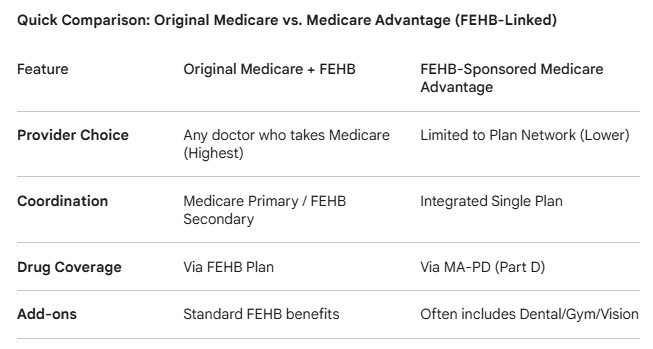
  • The Reality: Your FEHB plan already functions as your Medicare Supplement. When you have both, Medicare usually pays first, and your FEHB plan covers the remaining deductibles and coinsurance.

  • The Risk: Private Medigap plans can cost hundreds of dollars a month and often use medical underwriting. Paying for a private supplement while already paying FEHB premiums is essentially paying twice for the same "wraparound" protection.

2. Misunderstanding "Coordination of Benefits"

Many retirees fear they are "over-insured," but the synergy between FEHB and Original Medicare (Parts A and B) is powerful.

  • How it Works: Generally, Medicare becomes the primary payer, covering roughly $80\%$ of your outpatient costs. Your FEHB plan becomes the secondary payer.

  • The Benefit: In many cases, the coordination is so seamless that your out-of-pocket cost for a doctor’s visit or hospital stay drops to $0. This only works, however, if your providers accept "Medicare Assignment"—meaning they agree to the Medicare-approved price for services.

3. The "Small Print" in Medicare Advantage (MA)

Lately, OPM has encouraged carriers to offer Medicare Advantage "Part D" Employer Group Waiver Plans (MA-PD). These plans often offer "bells and whistles" like gym memberships, dental, and vision.

  • The Catch: These benefits often come with a restricted "provider network." If your favorite specialist isn't in that specific MA network, your costs could skyrocket.

  • The Decision: You can "suspend" FEHB to join a private MA plan, but most experts suggest staying within the FEHB-sponsored MA plans. Why? Because the government still pays roughly $72\%$ to $75\%$ of your premium, a subsidy you lose if you go to a purely private plan.

4. Part D and the 2026 Price Cap

As of 2026, the Inflation Reduction Act has significantly altered the landscape of prescription drug coverage (Part D).

  • Pertinent Info: The annual out-of-pocket cap for prescription drugs is now firmly set at $2,000.

  • The Error: Some retirees rush to sign up for a separate Part D plan, not realizing their FEHB drug coverage is already considered "creditable." If your current FEHB drug plan meets your needs, you might not need a separate Part D premium—unless you move to an MA-PD plan that includes it at no extra cost.


5. Timing: The Initial Enrollment Period (IEP)

You have a specific 7-month window to sign up for Medicare: the three months before you turn 65, your birth month, and the three months after.

  • The Penalty: If you miss this window and aren't still working, you may have to wait for the General Enrollment Period (January 1 – March 31).

  • The Sting: For every 12-month period you were eligible but didn't sign up for Part B, your premium increases by 10%—for the rest of your life.

6. Working Past 65: The Special Enrollment Period (SEP)

If you are still a "fed" at age 65, you don't have to sign up for Part B immediately. Your FEHB is considered primary coverage while you are an active employee.

  • The Window: Once you retire, you have an 8-month SEP to enroll in Part B without penalty.

  • Common Mistake: Retirees often confuse the "COBRA" rules with the "SEP" rules. For federal employees, the clock starts the moment you stop active service.

7. The IRMAA Surprise (Income-Related Adjustments)

The IRS and Medicare take a "look-back" at your tax returns from two years ago. If your income was high (e.g., from a large TSP withdrawal or a house sale), you may be hit with an Income-Related Monthly Adjustment Amount (IRMAA).

  • The Cost: This is a surcharge added to your Part B and Part D premiums. If you have a "life-changing event" (like retirement) that reduced your income, you can appeal this using Form SSA-44.

8. Ignoring "Medicare Assignment"

In Original Medicare, the price for a service is fixed.

  • Participating Providers: Agree to take exactly what Medicare pays.

  • Non-Participating Providers: Can charge up to an extra $15\%$ over the Medicare-approved amount (known as "excess charges").

  • The Error: Not checking if your doctor "accepts assignment" can result in you being billed for that extra $15\%$ out of your own pocket.

Financial Impact of Coinsurance

Under Original Medicare, your responsibility for Part B services is typically $20\%$.

$$\text{Patient Responsibility} = \text{Total Cost} \times 0.20$$

However, if your FEHB plan is active, it typically covers that $20\%$ for you, bringing your actual cost to $0.

Ultimately, securing your health benefits is only half the battle. Your Medicare strategy and your Thrift Savings Plan are deeply interconnected—one wrong withdrawal to pay a medical bill or a premium can accidentally trigger a higher tax bracket or an unwelcome IRMAA surcharge. Don't leave your hard-earned savings to chance or confusing fine print. At the end of the day, your retirement should be defined by the freedom you've earned, not the paperwork you've filed.


Ready to Optimize Your Federal Retirement?

If you want to ensure your TSP is working as hard as you did, let’s build a strategy that protects both your health and your wealth.

Contact us today for specialized TSP financial advice and let’s make sure your retirement strategy is as solid as your years of service.

6Lc_psgUAAAAAA9c7MediJBuq3wAxIyxDSt73c9j