Coronavirus Market Drop

It started in China, then spread to South Korea and Japan. Cruise ships have carried it; tourists have transported it. Now it’s in Italy and Iran, Thailand and Taiwan, and more countries besides. It has infected almost 80,000 people and been fatal to over 2,600.1

We are referring, of course, to the coronavirus.

COVID-19, as scientists call it, is a new strain of respiratory virus that can cause severe pneumonia and even death.  What started as a local outbreak in the Chinese city of Wuhan has rapidly become much more, and the markets are beginning to take it seriously.  On February 24, the Dow dropped over 1,000 points, and the S&P 500 over 100, after news broke that cases have surged in Italy and South Korea.2

Obviously, the human cost of an epidemic is more important than anything else.  But in addition to being a health crisis, COVID-19 also has the potential to create an economic crisis.  Viruses are small but insidious, and they can infect more than just people.

They can also infect supply chains.

This fact is what has investors – and even some of the world’s most powerful corporations – spooked.  As your financial advisors, we believe that it’s our job to explain why that is, as well as what we should do about it.

The Global Economy

There’s nothing like a virus to remind us that we are all connected.

To show what we mean, look at your phone for a moment. In a sense, you’re holding a miniature version of the world.  The screen you’re looking at probably came from Japan.  Your phone’s accelerometer likely came from Germany; the gyroscope, from Belgium.  The wi-fi chip may have come from Mexico, or perhaps Brazil; the audio chip, from the United States.

And your phone’s battery? That probably came from China.3

For a company like Apple to sell you an iPhone, they rely on the work of millions of people based in dozens of countries.  That is a supply chain, one of thousands of arteries that keep the world’s economy beating. A chain is only as strong as its weakest link, though. Imagine an epidemic breaks out near one link – a factory that produces widgets, for example.  Suddenly, people can’t go to work.

Manufacturing stops.  Fewer widgets are produced.

Somewhere down the chain, another factory makes gizmos – but they need widgets to do it. What happens when there aren’t enough widgets?  Soon, there won’t be enough gizmos, either.

And at the end of the chain, the company that turns the widget-powered gizmos into gadgets has fewer of those to sell. Which means they can’t reach their quarterly estimates, which means their stock price falls. As do the stock prices of the widget and gizmo manufacturers.

The result is a black day for the markets.  Like the one we had on February 24.

This is exactly what’s happening right now.  With one of the world’s largest economies, China is at the center of many, many supply chains. From electronics to blue jeans, the world relies on China for its resources and manpower.  But China is also at the center of the current outbreak, with over 77,000 confirmed cases and 2,500 deaths.1   This is why even companies like Apple and Adidas have recently admitted that COVID-19 will probably affect their bottom line.4&5

But the story doesn’t end there.

From Asia to Europe

The markets have long known about how the coronavirus could hamper global supply chains. But as long as the virus seemed limited to China, investors largely shrugged it off. That all started to change last week.

Take South Korea – small in terms of size, but a giant in terms of industry. On February 17, South Korea had 30 confirmed cases.6   Just one week later, there were over 800.1

Even more unnerving, to some analysists, is what’s going on in Northern Italy.  Last week, there were only a few reported cases. As of this writing, there are over 200, mainly centered in Lombardy, where some of the world’s most important carmakers are located.1   Officials have closed schools and put multiple towns on lockdown to keep the virus from spreading, but the fact that COVID-19 is now established on an entirely different continent is what’s causing fear.

Another cause of fear is that it’s not just supply chains and manufacturing being affected. Tourism, airlines, energy –many industries have seen a drop in business due to the coronavirus. And of course, the sheer fact that people have died is enough to make anyone wonder, “Should I be afraid, too?”

Let’s answer that right now.

Fear and financial decisions

Fear is at the heart of every market drop.  Usually, it’s fear of the unknown.  In this case, there are several unknowns for investors to contend with.  Why exactly is this virus spreading so fast? How far will it spread?  How long will it last? These are questions that no financial advisor can answer.

But fear, as we know, is a bad reason to make decisions. Fear of missing out, for example, often makes us behave too rashly. On the other side of the coin, fear of not getting out leads us to toss away opportunities or abandon the progress we’ve made to our goals.

Fortunately, whenever we feel fear, there are two tools that we can use to steady ourselves.

The first tool is history. Past performance, as you’ve no doubt heard many times, is no guarantee of future results. But past is also prologue, which means history can give us a good idea of what to expect in the future.  For example, here is how the S&P 500 performed over a 6-month period after other recent epidemics.7
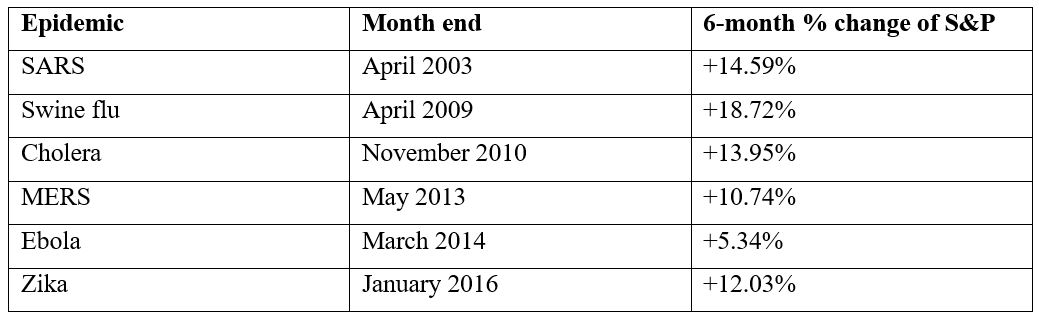
Now, these are all imperfect comparisons, as they dealt with different viruses, at different times, in different regions, in different contexts.  The point is that the markets, while occasionally impacted in the short term by epidemics, are rarely impacted over the long-term. And as we are investing to help you achieve your long-term goals, it’s the long-term that we care about.

The second tool, of course, is our own plan. You’ve probably heard us say this before, but we invest expecting volatility to happen. As your financial advisors, we can’t predict exactly when it will occur, nor always what will cause it. But we know that it will, so we are prepared for it.

This particular bout of volatility is coming after months of astonishing growth, and a correction has always been bound to happen at some point.  If it’s not coronavirus, it could be the trade war, or the U.S. presidential elections, or any of a dozen other things.

Over the coming weeks, we’ll probably see more scary-sounding headlines. It’s possible that COVID-19 could spread, and further disrupt the world economy.  It’s possible that should these things happen, the markets will drop – and then climb again when more positive headlines emerge the next day.  Coronavirus is unquestionably a serious issue of global importance, but it’s not worth panicking over. So, our advice is to not overreact to these day-to-day or even week-to- week swings.  To do that would be like playing whack-a-mole with your investments. Our team certainly won’t do that!

What we will do is continue to keep a very close eye on how the coronavirus is spreading, as well as how the world is handling it. If we ever feel that the long-term situation has changed, we may then make changes, too.  But in the meantime, let’s continue to be cautious, but never fearful, investors.

As always, please let us know if you have any questions or concerns.  We are always happy to help with both.  Have a great week!

Most Popular Financial Stories
Financial Advisor

Explanation of current positions

Several clients have told us they are a little overwhelmed by many of the new ETFs, and what their business model and investment objectives are.   Below is a short summary…

read more…
Happy Thanksgiving

Happy Thanksgiving

Wishing You a Happy Thanksgiving As Thanksgiving approaches, we pause to reflect on and appreciate the abundant blessings in our lives, especially the family and friends who…

read more…

SOURCES:

Will you be able to fly after October 1, 2020?

Did you know you will not be able to fly or access Federal facilities after October 1, 2020 without having your driver’s license updated to the federally mandated REAL ID?  

It is not mandatory that states update their driver's licenses, but citizens will not be able to use old style IDs to obtain admission into federal facilities and at airport security checkpoints run by the Department of Homeland Security.
Read more on the DHS website>>

Operation Valentine

To some people, the practice of exchanging valentines is great for children in elementary school, but it’s hardly something for adults. Right?

Well, one of the toughest, most resilient men you’ll ever meet doesn’t think that valentines are silly. And he should know – after all, he just received over 20,000 of them.1

The Oldest Marine

Major Bill White is a 104-year-old veteran of World War II, and perhaps the oldest Marine alive.1   He’s a Purple Heart recipient who fought at Iwo Jima, and later served in the Korean War as well.  These days, Major White lives in an assisted care facility in California and spends much of his time collecting memorabilia of the incredible life he has lived.

But as he looked over his collection, he decided there was something missing.  Something he dearly wanted to add.

He wanted a valentine.

So, another facility resident put a call out on social media.  Would anyone like to send this hero a card for Valentine’s Day?

Operation Valentine had begun.

Within days, the responses started pouring in.  Blankets, quilts, candy, and of course, cards. Many were homemade, with simple, heartfelt messages.  Some thanked Major White for his service.  Others described how their family members had served in the military, and why it meant the world to show their love for someone similar. Some cards came from the elderly; others were sent by children.  At first, his facility hoped for a few thousand cards.  They were blown away when they received tens of thousands.

Major White intends to save every single one.

“I’ll save every one of them…and they’ll be a personal part of my history,” he explains.2

When you look past the flower bouquets, candy hearts, and boxes of chocolate, I think this is what Valentine’s Day is really all about.  It’s a chance to tell someone, anyone, that they are loved, needed, and valued.  And while it’s true that we have 364 other days to do that, we all know busy life gets.  How demanding the world can be.  We all know how easy it is to let time go by.

So, sometimes, it’s good to have a day on the calendar to remind ourselves to send someone a valentine.  It could be a spouse or partner.  It could be a neighbor, teacher, or a local policeman. Or it could be the nearest 104-year-old Marine you can find. Because when you think about it, what is a valentine, really?  It’s more than a heart cut out of construction paper.  It’s more than a card in an envelope.

A valentine is love.

As for Major Bill White, he remains as tough as ever. He still wears the same uniform he’s had for over 60 years, and in his mind, he’s never stopped serving.

“I’ve been a Marine for 85 years now,” he says.  “So, if they feel like it, they could call me back on active duty anytime.  I’m still on the list.”1

On behalf of everyone at Research Financial Strategies, we hope you have a wonderful Valentine’s Day!


P.S.  If you want to send Major White a valentine, you can address it to:
Operation Valentine
ATTN: Hold for Maj Bill White, USMC (Ret) The Oaks at Inglewood
6725 Inglewood Ave.
Stockton, CA 95207

Most Popular Financial Stories

Financial Advisor

Explanation of current positions

Several clients have told us they are a little overwhelmed by many of the new ETFs, and what their business model and investment objectives are.   Below is a short summary…

read more…
Happy Thanksgiving

Happy Thanksgiving

Wishing You a Happy Thanksgiving As Thanksgiving approaches, we pause to reflect on and appreciate the abundant blessings in our lives, especially the family and friends who…

read more…

“104-year-old WWII vet receives thousands of cards for Valentine’s Day,” USA Today, January 26, 2020.  https://www.usatoday.com/story/news/nation/2020/01/25/wwii-vet-california-receives-nearly-100-k-valentines-day-   cards/4562457002/
“104-year-old Marine Corps veteran collecting Valentine’s Day cards,” Fox40, January 9, 2020.  https://fox40.com/2020/01/09/104-year-old-marine-corps-veteran-collecting-valentines-day-cards/

Looking at how the coronavirus outbreak is affecting the financial markets

By now, you’ve probably heard about the coronavirus outbreak in the Chinese city of Wuhan. As of this writing, there have been about 2,900 confirmed cases, with over 80 deaths.1 Most cases have been within China itself, but the virus has spread to a small number of individuals in over fifteen countries.

As you can imagine, the outbreak has put global markets on edge. On Monday, the Dow dropped over 450 points due to concerns about the virus’s spread.2 While there’s no reason to be alarmed, this is a good opportunity to remind ourselves why taking a longer view is so important. We’ll explain what we mean with a brief Q&A:

Q: I’ve been ignoring the news. Can you tell me what’s going on?
Quick recap. Coronavirus is actually a group of viruses that cause respiratory infections. For most people, these infections rarely amount to anything worse than a common cold. But sometimes, certain strains can be either more virulent, more transmissible, or both. Remember the SARS outbreak of 2003? That was also a type of coronavirus.

A new strain of coronavirus is behind the current outbreak. First identified in Wuhan at the beginning of the year, the virus is transmittable from person to person and can cause severe pneumonia, especially in the elderly and people with weak immune systems. The outbreak seems to have worsened in recent weeks, with travelers from China carrying the virus to multiple countries. In response, Wuhan has gone into lockdown, and many countries have evacuated their citizens.

 Q: Okay, so why are the markets worried about this?
The immediate concern is what the outbreak will do to China’s economy. As the second largest in the world, whenever China sneezes, other economies feel the wind. With a virus outbreak, analysts are worried about both slowing consumption and production, as well as dramatically reduced travel to and from China. All these things could impact the bottom-line of those countries and corporations that do business with China. (Which, of course, is most of them.)

The other concern is what will happen if this outbreak turns into a worldwide pandemic. We are not  scientists, but that seems more like a scenario for Hollywood screenwriters than investors. On the other hand, China’s decision to put a city of 11 million people on lockdown is a good indicator that they are taking the problem seriously and don’t want it to get worse.

As always, the real culprit here is uncertainty.  No one knows for certain how long the outbreak will last, how bad it will get, how far it will spread, or how it will impact economic growth. The natural instinct, then, is to shut the doors, draw the blinds, stick the money under the mattress, and wait for the storm to blow over. That’s exactly what we’re seeing some investors do right now.

 Q: Is that what we should do?
No! While natural instincts are great if you’re trying to avoid getting eaten by tigers, they’re not so helpful with making investment decisions.

Make no mistake, viral outbreaks can have an impact on the global economy. Certain sectors of the markets, like travel, energy, and retail, could be in for a few weeks – or months – of headaches. For example, let’s go back to the SARS outbreak of 2003. In that case, SARS is estimated to have cost the world economy $40 billion.3 The S&P 500 dropped 8.3% during that time, and many other stock markets suffered large losses, too.4

But there are two things to remember here.

First, the current outbreak is nowhere near what SARS was. Back then, nearly 800 people died in 17 different countries, and over 8,000 people were infected.3 As of now, this virus is neither as widespread nor as deadly. Furthermore, humanity’s ability to respond to it is much greater than it was 17 years ago. The situation can change, of course, but until it does, it’s important we keep a sense of perspective.

The second thing to remember is that the effect SARS had on the market was temporary. After hitting its low in February of 2003, the S&P then went on a tear, finishing up 26% for the year.5 This is in keeping with how global events usually affect the markets: A short, sometimes steep slide as investors try to figure out what’s going on, followed by a longer climb. Generally speaking, it takes long-term trends, or major changes to the economy’s fundamentals, to make long-term changes in the direction of the markets.

 Q: So, what should we do about all this?
For the people directly affected by the outbreak, and for the heroic men and women combatting it, coronavirus is a serious issue. For us, this is an opportunity to remember why we shouldn’t overreact to headlines. While headlines can be unsettling, they very rarely require us to make changes to our investment strategy. For that reason, the best thing we can do is to mentally prepare ourselves for more volatility should this outbreak worsen. Of course, mental preparation and emotional discipline are two of the best things we can practice as investors, in rain or shine, in sickness and in health. But in the meantime, for us here at Research Financial Strategies, it’s business as usual. We hope it is for you, too.

As always, please let us know if you have any questions or concerns.  We are always happy to be of service.
Have a great February!

Most Popular Financial Stories

Financial Advisor

Explanation of current positions

Several clients have told us they are a little overwhelmed by many of the new ETFs, and what their business model and investment objectives are.   Below is a short summary…

read more…
Happy Thanksgiving

Happy Thanksgiving

Wishing You a Happy Thanksgiving As Thanksgiving approaches, we pause to reflect on and appreciate the abundant blessings in our lives, especially the family and friends who…

read more…

Investment advice offered through Research Financial Strategies, a registered investment advisor.

1 “Tracking coronavirus,” BNO News, https://bnonews.com/index.php/2020/01/the-latest-coronavirus-cases/
2 “Dow Drops Over 450 Points on Coronavirus Fears,” The Wall Street Journal, https://www.wsj.com/articles/global-stocks-slide-on-coronavirus-fears-11580119666?mod=hp_lead_pos2
3 “SARS wiped $40 billion off world markets,” NBC News, https://www.nbcnews.com/business/markets/sars-wiped-40-billion-world-markets-what-will-coronavirus-do-n1122151
4 “A History of Coronavirus Outbreaks and the Stock Market,” Yahoo Finance, https://finance.yahoo.com/news/history-coronavirus-outbreaks-stock-market-204520997.html
5 “S&P 500 Historical Annual Returns,” Macro Trends, https://www.macrotrends.net/2526/sp-500-historical-annual-returns

Keeping focused on our New Year’s resolutions

Keeping focused on our New Year’s resolutions

featuring the Aesop fable, “The Dog and His Reflection.”

As you know, this is a time of year when many people make New Year’s resolutions. Lose weight, stop smoking, save more, learn a new skill, get more sleep, visit a new place, get finances in order, etc. You name it, chances are, someone has resolved to do it.

As financial advisors, people often come to us for help with any financial resolutions they have – or resolutions that require some change in their financial situation to achieve. But often, people come only after they have tried and failed to keep those same resolutions on their own.

This got us thinking: Why are New Year’s resolutions so hard to keep? In most cases, our resolutions are good for us. We want to do them. So why aren’t they easier?

There are many reasons for this, but one of the most important can be best explained by Aesop’s classic fable about…

The Dog and His Reflection

It happened that a Dog, after much hunger and long labor, had finally procured for himself a chunk of meat, and was carrying it home in his mouth to eat in peace. On his way home, the Dog had to cross a fallen tree trunk lying across a running brook. As he crossed, he looked down and saw his own reflection in the water beneath. Thinking it was another dog with an equally large piece of meat, he made up his mind to have that also. So, he snapped at the reflection in the water. But as he opened his mouth, his own meat slipped out, fell into the brook, and was never seen by the Dog again.

While some have interpreted this fable to be a warning against greed, we look at it a little differently. Despite being halfway to his goal – enjoying a nice meal – the Dog became distracted by a different goal, and in pursuing that, lost sight of his own.

In our experience, this happens to most of us every year. We set a goal we want to achieve, something we truly care about. But it takes time to accomplish our resolutions, and it’s very easy to get distracted by the newest, shiniest things. For example, imagine someone resolves to save $200 per week, so that they can finally take that trip to the Caribbean they’ve always dreamed of.

But after doing this for three months, they see another person enjoying the latest iPhone that came out, so they decide to go for that instead. After all, the Caribbean will always be there. So, they spend all the money they’ve saved – and suddenly, they’ve sabotaged their own resolution.

This happens on a larger scale, too. we’ve seen people who dream of a retirement spent in the sun…only to go chasing shadows instead. We’ve seen people with grand plans to start their own business one day…only to spend their time watching television.

Of course, there’s nothing wrong with buying a new iPhone or relaxing in front of the TV. But to truly change our lives for the better, we must learn discipline. We must hold ourselves accountable.
We must keep our eye on what’s truly important, and not be distracted by reflections.

There are several ways we can do that. Here are a few we’ve found to be especially helpful:

  1. Be specific with your resolutions. People who set specific goals are more likely to achieve them. For example, instead of resolving to save money, resolve to save $200 per week.
  2. Put it in writing. Write down your resolutions and post them in a place where you will see them every day. This will help remind you of what you’re working towards, so you won’t end up like the Dog in the fable.
  3. Set realistic goals. Set goals that are within your reach, and don’t try to take on too much at once. Be mindful of your finances and schedule. Account for the fact that sometimes, you need to kick back and relax or spend money on a whim. In addition, take your time. There’s no prize for finishing first, and anyway, to quote another one of Aesop’s fables, slow and steady wins the race.
  4. Develop a plan. This is so important. Create a timeline with steps toward your goal. Set deadlines for each and cross them off as you go. This will help you generate both the momentum and the motivation you need to continue.
  5. Ask for help. Whether it’s with a financial professional or a life coach, if you find yourself struggling to reach your goals, don’t think you need to do it alone! Find someone who can help keep you focused and accountable.
  6. Reward yourself. Acknowledge even the smallest of achievements. Keeping resolutions is hard work, and you should be proud of everything you accomplish!


Regardless of what you do, always remember The Dog and His Reflection. It can make all the difference.

Good luck, and have a wonderful year!

Are you looking for a financial advisor?  Do you feel confident about your retirement account decisions? Business owner looking for a company 401K plan administrator? Or an athlete or high net worth individual needing long term financial planning advice? Research Financial Strategies can help. We are here to help you design a financial strategy that is molded specifically for you. One that changes as your life changes. Financial investments to help you live worry-free now and in the future.

In our experience, we've found that the most successful solutions begin by asking the right questions.
We gain a broader perspective of your goals and the future you wish to create

Today is a Good Day to Start Your Financial Plan

1. We Listen

Our focus is on your life and priorities. Not just your portfolio. That’s why we start by listening and learning about you. Each individual client has different needs and concerns that need to be addressed. We carefully listen to those concerns. We will gain important information that will help us to best serve our clients and help protect their financial futures.

2. Plan

Together we will work to implement the plan that was developed for you. We will keep you constantly updated on what is happening and evolve our plan as your life happens.
Above all, our advisors want to help you meet your goals, even if that means helping you find out what your goals are.

3. We Take Care Of The Rest

We are here for you whenever you need us. Call your Research Financial Strategies Financial Advisor at any time, for any reason. You will always have access to the guidance you need whether it is high tech, high touch or a combination of the two. Your personal Financial Advisor will help you figure out how to pay for life’s great adventures!


Ready to Make a Change?

With an “education first” approach, Research Financial Strategies ensures that our clients understand how their money is being invested, and we guide the development of financial plans that help them achieve their goals for personal wealth and retirement security.

How Can We Help?

Annuities, Potomac, Annuity, Bethesda,  Annuity Advisor, Rockville, 

Nine Vince Lombardi quotes and how they apply to your life

Nine Vince Lombardi Quotes

and how they apply to your life!

Happy New Year!

We hope 2020 is a great year for you, and the start of an even greater decade!

Fifty years ago, Vince Lombardi coached his last football game. Lombardi is universally recognized as one of the greatest coaches in football history, as well as a pioneering figure who helped break the sport’s color barrier. These days, however, Lombardi is equally remembered for his famous aphorisms about winning, teamwork, and perseverance.

For most of us, a New Year means new goals and resolutions. That’s why we thought it would be interesting to look at some of Lombardi’s most famous maxims.1 As financial advisors, we find them both inspiring and educational, because many can be applied not just to football success, but financial success. As you work towards the resolutions you set this year, keep these quotes in mind. Applying them may just make the difference between a resolution kept and a resolution abandoned.

So, without further ado, here are:

Nine Vince Lombardi Quotes

for goals, finances, life, and everything in between

  1. “The only place success comes before work is in the dictionary.”

When we think of all the people we’ve known who set ambitious goals and reached them, we are amazed by their work ethic. In many cases, the people who are most likely to reach their goals are the ones for whom the journey is the greatest reward.

  1. “Inches make champions.”

This is so true. When we commit ourselves to do just a little bit extra, when we never settle for eleven inches when twelve is what we want, those inches compound on themselves, and we can accomplish so much more. 

  1. “Once you learn to quit, it becomes a habit.”
  2. “Winning is a habit. Watch your thoughts, they become your beliefs. Watch your beliefs, they become your words. Watch your words, they become your actions. Watch your actions, they become your habits. Watch your habits, they become your character.”

The historian Will Durant once wrote, “We are what we repeatedly do. Excellence is not an act, but a habit.” As we pursue our goals in 2020 and beyond, it’s often best to focus on progressing just a little each day rather than trying to do too much, too quickly. The former is sustainable. The latter isn’t. 

  1. “The measure of who we are is what we do with what we have.”
  2. “The quality of a person’s life is in direct proportion to their commitment to excellence, regardless of their chosen field of endeavor.”

Just as none of us have the same goals in life, none of us have the same path to those goals. Some people begin the journey with more or less than others. Some people have more or less support than others. Some people set ambitious goals; others set more modest ones. But what truly matters, in the end, is not how much money we’ve earned or how many accolades we’ve gained. What matters is how well we spent the time given to us.

Life is an investment. If you put in all you have, you’ll take out even more. 

  1. “People who work together will win, whether it be against complex football defenses, or the problems of modern society.”

Another truth. Just as no one is an island, no one, not even the most self-reliant, achieves their goals entirely on their own. We all need a team to support and be supported by. Sometimes that team is our own family. Sometimes it’s the professionals we choose to partner with. Whoever it is, when we surround ourselves with honest, caring, and hard-working people, it becomes so much easier to be all those things, too. 

  1. “It’s not whether you get knocked down. It’s whether you get back up.”

Probably Lombardi’s most famous quotation, and for good reason. Whether it’s a New Year’s Resolution or a life-long goal, every single one of us will face setbacks. Every single one of us will fail – often more than once. But life is like football in a sense. We always have the opportunity to take the field again. Those who do will triumph in the end.

  1. “If you’ll not settle for anything less than your best, you will be amazed at what you can accomplish in your life.”

Our favorite quote of all. As you set new goals and resolutions, always lift your eyes to your highest dream. Believe me, it’s within your reach.

It’s always been within your reach.

We hope you have a Happy New Year – and an even happier new decade!

Please let us know if there is ever anything more we can do to help you work towards your goals and resolutions.  

Most Popular Financial Stories

Financial Advisor

Explanation of current positions

Several clients have told us they are a little overwhelmed by many of the new ETFs, and what their business model and investment objectives are.   Below is a short summary…

read more…
Happy Thanksgiving

Happy Thanksgiving

Wishing You a Happy Thanksgiving As Thanksgiving approaches, we pause to reflect on and appreciate the abundant blessings in our lives, especially the family and friends who…

read more…

1 “Famous Quotes by Vince Lombardi,” http://www.vincelombardi.com/quotes.html

6Lc_psgUAAAAAA9c7MediJBuq3wAxIyxDSt73c9j