TSP Audit Checklist

1. Contribution & Matching Audit

  • [ ] Verify the 5% Floor: Ensure you are contributing at least 5% of your basic pay to capture the full 4% agency match and 1% automatic contribution. Don't leave free money on the table.

  • [ ] Recalculate Your Paycheck Math: If you want to hit the new 2026 limit of $24,500 exactly over 26 pay periods, update your payroll deduction to $943 per paycheck.

  • [ ] Check Catch-Up Eligibility: If you are age 50 or older (or will turn 50 this year), are you utilizing the standard $8,000 catch-up? If you are between 60 and 63, are you utilizing the $11,250 "Super Catch-Up"?

2. Tax & Roth Strategy Audit

  • [ ] The High-Earner Rule: If your 2025 wages were over $150,000, confirm that your 2026 catch-up contributions are being routed to the Roth TSP (as now required by the IRS).

  • [ ] Evaluate In-Plan Conversions: Look at your current Traditional TSP balance and determine if initiating an In-Plan Roth Conversion makes sense for your tax bracket this year.

  • [ ] Check Your Tax Bucket Mix: Are you actively splitting your contributions between Traditional (pre-tax) and Roth (after-tax) to give yourself "tax flexibility" in retirement?

3. Investment & Diversification Audit

  • [ ] Review Your Asset Allocation: Are you too conservative for your age? Use the rule of thumb ($120 - \text{Your Age}$) to see if your exposure to the C, S, and I stock funds matches your timeline.

  • [ ] The Lifecycle (L) Fund Check: If you are in an L Fund, does it still match your personal tolerance for risk? Or has it shifted too conservatively, too quickly for your liking?

  • [ ] Rebalance Your Portfolio: If market shifts over the last year have left you too heavy in one sector, reset your target allocations to smooth out your ride.

4. Legacy & Paperwork Audit

  • [ ] Verify Your Beneficiaries: Life changes (marriage, divorce, births). Log into your TSP account and ensure your Form TSP-3 (Designation of Beneficiary) is completely up-to-date. (Remember, your Will does not override your TSP beneficiary designations!).

  • [ ] Consolidate Old Accounts: Do you have orphan 401(k)s or 403(b)s sitting with old employers? Consider rolling them into your current TSP to keep your investment tracking simple and your fees low.

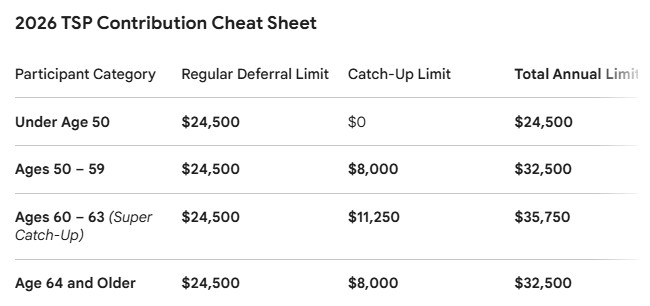
2026 TSP Contribution Cheat Sheet

Here is a 2026 TSP Contribution Cheat Sheet designed to be easily scannable for your readers. This is a high-value resource they can save or print to ensure they are maximizing their benefits under the latest SECURE 2.0 regulations.

2026 TSP Contribution

3 Critical Rules for 2026

  1. The $150k Roth Mandate: If your prior-year (2025) wages exceeded $150,000, the IRS now requires all catch-up contributions to be made to the Roth TSP. You can no longer make pre-tax catch-up contributions if you are in this high-earner bracket.

       2. No More Roth RMDs: Starting in 2024 and continuing through 2026, you are no longer required to take Required Minimum Distributions (RMDs) from your Roth TSP balance while you are alive. This allows your tax-free bucket to grow indefinitely.

        3. In-Plan Conversions: You now have the ability to move existing Traditional TSP balances into a Roth balance via an In-Plan Roth Conversion. This is a powerful "tax-locking" tool, but it must be handled carefully to avoid a massive tax bill in a single year.

Pro Tip: To hit the $24,500 limit exactly over 26 pay periods, set your contribution to $943 per paycheck. If you are 50+ and want to hit the full $32,500, aim for $1,250 per paycheck.


2026 TSP Frequently Asked Questions

2026 TSP Frequently Asked Questions: Navigating the New Rules

The Thrift Savings Plan is undergoing its most significant transformation in years. Here are the answers to the most common questions federal employees are asking in 2026.

What are the TSP contribution limits for 2026?
For the 2026 calendar year, the elective deferral limit has increased to $24,500. If you are age 50 or older, you can contribute an additional $8,000 in catch-up TSP contributions, bringing your total potential savings to $32,500.

How does the TSP "Super Catch-Up" work for ages 60–63?
Under SECURE 2.0, participants who turn 60, 61, 62, or 63 in 2026 are eligible for a higher catch-up limit of $11,250. When combined with the standard TSP limit, these "Super Catch-Up" eligible employees can contribute a total of $35,750 this year. Once you turn 64, your limit reverts to the standard catch-up amount.

I heard TSP catch-up contributions must be Roth now. Is that true?
Only for high earners. Starting in 2026, if your wages from the previous year (2025) exceeded $150,000, the law requires your catch-up contributions to be made to the Roth (after-tax) TSP. If you earn below this threshold, you can still choose between Traditional or Roth for your catch-up funds.

Can I finally move my Traditional TSP balance into a Roth account?
Yes! As of late January 2026, the TSP has officially launched In-Plan Roth Conversions. You can now move money from your Traditional (pre-tax) balance to your Roth (after-tax) balance without leaving the TSP.

  • The Catch: You must pay ordinary income tax on the converted amount in the year of the move, and you cannot use TSP funds to pay that tax bill—it must come from outside savings.


    Are Roth TSP balances subject to Required Minimum Distributions (RMDs)?
    No. One of the best changes for 2026 is that Roth TSP balances are no longer subject to RMDs during the owner’s lifetime. This allows your Roth money to stay in the plan and continue growing tax-free for as long as you live, mirroring the rules for private Roth IRAs.


What happens to my Agency TSP Match?
FERS and BRS participants still receive the 1% automatic and 4% matching contributions. A new feature for 2026 is the ability to convert your agency matching funds into Roth via the in-plan conversion tool, though these matches initially land in your Traditional balance first for tax-reporting purposes.

Top Thrift Savings Plan Mistakes to Avoid for Federal Workers

Federal employees have a unique advantage when planning for their post-career years: they typically receive a guaranteed pension through FERS or CSRS, alongside a Thrift Savings Plan (TSP). However, unlike a guaranteed pension, your TSP is a defined contribution plan. This means the money can run out if it isn't managed properly. To preserve and maximize your retirement wealth, it is essential to steer clear of these ten common TSP missteps.

1. Rolling Over to High-Fee IRAs  Many private financial advisors will encourage you to move your TSP funds into an Individual Retirement Account (IRA) under their management. What they often gloss over are the hidden expenses. The TSP is renowned for having some of the lowest administrative fees in the investment world, with zero commissions. Transferring your balance to a private IRA usually subjects your money to custodial fees and maintenance charges that actively eat away at your long-term returns.

2. Forgetting About Old 401(k) Accounts  When transitioning from the private sector to federal service, it is easy to leave old 401(k) accounts sitting idle with former employers. Neglecting these accounts can derail your overarching financial goals, as their asset allocations might no longer suit your timeline. A smarter move is often to consolidate your accounts by rolling those previous retirement funds directly into your TSP.

3. Coasting on the Default Contribution Rate  New hires are automatically set up to contribute 5% of their pay to the TSP, which allows them to capture the full agency match. However, assuming this baseline is enough to fund a comfortable retirement is a massive oversight. Financial experts broadly agree that individuals should be saving about 15% of their total income for retirement. To hit this target, federal employees should aim to contribute at least 10% from their own paychecks, which, combined with the 5% government match, hits that 15% sweet spot.

4. Panic Selling During Market Dips  When the stock market takes a dive—such as during the onset of the 2020 pandemic—some participants panic and move their assets out of the C, S, and I stock funds and into the ultra-safe G fund. This emotional reaction violates the core rule of investing: you end up selling low. Furthermore, panic sellers almost always miss the eventual market rebound, leaving their portfolios in a much worse position than those who simply stayed the course.

5. Taking Massive Lump-Sum Withdrawals  Cashing out your entire traditional TSP as soon as you retire is an incredibly costly mistake. Because traditional TSP funds have not yet been taxed, a lump-sum withdrawal is treated as ordinary income. A massive withdrawal could instantly catapult you into the highest federal tax bracket, saddle you with massive state income taxes, and permanently end the tax-deferred growth of your savings.

6. Playing it Too Safe in Your Youth  While older workers should rightfully transition to safer investments, young and mid-career feds often miss out on massive gains by avoiding the stock-based C, S, and I funds. Over 20- to 30-year timelines, stocks historically outperform bonds. A common rule of thumb for moderate growth is to subtract your current age from 120; the resulting number is the percentage of your portfolio that should be invested in stocks rather than conservative bond funds.

7. Waiting Until Mid-Career to Start Saving  Holding off on serious TSP contributions until you are in your 40s or 50s forces you to play an incredibly difficult game of catch-up. The greatest asset a retirement account has is time. Starting your contributions early allows you to harness the power of compound interest, making it exponentially easier to build a sizable nest egg compared to cramming your savings into the last decade of your career.

8. Failing to Diversify Your Holdings  To keep things simple, some TSP participants will dump all of their money into just one stock fund or one bond fund. This lack of diversification makes your portfolio unnecessarily vulnerable to market volatility. By spreading your investments across the various stock and bond funds the TSP offers, you can buffer your savings against sudden economic shocks.

9. Canceling Your Automatic Enrollment  Upon hiring, federal workers are automatically enrolled to contribute 5% of their paycheck to the TSP. Opting out of this automatic enrollment is one of the worst financial decisions a new employee can make. Not only does it halt your tax-advantaged compounding growth before it even starts, but it also means you are actively turning down the free "matching" money provided by your agency.

10. Blindly Trusting Lifecycle (L) Funds  Lifecycle (L) funds are fantastic for beginners because they automatically shift your investments from aggressive stocks to conservative bonds as you get closer to retirement. However, they rely on a one-size-fits-all formula. As you grow more experienced and approach retirement, relying completely on an L fund without factoring in your personal risk tolerance and specific financial situation can result in a portfolio that doesn't properly align with your actual needs.


Managing your Thrift Savings Plan isn't just about picking a fund and crossing your fingers—it requires a proactive strategy, especially with the major shifts hitting in 2026. Whether you're navigating the new $24,500 contribution limits, deciding if the $11,250 "super catch-up" for ages 60–63 applies to you, or weighing the benefits of the brand-new in-plan Roth conversions, there is a lot to get right. You don't have to guess your way through your golden years; one of our TSP advisors can ensure your TSP is working optimally for you now and in retirement.

Top Thrift Savings Plan Mistakes to Avoid for Federal Workers

Federal employees have a unique advantage when planning for their post-career years: they typically receive a guaranteed pension through FERS or CSRS, alongside a Thrift Savings Plan (TSP). However, unlike a guaranteed pension, your TSP is a defined contribution plan. This means the money can run out if it isn't managed properly. To preserve and maximize your retirement wealth, it is essential to steer clear of these ten common TSP missteps.

1. Rolling Over to High-Fee IRAs  Many private financial advisors will encourage you to move your TSP funds into an Individual Retirement Account (IRA) under their management. What they often gloss over are the hidden expenses. The TSP is renowned for having some of the lowest administrative fees in the investment world, with zero commissions. Transferring your balance to a private IRA usually subjects your money to custodial fees and maintenance charges that actively eat away at your long-term returns.

2. Forgetting About Old 401(k) Accounts  When transitioning from the private sector to federal service, it is easy to leave old 401(k) accounts sitting idle with former employers. Neglecting these accounts can derail your overarching financial goals, as their asset allocations might no longer suit your timeline. A smarter move is often to consolidate your accounts by rolling those previous retirement funds directly into your TSP.

3. Coasting on the Default Contribution Rate  New hires are automatically set up to contribute 5% of their pay to the TSP, which allows them to capture the full agency match. However, assuming this baseline is enough to fund a comfortable retirement is a massive oversight. Financial experts broadly agree that individuals should be saving about 15% of their total income for retirement. To hit this target, federal employees should aim to contribute at least 10% from their own paychecks, which, combined with the 5% government match, hits that 15% sweet spot.

4. Panic Selling During Market Dips  When the stock market takes a dive—such as during the onset of the 2020 pandemic—some participants panic and move their assets out of the C, S, and I stock funds and into the ultra-safe G fund. This emotional reaction violates the core rule of investing: you end up selling low. Furthermore, panic sellers almost always miss the eventual market rebound, leaving their portfolios in a much worse position than those who simply stayed the course.

5. Taking Massive Lump-Sum Withdrawals  Cashing out your entire traditional TSP as soon as you retire is an incredibly costly mistake. Because traditional TSP funds have not yet been taxed, a lump-sum withdrawal is treated as ordinary income. A massive withdrawal could instantly catapult you into the highest federal tax bracket, saddle you with massive state income taxes, and permanently end the tax-deferred growth of your savings.

6. Playing it Too Safe in Your Youth  While older workers should rightfully transition to safer investments, young and mid-career feds often miss out on massive gains by avoiding the stock-based C, S, and I funds. Over 20- to 30-year timelines, stocks historically outperform bonds. A common rule of thumb for moderate growth is to subtract your current age from 120; the resulting number is the percentage of your portfolio that should be invested in stocks rather than conservative bond funds.

7. Waiting Until Mid-Career to Start Saving  Holding off on serious TSP contributions until you are in your 40s or 50s forces you to play an incredibly difficult game of catch-up. The greatest asset a retirement account has is time. Starting your contributions early allows you to harness the power of compound interest, making it exponentially easier to build a sizable nest egg compared to cramming your savings into the last decade of your career.

8. Failing to Diversify Your Holdings  To keep things simple, some TSP participants will dump all of their money into just one stock fund or one bond fund. This lack of diversification makes your portfolio unnecessarily vulnerable to market volatility. By spreading your investments across the various stock and bond funds the TSP offers, you can buffer your savings against sudden economic shocks.

9. Canceling Your Automatic Enrollment  Upon hiring, federal workers are automatically enrolled to contribute 5% of their paycheck to the TSP. Opting out of this automatic enrollment is one of the worst financial decisions a new employee can make. Not only does it halt your tax-advantaged compounding growth before it even starts, but it also means you are actively turning down the free "matching" money provided by your agency.

10. Blindly Trusting Lifecycle (L) Funds  Lifecycle (L) funds are fantastic for beginners because they automatically shift your investments from aggressive stocks to conservative bonds as you get closer to retirement. However, they rely on a one-size-fits-all formula. As you grow more experienced and approach retirement, relying completely on an L fund without factoring in your personal risk tolerance and specific financial situation can result in a portfolio that doesn't properly align with your actual needs.

Managing your Thrift Savings Plan isn't just about picking a fund and crossing your fingers—it requires a proactive strategy, especially with the major shifts hitting in 2026. Whether you're navigating the new $24,500 contribution limits, deciding if the $11,250 "super catch-up" for ages 60–63 applies to you, or weighing the benefits of the brand-new in-plan Roth conversions, there is a lot to get right. You don't have to guess your way through your golden years; one of our TSP advisors can ensure your TSP is working optimally for you now and in retirement.

6Lc_psgUAAAAAA9c7MediJBuq3wAxIyxDSt73c9j