Market Commentary – April 15, 2019

Investors took an intermission.
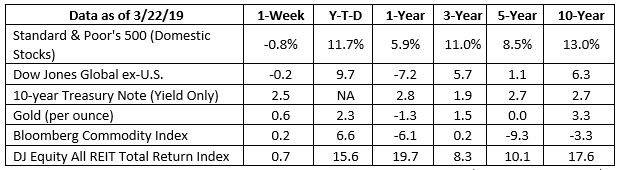
The curtain appeared to close on the first act of 2019 last week – and what an impressive act it was. The Standard & Poor’s 500 Index delivered some dramatic returns and is less than 1 percent away from a new all-time high.

Despite relatively few shares changing hands, major U.S. indices eked out gains. Ben Levisohn of Barron’s explained:
“Trading volume was tepid at best. This past Monday, fewer shares changed hands than on any day since December 24 – when the market closed early for Christmas. Tuesday’s volume was lower than Monday’s, Wednesday’s was lower than Tuesday’s, and…well, you get the point. That was just another sign that no one wanted to place any big bets on the market this past week – in either direction.”

Investors were complacent even though news suggested trade talks with China were progressing well. They remained unruffled in the face of a Presidential tweet suggesting the United States will impose tariffs on Europe in retaliation for illegal subsidies to a European aerospace firm.

There was another interesting development in the United States last week. It was widely reported that a number of companies in retail and banking sectors increased entry-level hourly wages to levels well above the national minimum wage of $7.25 an hour. The companies are paying $13 to $20 an hour, according to Renae Merle of The Washington Post and a report from Reuters.

That is good news for workers, but not such good news for investors since higher wages could lead to lower corporate profits, reported Joe Wallace and Akane Otani of The Wall Street Journal.

Thought required. People make everyday decisions based on the information they possess at any given moment, explained The Economist. As understanding of an issue changes, so do the decisions people make.

For example, a lot of people dislike plastic grocery bags. Many shoppers choose to take cloth bags to the grocery store rather than use plastic bags provided by the store. In fact, some 240 cities and counties have laws that ban or tax plastic bags, according to Planet Money, and there is a national movement afoot to ban the bags.

However, the economics of plastic grocery bags is not as straightforward as many believe. Banning plastic bags appears to be an effective solution to a serious environmental issue. Unfortunately, it is not. An Australian economist studied the effects of plastic bag bans and discovered bans helped and hurt the environment:

  • The good news: Cities with bans used fewer plastic bags, and 40 of those cities generated about 40 million fewer pounds of plastic trash annually.
  • The bad news: Sales of plastic garbage bags increased by 120 percent after the ban, possibly because people reused grocery bags to line trashcans and clean up after dogs. Since trash bags are made of heavier plastic than grocery bags, about 30 percent of the plastic trash gains associated with the bans were lost.

In addition, paper bag use rose, creating 80 million pounds of paper trash annually. Paper is biodegradable and can be composted; however, producing paper bags requires water, fuel, and trees, so that should be considered as well, reported Stanford Magazine.

A separate study conducted by the Danish government found, “The most environment-friendly way to carry groceries is to use the same bag over and over again…the best reusable ones are made from polyester or plastics like polypropylene.”

Weekly Focus – Think About It
Monday, April 15 is tax day in the United States. Below is an excerpt from a radio show:
“Vanek Smith: Joe and his California tax team are eating lunch and talking shop. And they tell Joe they have this idea, an idea they think would save California a bunch of money and time and help taxpayers. They say, most people in California have really simple taxes. They get all of their income from a regular paycheck, and taxes are already withheld from those paychecks.

Bankman: So their idea was – why don’t we start off giving them a tax return that’s already filled out with the income we know they have? And then they can make corrections on it. That was their idea…

Vanek Smith: So they did a pilot program in California. In the 2004 tax season, they sent [completed forms] out to about 11,000 taxpayers along with this little survey.

Bankman: So we asked people, do you think you’d like to use this again next year? And 99 percent of the people said yes. Ninety-nine percent of people don’t say yes to anything.”
–Joseph Bankman, Stanford Professor of Law and Business and Stacey Vanek Smith, Planet Money radio host

Best regards,
John F. Reutemann, Jr., CLU, CFP®

P.S.  Please feel free to forward this commentary to family, friends, or colleagues. If you would like us to add them to the list, please reply to this email with their email address and we will ask for their permission to be added.

Investment advice offered through Research Financial Strategies, a registered investment advisor.
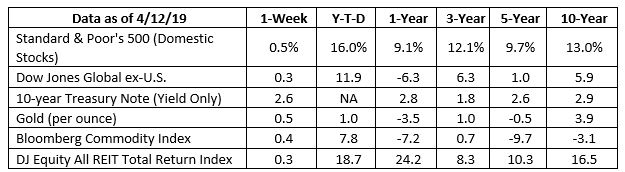
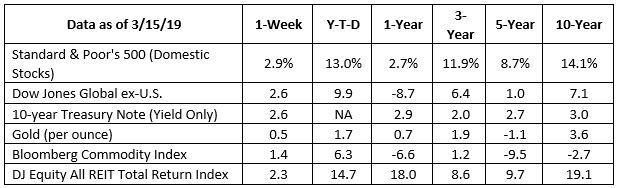
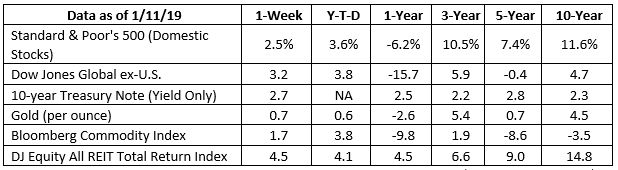
S&P 500, Dow Jones Global ex-US, Gold, Bloomberg Commodity Index returns exclude reinvested dividends (gold does not pay a dividend) and the three-, five-, and 10-year returns are annualized; the DJ Equity All REIT Total Return Index does include reinvested dividends and the three-, five-, and 10-year returns are annualized; and the 10-year Treasury Note is simply the yield at the close of the day on each of the historical time periods.
Sources: Yahoo! Finance, Barron’s, djindexes.com, London Bullion Market Association.
Past performance is no guarantee of future results. Indices are unmanaged and cannot be invested into directly. N/A means not applicable.

Most Popular Financial Stories

The Cracking Foundation of the American Consumer

The Shifting Ground of the American Consumer: Finding Opportunity in Change The economic landscape is undergoing a significant transformation, and understanding these shifts is key to positioning your portfolio for what comes next. While headline numbers often mask…

read more…

Explanation of current positions

Several clients have told us they are a little overwhelmed by many of the new ETFs, and what their business model and investment objectives are.   Below is a short summary of all the ETFs currently in the growth model as of today.  If you have any questions, please…

read more…

Rate Cut Ahead: Is Your Income Strategy Ready?

Rate Cut Ahead: Is Your Income Strategy Ready? With the Federal Reserve now signaling an 87% chance of cutting interest rates at its upcoming meeting, it is crucial to assess how this shift could impact your financial future—especially if you rely on your portfolio…

read more…

Happy Thanksgiving

Wishing You a Happy Thanksgiving As Thanksgiving approaches, we pause to reflect on and appreciate the abundant blessings in our lives, especially the family and friends who enrich our days. We look forward with great anticipation to the coming year and the entire…

read more…

* Government bonds and Treasury Bills are guaranteed by the U.S. government as to the timely payment of principal and interest and, if held to maturity, offer a fixed rate of return and fixed principal value.  However, the value of fund shares is not guaranteed and will fluctuate.
* Corporate bonds are considered higher risk than government bonds but normally offer a higher yield and are subject to market, interest rate and credit risk as well as additional risks based on the quality of issuer coupon rate, price, yield, maturity, and redemption features.
* The Standard & Poor’s 500 (S&P 500) is an unmanaged group of securities considered to be representative of the stock market in general. You cannot invest directly in this index.
* All indexes referenced are unmanaged. Unmanaged index returns do not reflect fees, expenses, or sales charges. Index performance is not indicative of the performance of any investment.
* The Dow Jones Global ex-U.S. Index covers approximately 95% of the market capitalization of the 45 developed and emerging countries included in the Index.
* The 10-year Treasury Note represents debt owed by the United States Treasury to the public. Since the U.S. Government is seen as a risk-free borrower, investors use the 10-year Treasury Note as a benchmark for the long-term bond market.
* Gold represents the afternoon gold price as reported by the London Bullion Market Association. The gold price is set twice daily by the London Gold Fixing Company at 10:30 and 15:00 and is expressed in U.S. dollars per fine troy ounce.
* The Bloomberg Commodity Index is designed to be a highly liquid and diversified benchmark for the commodity futures market. The Index is composed of futures contracts on 19 physical commodities and was launched on July 14, 1998.
* The DJ Equity All REIT Total Return Index measures the total return performance of the equity subcategory of the Real Estate Investment Trust (REIT) industry as calculated by Dow Jones.
* The Dow Jones Industrial Average (DJIA), commonly known as “The Dow,” is an index representing 30 stock of companies maintained and reviewed by the editors of The Wall Street Journal.
* The NASDAQ Composite is an unmanaged index of securities traded on the NASDAQ system.
* International investing involves special risks such as currency fluctuation and political instability and may not be suitable for all investors. These risks are often heightened for investments in emerging markets.
* Yahoo! Finance is the source for any reference to the performance of an index between two specific periods.
* Opinions expressed are subject to change without notice and are not intended as investment advice or to predict future performance.
* Economic forecasts set forth may not develop as predicted and there can be no guarantee that strategies promoted will be successful.
* Past performance does not guarantee future results. Investing involves risk, including loss of principal.
* You cannot invest directly in an index.
* Stock investing involves risk including loss of principal.
* The foregoing information has been obtained from sources considered to be reliable, but we do not guarantee it is accurate or complete.
* There is no guarantee a diversified portfolio will enhance overall returns or outperform a non-diversified portfolio. Diversification does not protect against market risk.
* Asset allocation does not ensure a profit or protect against a loss.
* Consult your financial professional before making any investment decision.
* To unsubscribe from the Weekly Market Commentary please reply to this e-mail with “Unsubscribe” in the subject.

Sources:
https://www.barrons.com/articles/stocks-near-record-highs-as-investors-sit-tight-51555121334?mod=hp_DAY_3 (or go to https://s3-us-west-2.amazonaws.com/peakcontent/+Peak+Commentary/04-15-19_Barrons-Stocks_Near_Record_Highs_as_Investors_Sit_Tight-Footnote_1.pdf)
https://www.nytimes.com/2019/04/09/us/politics/boeing-airbus-tariffs.html
https://www.washingtonpost.com/business/2019/04/12/jamie-dimon-defends-jpmorgan-chases-an-hour-minimum-wage-says-its-not-an-arms-race/?utm_term=.4f16708d86ab
https://www.nbcnews.com/business/business-news/target-raises-minimum-wage-13-hour-tight-labor-market-n990866
https://www.wsj.com/articles/investors-brace-for-hit-to-profits-as-costs-rise-11554283800 (or go to https://s3-us-west-2.amazonaws.com/peakcontent/+Peak+Commentary/04-15-19_WSJ-Investors_Brace_for_Hit_to_Profits_as_Costs_Rise-Footnote_5.pdf)
https://www.economist.com/finance-and-economics/2019/04/04/simple-interactions-can-have-unpredictable-consequences (or go to https://s3-us-west-2.amazonaws.com/peakcontent/+Peak+Commentary/04-15-19_TheEconomist-Simple_Interactions_Can_Have_Unpredictable_Consequences-Footnote_6.pdf)
https://www.npr.org/sections/money/2019/04/09/711181385/are-plastic-bag-bans-garbage
https://stanfordmag.org/contents/paper-plastic-or-reusable?utm_source=npr_newsletter&utm_medium=email&utm_content=20190408&utm_campaign=money&utm_term=nprnews
https://www.npr.org/templates/transcript/transcript.php?storyId=521132960
Market Commentary – April 8, 2019

The first quarter of 2019 brought a welcome reversal.
Last year, Barron’s published a group of market strategists’ expectations for 2019 performance. The article came out in mid-December, before the steep year-end stock market decline. At that time, all of the strategists agreed: The S&P 500 Index would move higher during 2019.

Their expectations appeared to be wildly optimistic when the Index lost 3.5 percent during the last two weeks of 2018, and finished the year down 6.2 percent.

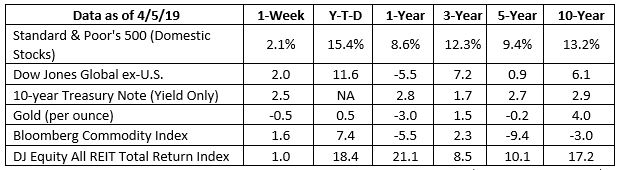
Overall, at the end of 2018, strategists expected the Index to reach 2,975 by year-end 2019. Despite starting 2019 at a lower level than many anticipated, the Index finished last week at 2,892, a gain of about 15.4 percent year-to-date, and 83 points from strategists’ full-year performance expectations.

While the U.S. stock market has delivered attractive returns year-to-date, suggesting investors anticipate strong economic growth ahead, the bond market has been telling a different story.

Late in the first quarter, the yield curve inverted, which means the yield on short-term Treasury bonds was higher than the yield on long-term Treasury bonds. Inverted yield curves are unusual because investors normally want to earn a higher yield when they lend their savings for longer periods of time.

In some cases, inverted yield curves have been a sign that recession is ahead. That may not be the case this time, reported Eva Szalay of Financial Times. It seems the extreme measures taken by central banks following the financial crisis may have undermined the yield curve’s predictive value: “…according to a new piece of research from Pictet Wealth Management, the curve has been sending out misleading signals for a while. The distortions created by extraordinary post-crisis monetary policies have led to the breakdown in the relationship between interest rate expectations and economic growth, the firm argues…Since central banks have injected vast amounts of liquidity into their respective economies to compensate for lackluster growth, long-term interest rates have become artificially compressed…So the old rule no longer applies.”

The yield curve has since righted itself.

While recession may not be imminent, there are signs economies around the world are growing more slowly. Capital Economics reported, “World GDP [gross domestic product] growth seems to have slowed sharply in Q1, but the latest business surveys suggest that growth has bottomed out in some parts of the world at least…there are very few signs of improvement in the euro-zone and the United States has clearly been suffering from previous interest rate hikes and the fading fiscal boost. Those hoping for an imminent rebound in global growth are therefore likely to be disappointed.”

Slowing growth isn’t a sign recession is imminent in the United States. Last week’s jobs report suggests the American economy is still healthy, reported Tim Mullaney of MarketWatch, even if it is puttering along at a slower pace than many would like. 

exercise is important – really important – but don’t get too much. Researchers tested the relationship between mental health and exercise by collecting self-reported data from 1.2 million Americans. They discovered exercise – including everything from childcare and housework to weight lifting and running – can improve mental health.

Americans who were active tended to be happier and experienced poor mental health about 35 days a year. In contrast, those who remained inactive felt bad emotionally about 53 days a year, reported Entrepreneur.com. Exercising in a social setting – team sports, classes, and group cycling, for instance – appeared to deliver the biggest mental health benefits.

The study’s findings indicated it might be possible to exercise too much. “Exercising for 30-60 minutes was associated with the biggest reduction in poor mental health days…Small reductions were still seen for people who exercised more than 90 minutes a day, but exercising for more than three hours a day was associated with worse mental health than not exercising at all. The authors note that people doing extreme amounts of exercise might have obsessive characteristics which could place them at greater risk of poor mental health.”

If you’re not exercising regularly, you may want to find ways to include it in your day.

Weekly Focus – Think About It
“I have always tried to put my kids first, and then…put myself a really close second, as opposed to fifth or seventh. One thing that I’ve learned from male role models is that they don’t hesitate to invest in themselves, with the view that, if I’m healthy and happy, I’m going to be a better support to my spouse and children. And I’ve found that to be the case: Once my kids were settled, the next thing I did was take care of my own health and sanity. And made sure that I was exercising and felt good about myself. I’d bring that energy to everything else that I did, the career, relationship, on and on and on.”
–Michelle Obama, Former First Lady of the United States

Best regards,
John F. Reutemann, Jr., CLU, CFP®

P.S.  Please feel free to forward this commentary to family, friends, or colleagues. If you would like us to add them to the list, please reply to this email with their email address and we will ask for their permission to be added.

Investment advice offered through Research Financial Strategies, a registered investment advisor.

S&P 500, Dow Jones Global ex-US, Gold, Bloomberg Commodity Index returns exclude reinvested dividends (gold does not pay a dividend) and the three-, five-, and 10-year returns are annualized; the DJ Equity All REIT Total Return Index does include reinvested dividends and the three-, five-, and 10-year returns are annualized; and the 10-year Treasury Note is simply the yield at the close of the day on each of the historical time periods.
Sources: Yahoo! Finance, Barron’s, djindexes.com, London Bullion Market Association.
Past performance is no guarantee of future results. Indices are unmanaged and cannot be invested into directly. N/A means not applicable.

Most Popular Financial Stories

The Cracking Foundation of the American Consumer

The Shifting Ground of the American Consumer: Finding Opportunity in Change The economic landscape is undergoing a significant transformation, and understanding these shifts is key to positioning your portfolio for what comes next. While headline numbers often mask…

read more…

Explanation of current positions

Several clients have told us they are a little overwhelmed by many of the new ETFs, and what their business model and investment objectives are.   Below is a short summary of all the ETFs currently in the growth model as of today.  If you have any questions, please…

read more…

Rate Cut Ahead: Is Your Income Strategy Ready?

Rate Cut Ahead: Is Your Income Strategy Ready? With the Federal Reserve now signaling an 87% chance of cutting interest rates at its upcoming meeting, it is crucial to assess how this shift could impact your financial future—especially if you rely on your portfolio…

read more…

Happy Thanksgiving

Wishing You a Happy Thanksgiving As Thanksgiving approaches, we pause to reflect on and appreciate the abundant blessings in our lives, especially the family and friends who enrich our days. We look forward with great anticipation to the coming year and the entire…

read more…

* Government bonds and Treasury Bills are guaranteed by the U.S. government as to the timely payment of principal and interest and, if held to maturity, offer a fixed rate of return and fixed principal value.  However, the value of fund shares is not guaranteed and will fluctuate.
* Corporate bonds are considered higher risk than government bonds but normally offer a higher yield and are subject to market, interest rate and credit risk as well as additional risks based on the quality of issuer coupon rate, price, yield, maturity, and redemption features.
* The Standard & Poor’s 500 (S&P 500) is an unmanaged group of securities considered to be representative of the stock market in general. You cannot invest directly in this index.
* All indexes referenced are unmanaged. Unmanaged index returns do not reflect fees, expenses, or sales charges. Index performance is not indicative of the performance of any investment.
* The Dow Jones Global ex-U.S. Index covers approximately 95% of the market capitalization of the 45 developed and emerging countries included in the Index.
* The 10-year Treasury Note represents debt owed by the United States Treasury to the public. Since the U.S. Government is seen as a risk-free borrower, investors use the 10-year Treasury Note as a benchmark for the long-term bond market.
* Gold represents the afternoon gold price as reported by the London Bullion Market Association. The gold price is set twice daily by the London Gold Fixing Company at 10:30 and 15:00 and is expressed in U.S. dollars per fine troy ounce.
* The Bloomberg Commodity Index is designed to be a highly liquid and diversified benchmark for the commodity futures market. The Index is composed of futures contracts on 19 physical commodities and was launched on July 14, 1998.
* The DJ Equity All REIT Total Return Index measures the total return performance of the equity subcategory of the Real Estate Investment Trust (REIT) industry as calculated by Dow Jones.
* The Dow Jones Industrial Average (DJIA), commonly known as “The Dow,” is an index representing 30 stock of companies maintained and reviewed by the editors of The Wall Street Journal.
* The NASDAQ Composite is an unmanaged index of securities traded on the NASDAQ system.
* International investing involves special risks such as currency fluctuation and political instability and may not be suitable for all investors. These risks are often heightened for investments in emerging markets.
* Yahoo! Finance is the source for any reference to the performance of an index between two specific periods.
* Opinions expressed are subject to change without notice and are not intended as investment advice or to predict future performance.
* Economic forecasts set forth may not develop as predicted and there can be no guarantee that strategies promoted will be successful.
* Past performance does not guarantee future results. Investing involves risk, including loss of principal.
* You cannot invest directly in an index.
* Stock investing involves risk including loss of principal.
* The foregoing information has been obtained from sources considered to be reliable, but we do not guarantee it is accurate or complete.
* There is no guarantee a diversified portfolio will enhance overall returns or outperform a non-diversified portfolio. Diversification does not protect against market risk.
* Asset allocation does not ensure a profit or protect against a loss.
* Consult your financial professional before making any investment decision.
* To unsubscribe from the Weekly Market Commentary please reply to this e-mail with “Unsubscribe” in the subject.


Sources:
https://www.barrons.com/articles/u-s-stocks-could-rally-more-than-10-in-2019-51544837183 (or go to https://s3-us-west-2.amazonaws.com/peakcontent/+Peak+Commentary/04-08-19_Barrons-2019_Outlook-US_Stocks_Could_Rally_About_10_Percent-Footnote_1.pdf)
https://finance.yahoo.com/quote/^GSPC?p=^GSPC (Historical data)
https://www.macrotrends.net/2488/sp500-10-year-daily-chart
https://www.cnbc.com/2019/03/22/the-rally-got-mugged-by-economic-realities-and-a-global-slowdown.html
https://www.investopedia.com/terms/i/invertedyieldcurve.asp
https://www.ft.com/content/15d4048e-552f-11e9-91f9-b6515a54c5b1 (or go to https://s3-us-west-2.amazonaws.com/peakcontent/+Peak+Commentary/04-08-19_FinancialTimes-Why_the_Yield_Curve_is_Not_the_Economic_Guide_It_Once_Was-Footnote_6.pdf)
https://www.capitaleconomics.com/publications/global-economics/global-economics-chart-book/divergent-surveys-offer-limited-hope/ (or go to https://s3-us-west-2.amazonaws.com/peakcontent/+Peak+Commentary/04-08-19_CapitalEconomics-Global_Economics_Chart_Book-Footnote_7.pdf)
https://www.marketwatch.com/story/the-jobs-report-nails-it-its-a-slowdown-not-a-recession-2019-04-05
https://www.thelancet.com/journals/lanpsy/article/PIIS2215-0366(18)30227-X/fulltext
https://www.sciencedaily.com/releases/2018/08/180808193656.htm
https://www.entrepreneur.com/article/331696
https://www.sciencedirect.com/science/article/pii/S221503661830227X
https://www.glamour.com/story/michelle-obama

Market Commentary April 1, 2019

“Fascinatingly counterintuitive…”
That’s how Michael Arone, an investment strategist, described the U.S. market environment to Avi Salzman of Barron’s:  “‘Stocks are rallying, but bond yields are reflecting much lower growth.’ Stocks rose during the quarter because the Fed backed away from raising interest rates, and investors grew more confident that the U.S. and China would sign a trade deal, Arone said. The market was also rebounding from a very rough fourth quarter – ‘conditions at the end of the year were wildly oversold,’ he noted.”

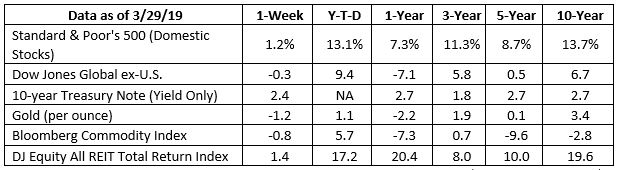
Through the end of last week, the Standard & Poor’s 500 Index was up more than 13 percent year-to-date, despite falling corporate earnings and modest consumer spending gains.

Consumer optimism may have played a role in U.S. stock market gains. The University of Michigan’s Surveys of Consumers Economist Richard Curtin reported:  “…the last time a larger proportion of households reported income gains was in 1966. Rising incomes were accompanied by lower expected year-ahead inflation rates, resulting in more favorable real income expectations…Moreover, all income groups voiced more favorable growth prospects for the overall economy…Overall, the data do not indicate an emerging recession but point toward slightly lower unit sales of vehicles and homes during the year ahead.”

The Bureau of Economic Analysis released its report on economic growth in 2018 last week. Real gross domestic product (GDP), which is a measure of economic growth after inflation, was revised down to 2.2 percent in the fourth quarter of 2018. Growth was up 2.9 percent for the year, though, which was an improvement on 2017’s gain of 2.2 percent.

Slowing economic growth gives weight to bond investors’ expectations, while consumer optimism supports stock investors’ outlook. Divergent market performance and conflicting data make it hard to know what may be ahead. One way to protect capital is to hold a well-diversified portfolio.

how much does it cost to make money? You may not have given it much thought, but it costs money to make money. In fact, the costs of the metals required to make some U.S. coins is higher than the value of the coins! George Washington and Abraham Lincoln might not approve, if they knew. Take this quiz to see what you know about the cost and value of U.S. coins.

  1. How much did it cost the U.S. Mint to make a U.S. penny in 2018?
    1. 0.5 cents
    2. 1.25 cents
    3. 2.06 cents
    4. 3.0 cents
  2. How much did it cost the U.S. Mint to make a U.S. nickel in 2018?
    1. 1.25 cents
    2. 4.97 cents
    3. 6.03 cents
    4. 7.53 cents
  3. What makes a coin valuable to a collector?
    1. Metal
    2. Age
    3. Rarity
    4. All of the above
  4. Which of these coins is the most valuable to collectors?
    1. 1849 Coronet Head Gold $20 Double Eagle
    2. 1913 Liberty Nickel
    3. 1943-D Lincoln Wheat Cent Penny
    4. 1835 Classic Head Gold $5 Half Eagle


Weekly Focus – Think About It
According to the Federal Reserve, the estimated lifespan of a $10 bill is 4.5 years. The estimated lifespans of a $5 and $1 bill are 5.5 years and 5.8 years, respectively. A $100 bill may last 15.5 years because it circulates less frequently.


Answers:

  1. It cost 2.06 cents to make a one-cent coin that few people use. A group of citizens has been encouraging the government to retire the penny.
  2. It cost 7.53 cents to make a nickel in 2018.
  3. All of the above.
  4. The 1849 Coronet Head Gold $20 Double Eagle is worth more than $16,600,000. It is one of the rarest U.S. coins.


Best regards,
John F. Reutemann, Jr., CLU, CFP®

P.S.  Please feel free to forward this commentary to family, friends, or colleagues. If you would like us to add them to the list, please reply to this email with their email address and we will ask for their permission to be added.

Investment advice offered through Research Financial Strategies, a registered investment advisor.

S&P 500, Dow Jones Global ex-US, Gold, Bloomberg Commodity Index returns exclude reinvested dividends (gold does not pay a dividend) and the three-, five-, and 10-year returns are annualized; the DJ Equity All REIT Total Return Index does include reinvested dividends and the three-, five-, and 10-year returns are annualized; and the 10-year Treasury Note is simply the yield at the close of the day on each of the historical time periods.
Sources: Yahoo! Finance, Barron’s, djindexes.com, London Bullion Market Association.
Past performance is no guarantee of future results. Indices are unmanaged and cannot be invested into directly. N/A means not applicable.

Most Popular Financial Stories

The Cracking Foundation of the American Consumer

The Shifting Ground of the American Consumer: Finding Opportunity in Change The economic landscape is undergoing a significant transformation, and understanding these shifts is key to positioning your portfolio for what comes next. While headline numbers often mask…

read more…

Explanation of current positions

Several clients have told us they are a little overwhelmed by many of the new ETFs, and what their business model and investment objectives are.   Below is a short summary of all the ETFs currently in the growth model as of today.  If you have any questions, please…

read more…

Rate Cut Ahead: Is Your Income Strategy Ready?

Rate Cut Ahead: Is Your Income Strategy Ready? With the Federal Reserve now signaling an 87% chance of cutting interest rates at its upcoming meeting, it is crucial to assess how this shift could impact your financial future—especially if you rely on your portfolio…

read more…

Happy Thanksgiving

Wishing You a Happy Thanksgiving As Thanksgiving approaches, we pause to reflect on and appreciate the abundant blessings in our lives, especially the family and friends who enrich our days. We look forward with great anticipation to the coming year and the entire…

read more…

* Government bonds and Treasury Bills are guaranteed by the U.S. government as to the timely payment of principal and interest and, if held to maturity, offer a fixed rate of return and fixed principal value.  However, the value of fund shares is not guaranteed and will fluctuate.
* Corporate bonds are considered higher risk than government bonds but normally offer a higher yield and are subject to market, interest rate and credit risk as well as additional risks based on the quality of issuer coupon rate, price, yield, maturity, and redemption features.
* The Standard & Poor’s 500 (S&P 500) is an unmanaged group of securities considered to be representative of the stock market in general. You cannot invest directly in this index.
* All indexes referenced are unmanaged. Unmanaged index returns do not reflect fees, expenses, or sales charges. Index performance is not indicative of the performance of any investment.
* The Dow Jones Global ex-U.S. Index covers approximately 95% of the market capitalization of the 45 developed and emerging countries included in the Index.
* The 10-year Treasury Note represents debt owed by the United States Treasury to the public. Since the U.S. Government is seen as a risk-free borrower, investors use the 10-year Treasury Note as a benchmark for the long-term bond market.
* Gold represents the afternoon gold price as reported by the London Bullion Market Association. The gold price is set twice daily by the London Gold Fixing Company at 10:30 and 15:00 and is expressed in U.S. dollars per fine troy ounce.
* The Bloomberg Commodity Index is designed to be a highly liquid and diversified benchmark for the commodity futures market. The Index is composed of futures contracts on 19 physical commodities and was launched on July 14, 1998.
* The DJ Equity All REIT Total Return Index measures the total return performance of the equity subcategory of the Real Estate Investment Trust (REIT) industry as calculated by Dow Jones.
* The Dow Jones Industrial Average (DJIA), commonly known as “The Dow,” is an index representing 30 stock of companies maintained and reviewed by the editors of The Wall Street Journal.
* The NASDAQ Composite is an unmanaged index of securities traded on the NASDAQ system.
* International investing involves special risks such as currency fluctuation and political instability and may not be suitable for all investors. These risks are often heightened for investments in emerging markets.
* Yahoo! Finance is the source for any reference to the performance of an index between two specific periods.
* Opinions expressed are subject to change without notice and are not intended as investment advice or to predict future performance.
* Economic forecasts set forth may not develop as predicted and there can be no guarantee that strategies promoted will be successful.
* Past performance does not guarantee future results. Investing involves risk, including loss of principal.
* You cannot invest directly in an index.
* Stock investing involves risk including loss of principal.
* The foregoing information has been obtained from sources considered to be reliable, but we do not guarantee it is accurate or complete.
* There is no guarantee a diversified portfolio will enhance overall returns or outperform a non-diversified portfolio. Diversification does not protect against market risk.
* Asset allocation does not ensure a profit or protect against a loss.
* Consult your financial professional before making any investment decision.
* To unsubscribe from the Weekly Market Commentary please reply to this e-mail with “Unsubscribe” in the subject.

Sources:
https://www.barrons.com/articles/the-s-p-500-is-off-to-its-best-start-since-1998-51553908143?mod=hp_DAY_1 (or go to https://www.barrons.com/market-data/market-lab
http://www.sca.isr.umich.edu (or go to http://www.sca.isr.umich.edu/
https://www.reuters.com/article/us-usa-economy-spending/u-s-consumer-spending-soft-inflation-benign-as-economy-slows-idUSKCN1RA1EK
https://www.bea.gov/news/2019/gross-domestic-product-4th-quarter-and-annual-2018-third-estimate-corporate-profits-4th
https://www.usmint.gov/about/reports (Click on 2018 Annual Report, go to page 10)
https://www.federalreserve.gov/faqs/how-long-is-the-life-span-of-us-paper-money.htm
http://www.retirethepenny.org
https://www.usmint.gov/learn/kids/collectors-club/ten-facts-of-collecting#nine
https://www.usacoinbook.com/encyclopedia/most-valuable-coins/
https://www.usacoinbook.com/coins/4291/gold-20-double-eagle/coronet-head/1849-P/unique-smithsonian-collection/

Market Commentary – March 25, 2019

Wonder what the Federal Reserve’s 40-yard dash time is?
On Wednesday, the Fed juked like an NFL running back and left investors wondering whether they should buy or sell. Heather Long of The Washington Post reported the U.S. central bank:

  1. Lowered its 2019 estimate for U.S. economic growth to 2.1 percent
  2. Announced its intention not to raise rates in 2019
  3. Indicated it will stop shrinking its balance sheet in September

Fed Chair Jerome Powell explained, “My colleagues and I have one overarching goal: to sustain the economic expansion with a strong job market and stable prices for the benefit of the American people. The U.S. economy is in a good place and we will continue to use our monetary policy tools to keep it there…We continue to expect that the American economy will grow at solid pace in 2019, although slower than the very strong pace of 2018.”

The Fed’s decision to adopt a looser monetary policy was informed by a variety of factors, including slower economic growth in the United States, China, and Europe, as well as unresolved policy issues like Brexit and ongoing trade negotiations.

Investors weren’t sure what to make of the Fed’s moves. Initially, major U.S. stock indices trended higher as investors celebrated the benefits of accommodative monetary policy. By the end of the week, though, many investors had changed their minds and fled to ‘safe haven’ investments, pushing long-term Treasury rates lower. Alexandra Scaggs of Barron’s reported:  “When short-term yields rise above long-term yields, it’s known as an inverted yield curve, which is seen even by central bankers as a sign that an economic contraction could be on the way…Benchmark 10-year Treasuries rallied Friday morning, driving their yields below those of the three-month U.S. Treasury.”

So, is recession imminent in the United States? It’s possible but unlikely. According to a source cited by Barron’s, the last six times the yield curve inverted for 10 days or longer, recession occurred within the next two years.

No matter how the economy and/or markets perform, it may not be a good idea to make sudden portfolio changes. If you’re feeling uncertain, give us a call. We can discuss changes you may want to make to your portfolio.

Scandinavia sweeps again. The 2019 United Nation’s World Happiness Report was published last week. The Finns remain the happiest people in the world. In fact, happiness in Finland has been trending higher since 2014.

People in Denmark and Norway also are happier than they were previously. The average score for the Danes increased by more than the average score for the Norwegians, so Denmark is now second and Norway third.

The report’s authors explained, “…the top countries tend to have high values for most of the key variables that have been found to support well-being: income, healthy life expectancy, social support, freedom, trust, and generosity.”

The 10 happiest countries in the world, according to the report, which aggregated data on 156 countries from Gallup World Polls, are:

  1. Finland (7.769)
  2. Denmark (7.600)
  3. Norway (7.554)
  4. Iceland (7.494)
  5. Netherlands (7.488)
  6. Switzerland (7.480)
  7. Sweden (7.343)
  8. New Zealand (7.307)
  9. Canada (7.278)
  10. Austria (7.246)

Since the report began, happiness has increased most dramatically in Benin (#102), Nicaragua (#45), Bulgaria (#97), Latvia (#53), and Togo (#139).

The United States came in at #19. Overall, happiness levels in the U.S. have declined by almost 0.5 since the report was first issued. The report stated:  “Several credible explanations have been posited to explain the decline in happiness among adult Americans, including declines in social capital and social support (Sachs, 2017) and increases in obesity and substance abuse (Sachs, 2018)…I suggest another, complementary explanation: that Americans are less happy due to fundamental shifts in how they spend their leisure time…the way adolescents socialize has fundamentally shifted, moving toward online activities and away from face-to-face social interaction.”

Weekly Focus – Think About It
“The human race has only one really effective weapon and that is laughter.”
–Mark Twain, American author

Best regards,
John F. Reutemann, Jr., CLU, CFP®

P.S.  Please feel free to forward this commentary to family, friends, or colleagues. If you would like us to add them to the list, please reply to this email with their email address and we will ask for their permission to be added.

Investment advice offered through Research Financial Strategies, a registered investment advisor.

S&P 500, Dow Jones Global ex-US, Gold, Bloomberg Commodity Index returns exclude reinvested dividends (gold does not pay a dividend) and the three-, five-, and 10-year returns are annualized; the DJ Equity All REIT Total Return Index does include reinvested dividends and the three-, five-, and 10-year returns are annualized; and the 10-year Treasury Note is simply the yield at the close of the day on each of the historical time periods.
Sources: Yahoo! Finance, Barron’s, djindexes.com, London Bullion Market Association.
Past performance is no guarantee of future results. Indices are unmanaged and cannot be invested into directly. N/A means not applicable.

Most Popular Financial Stories

The Cracking Foundation of the American Consumer

The Shifting Ground of the American Consumer: Finding Opportunity in Change The economic landscape is undergoing a significant transformation, and understanding these shifts is key to positioning your portfolio for what comes next. While headline numbers often mask…

read more…

Explanation of current positions

Several clients have told us they are a little overwhelmed by many of the new ETFs, and what their business model and investment objectives are.   Below is a short summary of all the ETFs currently in the growth model as of today.  If you have any questions, please…

read more…

Rate Cut Ahead: Is Your Income Strategy Ready?

Rate Cut Ahead: Is Your Income Strategy Ready? With the Federal Reserve now signaling an 87% chance of cutting interest rates at its upcoming meeting, it is crucial to assess how this shift could impact your financial future—especially if you rely on your portfolio…

read more…

Happy Thanksgiving

Wishing You a Happy Thanksgiving As Thanksgiving approaches, we pause to reflect on and appreciate the abundant blessings in our lives, especially the family and friends who enrich our days. We look forward with great anticipation to the coming year and the entire…

read more…

* Government bonds and Treasury Bills are guaranteed by the U.S. government as to the timely payment of principal and interest and, if held to maturity, offer a fixed rate of return and fixed principal value.  However, the value of fund shares is not guaranteed and will fluctuate.
* Corporate bonds are considered higher risk than government bonds but normally offer a higher yield and are subject to market, interest rate and credit risk as well as additional risks based on the quality of issuer coupon rate, price, yield, maturity, and redemption features.
* The Standard & Poor’s 500 (S&P 500) is an unmanaged group of securities considered to be representative of the stock market in general. You cannot invest directly in this index.
* All indexes referenced are unmanaged. Unmanaged index returns do not reflect fees, expenses, or sales charges. Index performance is not indicative of the performance of any investment.
* The Dow Jones Global ex-U.S. Index covers approximately 95% of the market capitalization of the 45 developed and emerging countries included in the Index.
* The 10-year Treasury Note represents debt owed by the United States Treasury to the public. Since the U.S. Government is seen as a risk-free borrower, investors use the 10-year Treasury Note as a benchmark for the long-term bond market.
* Gold represents the afternoon gold price as reported by the London Bullion Market Association. The gold price is set twice daily by the London Gold Fixing Company at 10:30 and 15:00 and is expressed in U.S. dollars per fine troy ounce.
* The Bloomberg Commodity Index is designed to be a highly liquid and diversified benchmark for the commodity futures market. The Index is composed of futures contracts on 19 physical commodities and was launched on July 14, 1998.
* The DJ Equity All REIT Total Return Index measures the total return performance of the equity subcategory of the Real Estate Investment Trust (REIT) industry as calculated by Dow Jones.
* The Dow Jones Industrial Average (DJIA), commonly known as “The Dow,” is an index representing 30 stock of companies maintained and reviewed by the editors of The Wall Street Journal.
* The NASDAQ Composite is an unmanaged index of securities traded on the NASDAQ system.
* International investing involves special risks such as currency fluctuation and political instability and may not be suitable for all investors. These risks are often heightened for investments in emerging markets.
* Yahoo! Finance is the source for any reference to the performance of an index between two specific periods.
* Opinions expressed are subject to change without notice and are not intended as investment advice or to predict future performance.
* Economic forecasts set forth may not develop as predicted and there can be no guarantee that strategies promoted will be successful.
* Past performance does not guarantee future results. Investing involves risk, including loss of principal.
* You cannot invest directly in an index.
* Stock investing involves risk including loss of principal.
* The foregoing information has been obtained from sources considered to be reliable, but we do not guarantee it is accurate or complete.
* There is no guarantee a diversified portfolio will enhance overall returns or outperform a non-diversified portfolio. Diversification does not protect against market risk.
* Asset allocation does not ensure a profit or protect against a loss.
* Consult your financial professional before making any investment decision.
* To unsubscribe from the Weekly Market Commentary please reply to this e-mail with “Unsubscribe” in the subject.


Sources:
https://www.washingtonpost.com/business/2019/03/20/federal-reserve-cuts-growth-forecast-predicts-no-more-rate-hikes/?utm_term=.3ead92852b27
https://www.federalreserve.gov/newsevents.htm (Video timestamp 0:15 to 3:00 minutes)
https://finance.yahoo.com/quote/^DJI?p=^DJI&.tsrc=fin-srch (5-day chart or historical pricing)
https://finance.yahoo.com/quote/^IXIC?p=^IXIC (5-day chart or historical pricing)
https://finance.yahoo.com/quote/%5EGSPC?p=%5EGSPC (5-day chart or historical pricing)
https://www.barrons.com/articles/the-yield-curve-just-inverted-that-doesnt-mean-sell-stocks-51553267161?mod=hp_BRIEF&mod=article_inline (or go to https://s3-us-west-2.amazonaws.com/peakcontent/+Peak+Commentary/03-25-19_Barrons-The_Yield_Curve_Just_Inverterted-Thats_Not_as_Scary_as_You_Think-Footnote_6.pdf)
https://s3.amazonaws.com/happiness-report/2019/WHR19.pdf (Pages 22-27, 34-37, and 88-89)
https://www.goodreads.com/search?page=5&q=twain&search%5Bsource%5D=goodreads&search_type=quotes&tab=quotes

Market Commentary – March 18, 2019

Stock and bond markets rallied.
Last week, major U.S. stock indices finished higher for the 10th time in 12 weeks. Bond markets moved higher, too, with the yield on 10-year Treasuries dropping just below 2.6 percent, reported Randall Forsyth of Barron’s. Yields on 10-year Treasuries haven’t been this low since January 2018.

The simultaneous rallies are curious because improving share prices are often an indication of a strong or strengthening economy. Improving bond prices tend to be a sign of weakening economic growth, reported Michael Santoli of CNBC.

Why are U.S. stock and bond markets telling different stories?
It may have something to do with investor uncertainty. A lot of important issues remain unsettled. The British government appears incapable of resolving Brexit issues, the United States and China have not yet reached a trade agreement, and recent economic reports have caused investors to take a hard look at the U.S. economy.

Barron’s pointed out investors appear to be hedging their bets by favoring in utilities and other stocks that have bond-like characteristics and participate in the stock market’s gains. An investment strategist cited by Barron’s explained:  “The strength in utilities reflects the attitude of investors who ‘don’t really buy the rally’…While they’re skittish, they still want to participate in the stock market rally but opt for its most conservative sector.”

We’ve seen this before with stocks and bonds, according to a financial strategist cited by Patti Domm of CNBC. “It’s a little bit of a funky correlation. We’ve had both things rallying, which is strange. This is what happened in 2017, when all asset classes did well. In 2018, nothing did well…I would suspect it goes away soon.”

Times like these illustrate the importance of having a well-diversified portfolio.

Gen Xers and millennials: what are your priorities? The 2018 Insights on Wealth and Worth survey provided some startling information about the priorities of high net worth (HNW) investors. More than one-half (54 percent) indicated long-term capital appreciation was a higher priority than income generation. The other 46 percent were looking for steady income.

Let’s look at the percentages by age group:

  • Millennials: 56 percent capital appreciation / 44 percent steady income
  • Gen X: 56 percent capital appreciation / 44 percent steady income
  • Baby Boomers: 56 percent capital appreciation / 44 percent steady income
  • Silent Generation: 46 percent capital appreciation / 54 percent steady income

Millennials (ages 21 to 37), Gen Xers (ages 38 to 53), and Baby Boomers (ages 54 to 72) prioritize steady long-term income to the same extent.

Older investors, who are near or are in retirement, tend to emphasize steady long-term income because they need to maintain their standard of living in retirement. However, one of the advantages of youth is these investors have the time and flexibility to take on higher levels of risk and recover from any market downturns. In other words, younger investors prioritize capital appreciation (i.e., growth) while older investors prioritize income.

It’s important for younger investors to consider their life goals and how their finances may support the pursuit of those goals.

Weekly Focus – Think About It
“There are risks and costs to action. But they are far less than the long range risks of comfortable inaction.”
–John F. Kennedy, 35th President of the United States

Best regards,
John F. Reutemann, Jr., CLU, CFP®

P.S.  Please feel free to forward this commentary to family, friends, or colleagues. If you would like us to add them to the list, please reply to this email with their email address and we will ask for their permission to be added.

Investment advice offered through Research Financial Strategies, a registered investment advisor.

S&P 500, Dow Jones Global ex-US, Gold, Bloomberg Commodity Index returns exclude reinvested dividends (gold does not pay a dividend) and the three-, five-, and 10-year returns are annualized; the DJ Equity All REIT Total Return Index does include reinvested dividends and the three-, five-, and 10-year returns are annualized; and the 10-year Treasury Note is simply the yield at the close of the day on each of the historical time periods.
Sources: Yahoo! Finance, Barron’s, djindexes.com, London Bullion Market Association.
Past performance is no guarantee of future results. Indices are unmanaged and cannot be invested into directly. N/A means not applicable.

Most Popular Financial Stories

The Cracking Foundation of the American Consumer

The Shifting Ground of the American Consumer: Finding Opportunity in Change The economic landscape is undergoing a significant transformation, and understanding these shifts is key to positioning your portfolio for what comes next. While headline numbers often mask…

read more…

Explanation of current positions

Several clients have told us they are a little overwhelmed by many of the new ETFs, and what their business model and investment objectives are.   Below is a short summary of all the ETFs currently in the growth model as of today.  If you have any questions, please…

read more…

Rate Cut Ahead: Is Your Income Strategy Ready?

Rate Cut Ahead: Is Your Income Strategy Ready? With the Federal Reserve now signaling an 87% chance of cutting interest rates at its upcoming meeting, it is crucial to assess how this shift could impact your financial future—especially if you rely on your portfolio…

read more…

Happy Thanksgiving

Wishing You a Happy Thanksgiving As Thanksgiving approaches, we pause to reflect on and appreciate the abundant blessings in our lives, especially the family and friends who enrich our days. We look forward with great anticipation to the coming year and the entire…

read more…

* Government bonds and Treasury Bills are guaranteed by the U.S. government as to the timely payment of principal and interest and, if held to maturity, offer a fixed rate of return and fixed principal value.  However, the value of fund shares is not guaranteed and will fluctuate.
* Corporate bonds are considered higher risk than government bonds but normally offer a higher yield and are subject to market, interest rate and credit risk as well as additional risks based on the quality of issuer coupon rate, price, yield, maturity, and redemption features.
* The Standard & Poor’s 500 (S&P 500) is an unmanaged group of securities considered to be representative of the stock market in general. You cannot invest directly in this index.
* All indexes referenced are unmanaged. Unmanaged index returns do not reflect fees, expenses, or sales charges. Index performance is not indicative of the performance of any investment.
* The Dow Jones Global ex-U.S. Index covers approximately 95% of the market capitalization of the 45 developed and emerging countries included in the Index.
* The 10-year Treasury Note represents debt owed by the United States Treasury to the public. Since the U.S. Government is seen as a risk-free borrower, investors use the 10-year Treasury Note as a benchmark for the long-term bond market.
* Gold represents the afternoon gold price as reported by the London Bullion Market Association. The gold price is set twice daily by the London Gold Fixing Company at 10:30 and 15:00 and is expressed in U.S. dollars per fine troy ounce.
* The Bloomberg Commodity Index is designed to be a highly liquid and diversified benchmark for the commodity futures market. The Index is composed of futures contracts on 19 physical commodities and was launched on July 14, 1998.
* The DJ Equity All REIT Total Return Index measures the total return performance of the equity subcategory of the Real Estate Investment Trust (REIT) industry as calculated by Dow Jones.
* The Dow Jones Industrial Average (DJIA), commonly known as “The Dow,” is an index representing 30 stock of companies maintained and reviewed by the editors of The Wall Street Journal.
* The NASDAQ Composite is an unmanaged index of securities traded on the NASDAQ system.
* International investing involves special risks such as currency fluctuation and political instability and may not be suitable for all investors. These risks are often heightened for investments in emerging markets.
* Yahoo! Finance is the source for any reference to the performance of an index between two specific periods.
* Opinions expressed are subject to change without notice and are not intended as investment advice or to predict future performance.
* Economic forecasts set forth may not develop as predicted and there can be no guarantee that strategies promoted will be successful.
* Past performance does not guarantee future results. Investing involves risk, including loss of principal.
* You cannot invest directly in an index.
* Stock investing involves risk including loss of principal.
* The foregoing information has been obtained from sources considered to be reliable, but we do not guarantee it is accurate or complete.
* There is no guarantee a diversified portfolio will enhance overall returns or outperform a non-diversified portfolio. Diversification does not protect against market risk.
* Asset allocation does not ensure a profit or protect against a loss.
* Consult your financial professional before making any investment decision.

* To unsubscribe from the Weekly Market Commentary please reply to this e-mail with “Unsubscribe” in the subject.

Sources:
https://www.barrons.com/articles/why-investors-are-rushing-into-stocks-that-act-like-bonds-51552700368?mod=hp_DAY_4
https://www.cnbc.com/2019/03/14/stock-investors-wonder-whether-the-bond-market-knows-something-they-dont.html
https://www.bls.gov/news.release/empsit.nr0.htm
https://www.barrons.com/articles/why-utility-stocks-are-worth-a-second-look-1531344310
https://www.cnbc.com/2019/02/06/bonds-and-stocks-going-up-together-could-be-signaling-market-at-an-inflection-point.html
https://ustrustaem.fs.ml.com/content/dam/ust/articles/pdf/insights-on-wealth-and-worth-2018/Detailed_Findings.pdf (Pages 3 and 39)
https://www.moneyunder30.com/asset-allocation-for-investors-under-thirty
https://www.brainyquote.com/quotes/john_f_kennedy_109216?src=t_risks

Market Commentary – March 11, 2019

Markets were rattled last week.
The market hates surprises, especially when the surprise comes from a central bank. Last week, the European Central Bank (ECB) unexpectedly reversed course and took a more accommodative stance on monetary policy in an effort to encourage stronger European economic growth. Tom Fairless of Barron’s explained:

“Officials are seeking to shore up an economy that has been rattled by shocks ranging from a slowdown in China to mass protests in France and bottlenecks in Germany’s crucial auto industry. They are threading a careful path between providing sufficient support for the region’s softening economy while avoiding any appearance of panic, which could ricochet through financial markets.”

The Eurozone isn’t the only region feeling the pinch of weaker economic growth. China’s exports were down more than 20 percent in February, reported Investing.com. Analysts had expected a decline of about 5 percent. Concerns about the health of China’s economy have been growing since the publication of ‘A Forensic Examination of China’s National Accounts’ by the Brookings Institute. The authors concluded:

“First, nominal GDP [gross domestic product*] growth after 2008 and particularly after 2013 is lower than suggested by the official statistics. Second, the savings rate has declined by 10 percentage points between 2008 and 2016. The official statistics suggest the savings rate only declined by 3 percentage points between these two years. Third, our statistics suggest that the investment rate has [fallen] by about 3 percent of GDP between 2008 and 2016. Official statistics suggest that the investment rate has increased over this period.”

*Gross domestic product is the monetary measure of the market value of all goods and services produced annually in the country.

As if that weren’t enough, the U.S. jobs report for February reported far fewer jobs had been created than was expected. It will come as little surprise to learn that major U.S. stock indices moved lower last week.

How do you reconcile the beige book and the labor report?
If you have never heard of the Beige Book, it’s a scintillating tale of business and economics published by the Federal Reserve. Okay, maybe it’s not scintillating, but it has some pretty interesting stories.

The March 2019 installation – it’s published eight times a year – includes real world stories about businesses and workers gathered by Federal Reserve Banks across the nation. For instance, the St. Louis Federal Reserve reported their contacts in higher education reported falling enrollment. It seems more potential college and post-graduate students have been choosing to go straight into the workforce.

The Beige Book reported, across the nation, “Labor markets remained tight for all skill levels, including notable worker shortages for positions relating to information technology, manufacturing, trucking, restaurants, and construction. Contacts reported labor shortages were restricting employment growth in some areas.”

Of course, labor is easier to come by in some districts than in others. The Boston Federal Reserve reported contacts in its district have a hard time finding skilled workers in fields like information technology, but retail businesses are having no trouble filling jobs.

Wages have been going up in the Cleveland Federal Reserve’s district. “Bankers raised wages both for low-wage and for high-wage positions, citing competitive labor markets. A couple of construction companies granted large retention-focused merit increases to office staff, but other companies mentioned that they tended to grant raises during busier seasons.”

Hiring was up in the San Francisco Federal Reserve’s territory. “Employment at a large San Francisco software and consulting company grew notably as demand for its services increased. A cattle ranching company in Arizona also increased employment to meet growing demand. In the Mountain West, a regional bank noted that its hiring was limited only by a shortage of qualified labor.”

In light of last week’s incredibly weak jobs report, the Beige Book’s findings seem odd that companies are having trouble hiring enough workers and are raising wages to attract them. How can so few jobs have been created when there is high demand for labor? (Economists’ rule of thumb is 100,000 jobs are needed to accommodate people entering the labor force each month, according to MarketWatch.)

An economist cited by MarketWatch commented, “One poor report should not set off alarm bells, but given that the labor market is the linchpin for the entire economy, it does add to existing concerns and raises the stakes for next month’s report.”

Weekly Focus – Think About It
“Hard work spotlights the character of people: some turn up their sleeves, some turn up their noses, and some don’t turn up at all.”
–Sam Ewing, Professional baseball player

Best regards,

John F. Reutemann, Jr., CLU, CFP®

P.S.  Please feel free to forward this commentary to family, friends, or colleagues. If you would like us to add them to the list, please reply to this email with their email address and we will ask for their permission to be added.

Investment advice offered through Research Financial Strategies, a registered investment advisor.

S&P 500, Dow Jones Global ex-US, Gold, Bloomberg Commodity Index returns exclude reinvested dividends (gold does not pay a dividend) and the three-, five-, and 10-year returns are annualized; the DJ Equity All REIT Total Return Index does include reinvested dividends and the three-, five-, and 10-year returns are annualized; and the 10-year Treasury Note is simply the yield at the close of the day on each of the historical time periods.
Sources: Yahoo! Finance, Barron’s, djindexes.com, London Bullion Market Association.
Past performance is no guarantee of future results. Indices are unmanaged and cannot be invested into directly. N/A means not applicable.

Most Popular Financial Stories

The Cracking Foundation of the American Consumer

The Shifting Ground of the American Consumer: Finding Opportunity in Change The economic landscape is undergoing a significant transformation, and understanding these shifts is key to positioning your portfolio for what comes next. While headline numbers often mask…

read more…

Explanation of current positions

Several clients have told us they are a little overwhelmed by many of the new ETFs, and what their business model and investment objectives are.   Below is a short summary of all the ETFs currently in the growth model as of today.  If you have any questions, please…

read more…

Rate Cut Ahead: Is Your Income Strategy Ready?

Rate Cut Ahead: Is Your Income Strategy Ready? With the Federal Reserve now signaling an 87% chance of cutting interest rates at its upcoming meeting, it is crucial to assess how this shift could impact your financial future—especially if you rely on your portfolio…

read more…

Happy Thanksgiving

Wishing You a Happy Thanksgiving As Thanksgiving approaches, we pause to reflect on and appreciate the abundant blessings in our lives, especially the family and friends who enrich our days. We look forward with great anticipation to the coming year and the entire…

read more…

* Government bonds and Treasury Bills are guaranteed by the U.S. government as to the timely payment of principal and interest and, if held to maturity, offer a fixed rate of return and fixed principal value.  However, the value of fund shares is not guaranteed and will fluctuate.
* Corporate bonds are considered higher risk than government bonds but normally offer a higher yield and are subject to market, interest rate and credit risk as well as additional risks based on the quality of issuer coupon rate, price, yield, maturity, and redemption features.
* The Standard & Poor’s 500 (S&P 500) is an unmanaged group of securities considered to be representative of the stock market in general. You cannot invest directly in this index.
* All indexes referenced are unmanaged. Unmanaged index returns do not reflect fees, expenses, or sales charges. Index performance is not indicative of the performance of any investment.
* The Dow Jones Global ex-U.S. Index covers approximately 95% of the market capitalization of the 45 developed and emerging countries included in the Index.
* The 10-year Treasury Note represents debt owed by the United States Treasury to the public. Since the U.S. Government is seen as a risk-free borrower, investors use the 10-year Treasury Note as a benchmark for the long-term bond market.
* Gold represents the afternoon gold price as reported by the London Bullion Market Association. The gold price is set twice daily by the London Gold Fixing Company at 10:30 and 15:00 and is expressed in U.S. dollars per fine troy ounce.
* The Bloomberg Commodity Index is designed to be a highly liquid and diversified benchmark for the commodity futures market. The Index is composed of futures contracts on 19 physical commodities and was launched on July 14, 1998.
* The DJ Equity All REIT Total Return Index measures the total return performance of the equity subcategory of the Real Estate Investment Trust (REIT) industry as calculated by Dow Jones.
* The Dow Jones Industrial Average (DJIA), commonly known as “The Dow,” is an index representing 30 stock of companies maintained and reviewed by the editors of The Wall Street Journal.
* The NASDAQ Composite is an unmanaged index of securities traded on the NASDAQ system.
* International investing involves special risks such as currency fluctuation and political instability and may not be suitable for all investors. These risks are often heightened for investments in emerging markets.
* Yahoo! Finance is the source for any reference to the performance of an index between two specific periods.
* Opinions expressed are subject to change without notice and are not intended as investment advice or to predict future performance.
* Economic forecasts set forth may not develop as predicted and there can be no guarantee that strategies promoted will be successful.
* Past performance does not guarantee future results. Investing involves risk, including loss of principal.
* You cannot invest directly in an index.
* Stock investing involves risk including loss of principal.
* The foregoing information has been obtained from sources considered to be reliable, but we do not guarantee it is accurate or complete.
* There is no guarantee a diversified portfolio will enhance overall returns or outperform a non-diversified portfolio. Diversification does not protect against market risk.
* Asset allocation does not ensure a profit or protect against a loss.
* Consult your financial professional before making any investment decision.
* To unsubscribe from the Weekly Market Commentary please reply to this e-mail with “Unsubscribe” in the subject.


Sources:
https://www.barrons.com/articles/european-central-bank-stimulus-51551967979 (or go to https://drive.google.com/file/d/1jDwICeYbsalcb3ZVb5CKf7mVjlvC-N97/view?usp=sharing)
https://www.investing.com/news/economic-indicators/china-exports-tumble-in-february-1801611
https://www.brookings.edu/wp-content/uploads/2019/03/BPEA-2019-Forensic-Analysis-China.pdf (Page 25)
https://www.marketwatch.com/story/us-stock-futures-drop-as-gloomy-china-trade-report-adds-to-global-growth-fears-2019-03-08
https://www.federalreserve.gov/monetarypolicy/beige-book-default.htm
https://www.federalreserve.gov/monetarypolicy/beigebook201903.htm
https://www.marketwatch.com/story/us-adds-meager-20000-jobs-in-february-to-mark-smallest-increase-in-17-months-2019-03-08
https://www.brainyquote.com/quotes/sam_ewing_104937

6Lc_psgUAAAAAA9c7MediJBuq3wAxIyxDSt73c9j