Weekly Market Commentary

The Markets

Risk-on. Risk-off.

If you read the financial press, you may have seen the terms “risk-on” and “risk-off”.  When investing, there is a risk-return spectrum. Stocks typically have higher risk and higher return potential than high-quality bonds. High-quality bonds have lower risk and lower return potential than stocks, although they typically have higher risk and higher return potential than cash.

In financial speak, investors are:

  • Risk-on when they are excited about investing in stocks (and other types of assets that have higher risk profiles). “Risk-on environments can be carried by expanding corporate earnings, optimistic economic outlook, accommodative central bank policies, and speculation. As the market displays strong influential fundamentals, investors perceive less risk about the market and its outlook,” reported Adam Hayes for Investopedia. A risk-on environment may lead to rising stock prices.
  • Risk-off when they become cautious and concerned about losses. Risk averse investors may sell some types of stocks (and other types of assets that have higher risk profiles) in favor of dividend-paying stocks and more stable types of investments that can help preserve principal. Risk-off environments may arise when economic growth slows, economic uncertainty rises, company earnings slide lower, consumer confidence wavers, or financial markets experience other kinds of disruptions. A risk-off environment may lead to falling stock prices.

Last week, investors moved from a risk-on to a risk-off outlook. The change in attitude resulted from concerns about:

  • Tariffs. Concerns about tariffs intensified last week when “An unexpected move against car imports this week renewed warnings from economists that tariffs will almost surely raise consumer prices and harm economic growth,” reported Jeran Wittenstein and Ryan Vlastelica of Bloomberg.
  • Sticky inflation. Last week, the personal consumption expenditures (PCE) index, which is one of the Federal Reserve’s preferred inflation gauges, showed that headline inflation remained steady month to month and year to year. However, core inflation, which excludes food and energy prices, rose month to month and year to year.
  • Consumer sentiment. The final reading for consumer sentiment in March did not improve. “This month’s decline reflects a clear consensus across all demographic and political affiliations; Republicans joined independents and Democrats in expressing worsening expectations since February for their personal finances, business conditions, unemployment, and inflation,” wrote University of Michigan Surveys of Consumers Director Joanne Hsu.


During periods of market volatility, it’s important to keep a long-term perspective. Having an asset allocation strategy that reflects your risk tolerance and financial goals helps insulate your assets from market turbulence. Asset allocation helps manage risk, but it does not prevent losses

THE SILVER LINING OF MARKET DOWNTURNS. Volatile markets are challenging. Watching the value of your assets bounce higher and lower can be frustrating. In times like these, it can be helpful to focus on the opportunities that can be created by market volatility. One of those opportunities is tax-loss harvesting.

Investors “harvest” tax losses by selling an asset for less than they purchased it. Unfortunately, not every investment delivers stellar returns. Almost every investor has either owned an asset that loses value due to company underperformance or a market downturn. When the asset is sold at a lower value than its purchase price, the investor realizes a capital loss.

From a tax perspective, losses are quite valuable. They can help:

    1. Minimize capital gains tax. Capital losses can be used to offset capital gains, dollar for dollar. For example, if an investor sells shares of Company A for a gain of $1 and sells shares of Company B for a loss of $1, then the loss offsets the gain.


    1. Reduce taxable income today. When tax losses aren’t used to offset gains, the losses can reduce taxable income by up to $3,000. So, if an investor has a capital loss of $6,000 and a capital gain of $3,000, the capital loss could offset the capital gain and the $3,000 loss that is leftover could be used to reduce the investor’s taxable income.


    1. Reduce capital gains and taxable income tomorrow. When capital losses are greater than capital gains and income reductions combined, the extra losses can be carried forward and used to offset capital gains and taxable income in the future.

The key to tax loss harvesting is that the money from the asset sale must be invested in a new opportunity – perhaps capitalizing on the chance to invest in a strong company at an attractive price, which is another benefit of market downturns. In general, the new investment should fill a similar role in the investor’s asset allocation strategy to the investment that was sold.

The silver lining of market downturns is that investment losses can be tax wins.

Weekly Focus – Think About It
“Courage is the price that life exacts for granting peace.”
– Amelia Earhart, Aviation pioneer

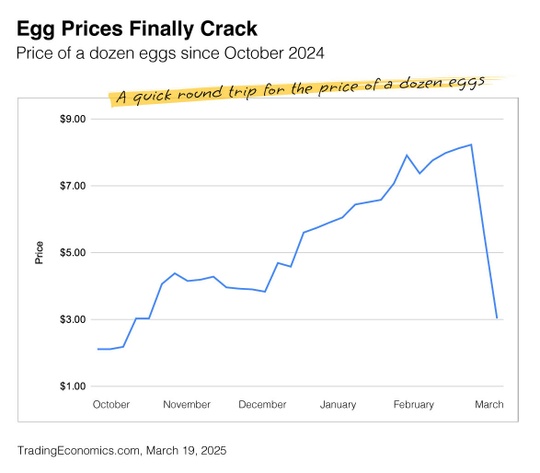
Sunny Side Down: Egg Prices Fall

Forget the Fed frenzy and take a timeout from tariff talk. Let's focus on what's really scrambling the markets right now: egg prices.

After reaching an all-time high of $8.17 a dozen in early March, prices have trended lower and may drop below $3 in the coming weeks. What’s behind the sudden fall? The three main reasons are weaker consumer demand, the bird flu coming under control, and ramped-up supply.

So, when will you start to see relief at the checkout line? Soon perhaps. However, grocery store prices remain unpredictable because retailers are still a bit concerned about supply chains.

In recent months, economists have paid more attention to the price of eggs than to other constituents of the Consumer Price Index.

Why have egg prices become a proxy for inflation? 

One theory is that eggs symbolize something bigger about the U.S. economy. Not only are eggs a critical, inexpensive source of protein and nutrients for millions of consumers, but they are also a core part of many other foods made at home or mass-produced. So, eggs have become a tangible symbol of how consumers believe the broader economy is doing.

The Inside Coop: Chicken prices have remained stable despite the bird flu because broilers (chicken raised for meat) tend to have a shorter lifespan than egg-laying hens (6-8 weeks compared to 2 years). Shorter life spans mean flocks are less susceptible to outbreaks, and supply-and-demand issues can be resolved quickly.

I hope today’s email provided some insights into the egg market. It’s not often such a small part of our daily life that takes center stage in economics. 

Sources:
TradingEconomics.com, March 19, 2025. "Eggs US"
TheHill.com, February 13, 2025. "Egg prices are surging, so why are chicken prices stable?"

Weekly Market Commentary

The Markets

The market whisperer…

Last week, the Federal Reserve (Fed) left the federal funds rate unchanged, and Fed Chair Jerome Powell soothed markets. He explained that conditions in the labor market were broadly in balance and inflation had eased significantly over the past two years. Overall, the possibility of recession, while rising, remained low.

Markets rallied following his comments.

The economic outlook for 2025
The Fed’s current median forecast for economic growth in 2025 is 1.7 percent, a bit lower than it was in December. In addition, the Fed’s current median estimate for inflation is 2.7 percent, a bit higher than in December. While he was reassuring, Powell explained there is a lot of uncertainty about the economic outlook in the United States. He stated:

“Looking ahead, the new administration is in the process of implementing significant policy changes in four distinct areas: trade, immigration, fiscal policy and regulation. It is the net effect of these policy changes that will matter for the economy and for the path of all monetary policy. While there have been recent developments in some of these areas, especially trade policy, uncertainty around the changes and their effects on the economic outlook is high. As we parse the incoming information, we are focused on separating the signal from the noise as the outlook evolves.”

Consumer spending and the wealth effect
Powell also said that it remains to be seen how consumer and business spending and investment will respond to heightened uncertainty about the economic outlook. It’s an important point because of the “wealth effect”.

The wealth effect is a theory in behavioral economics. It holds that people spend more when the stock market is rising and the value of their assets is growing. Conversely, people spend less when the stock market is falling and the value of their assets is declining. It’s difficult to quantify the effect as Mike Bird of The Economist explained:

“Estimates of the ‘wealth effect’ – the amount that rising or falling stocks can support or hurt consumer activity – vary wildly. One academic study in 2019 suggested that a dollar increase in stock market wealth boosted American spending by about three cents. [A large financial-services firm] suggests that the pass-through has risen significantly in recent years, coming up with an extraordinary figure of 24 cents. Whatever the true number, a declining stock market matters for the broader economy.”

Last week, major U.S. stock indices finished higher,  while yields on most maturities of U.S. Treasuries moved lower.

IF YOU LOSE YOUR WALLET, DO YOU EXPECT IT TO BE RETURNED? Here’s some good news from the 2025 World Happiness Report: “People are too pessimistic about the kindness of their communities.”

 As usual, the 2025 World Happiness Report offered insights to the countries where citizens are happiest. Once again, Nordic nations dominated. The United States landed in 24th place. The countries where the happiest people live are:

  1. Finland,
  2. Denmark,
  3. Iceland,
  4. Sweden, and
  5.  

 Where are people most benevolent?
The 2025 report also tracked a trend that surprised researchers during the Covid-19 years. In 2020, there was an upsurge in benevolent acts – people doing kind things for one another. Researchers theorized that helping others may have “…offset the negative effects felt by many of those whose lives were changed, endangered, and sometimes harmed during the pandemic.”

For the 2025 report, researchers asked how often people performed acts of kindness, specifically donating, volunteering, and helping strangers. The most benevolent countries varied, depending on the type of kindness.

  • For donations, Indonesia, Myanmar, and Ukraine ranked first, second, and third.
  • For volunteering, Indonesia, Liberia, and Kenya took top honors.
  • For helping strangers, Jamaica, Liberia, and Trinidad & Tobago were the leaders.

The United States was 12th for donations, 15th for volunteering, and 12th for helping a stranger.

What about lost wallets?
The study also asked participants how likely it was that a lost wallet would be returned. They compared the data to studies where researchers “lose” wallets to see how often they are returned. Overall, expectations that wallets would be returned were far lower than actual returns.

For example, the actual return rate for lost wallets was 1.8 times higher – almost double – the average estimated return rate. In addition, wallets were more likely to be returned if they contained money.

By the way, the best place to lose your wallet is in a Nordic nation. These countries had both the highest expected and the highest actual rate of return for lost wallets.

Weekly Focus – Think About It
“No act of kindness, no matter how small, is ever wasted.”
–Aesop, Storyteller

Weekly Market Commentary

The Markets

A correction and a bounce.

Last week, the Standard & Poor’s (S&P) 500 Index moved into correction territory. The Nasdaq Composite Index (Nasdaq) was already in a correction, and the Dow Jones Industrial Average (Dow) was close, reported Paul R. LaMonica of Barron’s.

A correction occurs when the value of an index drops 10 percent below its most recent peak. The S&P 500 correction occurred remarkably quickly. Just three weeks ago, the index was at a record high amid easing inflation pressures and solid earnings growth.

In fact, from December 15 through March 6, the number of companies mentioning the word “recession” on earnings calls was the lowest it had been in more than five years, reported John Butters of FactSet. There is another word that was mentioned frequently on earnings calls though: tariffs.

Tariffs on tariffs on tariffs

The tariff war escalated last week as the European Union (EU) and Canada introduced retaliatory tariffs in response to those of the United States, reported Joe Light of Barron’s. Brendan Murray and Alex Newman of Bloomberg have been tracking the tariffs. Through the end of last week, the United States government has imposed the following tariffs:

  • 10% on all goods imported from China (February 4)
  • An additional 10% on all goods imported from China (March 4)
  • 25% on some Canadian imports (March 4)
  • 25% on some Mexican imports. (March 4)
  • 10% on Canadian energy and potash (March 4)
  • 25% on steel and aluminum from major exporting countries (March 12)

“As Americans debate the wisdom of the administration’s on-again, off-again trade barriers…a few broad points are worth bearing in mind,” wrote The Editorial Board at Bloomberg. “One is that these measures are a tax on Americans. Foreign countries don’t simply pay up; US companies do when they import a product. This means that the costs are ultimately borne by consumers and by companies that use imported inputs. The effect of those higher prices is to eat into household budgets, push down real wages and reduce economic growth.”

Consumers are feeling salty

The trade war has raised questions about the path of the U.S. economy, and some economists have lowered their forecasts for economic growth in 2025, reported Brian Swint of Barron’s.

The primary driver of U.S. economic growth is consumer spending and consumers – anyone and everyone who buys things – are feeling less optimistic. Last week, the University of Michigan Survey of Consumers reported that sentiment fell 10.5 percent from February to March. Surveys of Consumers Director Joanne Hsu wrote:

“Sentiment has now fallen for three consecutive months and is currently down 22 [percent] from December 2024. While current economic conditions were little changed, expectations for the future deteriorated across multiple facets of the economy, including personal finances, labor markets, inflation, business conditions, and stock markets. Many consumers cited the high level of uncertainty around policy and other economic factors; frequent gyrations in economic policies make it very difficult for consumers to plan for the future.”

Major U.S. stock indices fell over much of last week before recovering some losses on Friday. The S&P 500, Nasdaq and Dow all finished the week more than two percent lower. U.S. Treasury yields bobbed lower before finishing the week close to where they were the previous Friday.

KEEP YOUR EYES ON YOUR FINANCIALS GOALS. While it is never comfortable to watch the value of savings and investments fall, as they do during a market correction, it’s important to remember that the decisions you make today can have a significant effect on the value of your portfolio over the long-term. During market downturns, investors generally have three choices. They can:

  1. Sell and take a loss. The thinking behind selling is usually something like this: If I sell, I will cut my losses and preserve what I have. Investors who do this realize a loss of principal. “A lesson many investors have learned is that if they sit tight and wait for the upturn to come, they won't realize a loss. In fact, they may even see their portfolios gain more value than they had before the downturn,” wrote Richard Bet of Investopedia.
  2. Sit tight. Investors who stay invested recognize that a market decline is not the same as a loss of principal. These investors understand that staying invested through market ups and downs can help them reach their long-term financial goals. The odds of a positive return increase with the amount of time an investor holds a stock or stock portfolio, explained Trevor Jennewine via Nasdaq. Historically, the chance of the S&P 500 Index delivering a positive return were:
  • 59 percent over a month period.
  • 69 percent over a year.
  • 79 percent over five years.
  • 88 percent over 10 years.
  • 100 percent over 20 years.
  1. Look for opportunities. A lot of investors recognize that market downturns create opportunities to purchase shares of attractive companies at lower prices. These investors work with their advisors to identify opportunities that may benefit their portfolios should the market recover. The goal of investing, after all, is to buy low and sell high.


If you’re feeling fearful, remember that corrections are a normal part of investing. The S&P 500 Index has experienced 56 corrections since 1929, reported Saqib Iqbal Ahmed of Reuters. Corrections tend to occur when share prices become overvalued. They wring out the excess and often create opportunities for investors.

Weekly Focus – Think About It
“The dark does not destroy the light; it defines it. It's our fear of the dark that casts our joy into the shadows.”
–Brené Brown, Author

Sources:

https://www.barrons.com/articles/s-p-500-correction-what-next-03225182 or go to https://resources.carsongroup.com/hubfs/WMC-Source/2025/03-17-25-Barrons-S&P-in-a-Correction%20-%201.pdf

https://www.bls.gov/cpi/

https://insight.factset.com/earnings-insight-infographic-q4-2024-by-the-numbers

https://insight.factset.com/lowest-number-of-sp-500-companies-citing-recession-on-earnings-calls-in-over-5-years

https://insight.factset.com/highest-number-of-sp-500-companies-citing-tariffs-on-earnings-calls-over-past-10-years

https://www.barrons.com/articles/canada-eu-tariffs-retaliation-60d1890d or go to https://resources.carsongroup.com/hubfs/WMC-Source/2025/03-17-25-Barrons-Canada-and-EU-Retaliate%20-%206.pdf

https://www.bloomberg.com/news/articles/2025-03-12/trump-tariff-list-here-s-a-running-tally-of-what-s-been-hit-so-far?srnd=homepage-americas or go to https://resources.carsongroup.com/hubfs/WMC-Source/2025/03-17-25-Bloomberg-Running-Tally-Tariff-Threats%20-%207.pdf

https://www.bloomberg.com/opinion/articles/2025-03-12/trump-s-tariffs-can-anyone-say-what-the-goal-is?srnd=phx-opinion or go to https://resources.carsongroup.com/hubfs/WMC-Source/2025/03-17-25-Bloomberg-Tariffs-are-Terrible-Idea%20-%208.pdf

https://www.barrons.com/livecoverage/stock-market-today-031025/card/goldman-sachs-jpmorgan-raise-europe-growth-forecasts-while-cutting-those-for-the-u-s--jeU7Q3yD2QHUzBd6ilCI or go to https://resources.carsongroup.com/hubfs/WMC-Source/2025/03-17-25-Barrons-Raise-Europe-Growth-Forecasts%20-%209.pdf

http://www.sca.isr.umich.edu

https://www.barrons.com/market-data?mod=BOL_TOPNAV or go to https://resources.carsongroup.com/hubfs/WMC-Source/2025/03-17-25-Barrons-DJIA-S&P-Nasdaq%20-%20%2011.pdf

https://home.treasury.gov/resource-center/data-chart-center/interest-rates/TextView?type=daily_treasury_yield_curve&field_tdr_date_value_month=202503

https://www.investopedia.com/articles/investing/021116/3-reasons-not-sell-after-market-downturn.asp

https://www.nasdaq.com/articles/heres-the-average-stock-market-return-in-every-month-of-the-year

https://www.reuters.com/markets/wealth/sp-500-correction-six-charts-2025-03-13

https://www.goodreads.com/author/quotes/162578.Bren_Brown

Weekly Market Commentary

The Markets

What do weather and investing have in common?  

From 1991 to 2020, the average temperature of the United States was 54.7° Fahrenheit. Of course, that doesn’t mean the temperature in every state on every day was 54.7°F. The weather varied dramatically from place to place and month to month.

The same is true of investment averages. At the end of February, the average annual total return* for the Standard & Poor’s (S&P) 500 Index over the past 10 years was 12.98 percent. That doesn’t mean the S&P 500 returned 12.98 percent every year – it didn’t. The index’s total return varied dramatically from year to year.

The stock market doesn’t provide level returns. In some years returns are positive, and in other years returns are negative. After two years, of stellar returns from U.S. stocks, the market has been experiencing a pull back.

Last week, U.S. financial markets were volatile. “A roller-coaster week for markets ended on that same note, with stocks whipsawing as traders tried to make sense of a myriad of headlines around the economy, tariffs and geopolitical developments. Just minutes after a slide that drove the S&P 500 down over 1 [percent], the gauge staged an ‘oversold bounce’ as Federal Reserve Chair Jerome Powell said the economy is fine. The Nasdaq 100 briefly breached the threshold of a correction. Bonds fell,” reported Rita Nazareth of Bloomberg.

In contrast, some European stock markets moved higher last week. “President Donald Trump’s drive to shake up the world order is creating some surprising winners. As the U.S. stock market reels from tariff fears, German stocks are surging because the government has committed to almost $1 trillion in new spending on infrastructure and defense…The sea change in policy is creating a giddy optimism in German markets not seen in decades,” reported Brian Swint of Barron’s.

The divergence in performance brings home the value of a diversified portfolio.

When markets are volatile, remain confident and resist the impulse to react to short-term performance. The assets in your portfolio were carefully chosen to help you reach your financial goals. Unless your goals and risk tolerance have changed, your asset allocation shouldn’t. The weight of evidence accumulated over previous decades supports the idea that staying the course – holding a well-allocated and diversified portfolio and rebalancing periodically – is a sound way to pursue long-term financial goals.

Last week, major U.S. stock indices finished the week lower despite a rebound on Friday. U.S. Treasury yields were mixed last week with yields for shorter maturities dropping while yields on longer maturities rose.

THE SPOTLIGHT WAS ON THE REAL FEDERAL RESERVE OF ATLANTA. You may have seen a headline or two about GDPNow last week. It’s the Atlanta Federal Reserve (Fed)’s unofficial economic growth forecasting model – and it’s been delivering twists and turns worthy of a reality TV show.

GDP, or gross domestic product, is the value of all goods and services produced in the United States. “The percentage that GDP grew (or shrank) from one period to another is an important way for Americans to gauge how their economy is doing. The United States' GDP is also watched around the world as an economic barometer,” reported the Bureau of Economic Analysis.

At the end of January, the Atlanta Fed’s GDPNow model estimated the United States economy would expand by 2.9 percent in the first quarter of 2025. Since then, the estimate has moved sharply lower. Last week, GDPNow projected the U.S. economy will shrink in the first quarter, contracting by 2.4 percent.

It’s a remarkable swing that captured a lot of media attention.

How should investors weight this bit of unofficial data? Probably not too heavily because GDPNow can be volatile. “These estimates are published regularly as new economic data is released…There were 11 [releases] in February alone. Friday's [February 28’s] shock reading of -1.5% was led by a record-high $153 billion trade deficit in January, most likely as firms front-loaded imports ahead of tariffs, and Monday's decline was driven by soft manufacturing activity. There's every chance -2.8% turns into a positive reading in a few weeks,” reported Jamie McGeever of Reuters.


GDP growth estimate 1Q2025 annualized (after inflation)

Atlanta Fed GDPNow

New York Fed Staff Nowcast

Dallas Fed Weekly Economic Index

Week of January 26

2.9%

2.9%

2.4%

February 2

3.9

3.1

2.5

February 9

2.3

3.0

2.5

February 16

2.3

3.0

2.4

February 23

-1.5

2.9

2.2

March 2

-2.4

2.7

NA


Other Federal Reserve Banks also have economic growth forecasts. These models also have been moving lower, but they haven’t shot into negative territory like GDPNow. The New York Nowcast dropped from an estimated 2.94 to an estimated 2.67 percent for the first quarter, and the Dallas Fed’s Weekly Economic Index moved from 2.4 percent to 2.2 percent.

The average absolute error of final GDPNow forecasts is 0.77 percentage points. The final forecast is expected in April.

Weekly Focus – Think About It
“Courage is willingness to take the risk once you know the odds. Optimistic overconfidence means you are taking the risk because you don't know the odds. It's a big difference.”
– Daniel Kahneman, Nobel Prize-winning psychologist

Weekly Market Commentary

The Markets

Is it supposed to be doing that?

At the end of last year, economists believed the chance of a recession in 2025 was relatively low. In December, economist Torsten Sløk wrote, “The outlook for the US economy remains strong with no signs of a major slowdown going into 2025.”

The economy has not been performing as expected, though.

“The U.S. Citi Economic Surprise Index, which tracks the difference between economic data and expectations, has fallen to its lowest level in almost six months. The index rises when the surprises are favorable, so the decline means the data are showing a less robust U.S. economy than expected,” reported Jacob Sonenshine of Barron’s.

One surprising piece of data is the slump in U.S. consumer confidence.

The University of Michigan Consumer Sentiment Survey reported that consumers have become less optimistic. Sentiment declined by 9.8 percent from January to February. The Conference Board Consumer Confidence Index showed a 7.0 percent drop over the same period.

“The decrease was unanimous across groups by age, income, and wealth…Year-ahead inflation expectations jumped up from 3.3 [percent] last month to 4.3 [percent] this month, the highest reading since November 2023 and marking two consecutive months of unusually large increases,” reported Surveys of Consumers Director Joanne Hsu.

The slump in sentiment is concerning because consumer spending is the primary driver of U.S. economic growth – accounting for about two-thirds of gross domestic product (GDP), which is the value of all goods and services produced in the country over a certain period. In general, when consumers are uneasy, spending tends to slow and so does economic growth.

Currently, one consumer group has more influence than others do.

When analysts took a closer look at consumer spending, they found a growing wealth gap.  “The wealthiest 10% of American households—those making more than $250,000 a year, roughly—are now responsible for half of all US consumer spending and at least a third of the country’s gross domestic product,” reported Amanda Mull of Bloomberg. “In the 1990s, spending by top-decile earners usually constituted a third or so of annual consumer spending overall. Now, their spending constitutes the largest share of the consumer economy in data going back to 1989.”

Last Friday, we learned that consumer spending declined 0.5 percent month to month, after inflation, in January. It was the biggest monthly decline in almost four years. “US consumers unexpectedly pulled back on spending on goods like cars in January amid extreme winter weather, and a slowdown in services, if sustained, may raise concerns about the resilience of the economy,” reported Augusta Saraiva of Bloomberg.

While we’ve seen a lot of uncertainty and some softer-than-expected economic data, the likelihood of a recession over the next 12 months remains low. Economists polled by The Wall Street Journal’s Economic Forecasting Survey put the odds at 22 percent, reported Andy Serwer of Barron’s.

No matter where the economy is headed, investors can manage the risks associated with market volatility through asset allocation and diversification. If you have not reviewed your portfolio recently, this is a good time to make sure your asset allocation is appropriate for your financial goals and risk tolerance. If you would like help, let us know.

Last week, the Dow Jones Industrial Average moved higher, while the Standard & Poor’s 500 and Nasdaq Composite Indexes moved lower. Treasuries rallied and the yield on the benchmark 10-year U.S. Treasury moved lower over the week.

ARE YOU BUNCHING? The Tax Cuts and Jobs Act (TCJA) introduced a higher standard deduction – $15,000 for single filers and $30,000 for people who are married and filing jointly in 2025. While the higher deduction was beneficial to many taxpayers, those who are near the cutoff for itemizing may employ an approach known as “bunching”, which makes it possible for taxpayers to itemize every other year, reported Adam Nash of Kiplinger’s.

Here’s how it works: taxpayers condense two years of tax-deductible expenses into a single tax year. Then, they itemize taxes for that year. In general, three types of expenses can be bunched. They include:

Charitable gifts. Some people choose to bunch charitable gifts into a single year by donating in January and then again in December. This increases the amount that can be itemized in a single year. There are other approaches that can help maximize charitable contributions into a single year, as well.

Medical expenses. Taxpayers can deduct qualified healthcare costs that are not reimbursed, as long as the amount exceeds 7.5% of their adjusted gross income. So, when you know a big medical expense is ahead, if it is possible plan the procedure for a year when you are itemizing.

Property taxes. If a municipality allows it, homeowners can make the previous year’s property tax payment in January and make the current year’s property tax payment in December. Currently, there is a $10,000 cap on state and local government taxes (SALT), which include property taxes, reported the Tax Foundation.

Some provisions of the TCJA are set to expire at the end of this year, including the cap on SALT. The administration has yet to decide how SALT deductibility will be modified. The options under consideration include:

  • Repealing the SALT deduction, which would raise $1 trillion over 10 years.
  • Making the $10,000 cap permanent and doubling it for married couples.
  • Raising the cap to $15,000 for individuals and $30,000 for married couples.
  • Eliminating income and sales tax deductibility while keeping property tax deductibility.
  • Eliminating the SALT deduction for businesses.

This information is not intended as tax, legal or accounting advice. It is offered for informational purposes only. Talk with a tax professional and your financial advisor before taking action.

Weekly Focus – Think About It

“Normal is an illusion. What is normal for the spider is chaos for the fly.”
~ Charles Addams, Cartoonist

Sources:

https://www.apollo.com/content/dam/apolloaem/documents/insights/apollo-global-2025-economic-outlook.pdf

https://www.barrons.com/articles/stocks-tariff-fall-outlook-3a9c1131?mod=hp_LEDE_C_1_B_2 or go to https://resources.carsongroup.com/hubfs/WMC-Source/2025/03-03-25-Barrons-Stock%20Markets%20Fall-2.pdf

http://www.sca.isr.umich.edu or go to https://resources.carsongroup.com/hubfs/WMC-Source/2025/03-03-25-Survey%20of%20Consumers-UoM-3.pdf

https://www.conference-board.org/topics/consumer-confidence

https://www.mckinsey.com/industries/consumer-packaged-goods/our-insights/the-value-now-consumer-making-sense-of-us-consumer-sentiment-and-spending

https://www.bloomberg.com/news/articles/2025-02-28/wealthy-americans-fuel-half-of-us-economy-consumer-spending? or go to https://resources.carsongroup.com/hubfs/WMC-Source/2025/03-03-25-Bloomberg-Rich%20People%20Cash%20Cannon-6.pdf

https://www.bloomberg.com/news/articles/2025-02-28/fed-s-favored-inflation-gauge-rises-at-mild-pace-spending-falls or go to https://resources.carsongroup.com/hubfs/WMC-Source/2025/03-03-25-Bloomberg-US%20Spending%20Drops-7.pdf

https://www.barrons.com/articles/recession-could-be-coming-this-year-97e58b6f or go to https://resources.carsongroup.com/hubfs/WMC-Source/2025/03-03-25-Barrons-Recession%20That%20Never%20Was-8.pdf

https://www.barrons.com/market-data or go to https://resources.carsongroup.com/hubfs/WMC-Source/2025/03-03-25-Barrons-DJIA-SP-Nasdaq-9.pdf

https://home.treasury.gov/resource-center/data-chart-center/interest-rates/TextView?type=daily_treasury_yield_curve&field_tdr_date_value_month=202502

https://www.irs.gov/newsroom/irs-releases-tax-inflation-adjustments-for-tax-year-2025

https://www.kiplinger.com/personal-finance/charity-bunching-tax-strategy-could-save-you-thousands

https://www.irs.gov/publications/p502#:~:text=You%20can%20deduct%20on%20Schedule,if%20you%20are%20self%2Demployed

https://smartasset.com/data-studies/deduction-bunching

https://taxfoundation.org/taxedu/glossary/salt-deduction/

https://subscriber.politicopro.com/article/2025/01/leak-of-gop-reconciliation-menu-causes-a-political-headache-00199150 and https://www.politico.com/f/?id=00000194-74a8-d40a-ab9e-7fbc70940000

https://www.goodreads.com/author/quotes/52274.Charles_Addams

6Lc_psgUAAAAAA9c7MediJBuq3wAxIyxDSt73c9j