Don’t Hand the IRS Your Retirement: 10 Costly TSP and IRA Rollover Traps
Managing your retirement funds as a federal employee can feel like navigating a minefield where the prizes are your own savings and the mines are IRS penalties. Whether you are moving funds between the Thrift Savings Plan (TSP) and an IRA, or just consolidating accounts, one wrong move can trigger a tax bill that bites into your future.
Here is a restructured and expanded guide to avoiding the most expensive pitfalls in the rollover process, updated with the latest legislative changes.
1. Understanding the "How": Direct vs. Indirect Rollovers
Before diving into errors, you must know the two ways money moves.
-
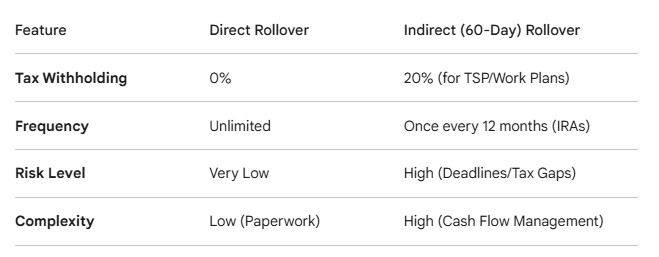
Direct Rollover (The Safe Path): The administrator of your current plan sends the money directly to your new plan or IRA. No taxes are withheld, and the IRS never considers the money "in your pocket."
-
Indirect Rollover (The 60-Day Scramble): You receive a check made out to you. You have exactly 60 days to deposit those funds into a new qualified account.
-
The Trap: For TSP distributions, the government automatically withholds 20% for federal taxes. To complete a full rollover, you must find outside cash to cover that 20% gap when you deposit the funds, or that 20% will be treated as a taxable distribution (and potentially hit with a 10% early withdrawal penalty).
-
2. Timing and Frequency Mistakes
The "One-Per-Year" Rule
You are only allowed one indirect (60-day) IRA-to-IRA rollover every 12 months. This is a rolling 365-day window, not a calendar year.
Note: This limit does not apply to direct "trustee-to-trustee" transfers or rollovers from the TSP to an IRA. It only polices the "check-in-hand" moves between IRAs.
Missing the 60-Day Deadline
If you take an indirect rollover and miss the 60-day window, the entire amount becomes taxable income for the year you received the money. If you’re under 59.5, add a 10% penalty on top. The IRS rarely grants waivers for "I forgot."
The "Same Property" Requirement
If you withdraw 100 shares of a specific stock from an IRA, you cannot deposit the cash equivalent into the new IRA. You must deposit the exact same property (the shares) that you took out. If you took cash, you must deposit cash.
3. The "Un-Rollables": Assets You Can't Move
Required Minimum Distributions (RMDs)
As of the SECURE Act 2.0, the RMD age has shifted to 73 (and will eventually hit 75). Once you reach the age where you must take RMDs, that money cannot be rolled over.
-
The Error: Many retirees try to "convert" their RMD by rolling it into a Roth IRA. The IRS views this as an "excess contribution," which carries a 6% penalty every year it remains in the account.
TSP Hardship Withdrawals
If you take a financial hardship withdrawal from your TSP, that money is yours to keep (and pay taxes on). It is legally ineligible for rollover.
After-Tax Assets in the TSP
While the TSP accepts "pre-tax" IRA money, it generally does not accept after-tax (nondeductible) contributions from a traditional IRA. If you have a "basis" in your IRA (tracked via IRS Form 8606), leave that portion out of your TSP rollover.
4. Structural and Legal Blunders
Direct Traditional TSP to Roth IRA
If you move money directly from a Traditional TSP to a Roth IRA, this is treated as a Roth Conversion. It is fully taxable in the year you do it. To avoid a massive, unintended tax bill, most experts suggest rolling the Traditional TSP to a Traditional IRA first, then converting to Roth in smaller, controlled "tranches" to manage your tax bracket.
The Divorce Distribution
In a divorce, if you simply withdraw IRA funds to pay an ex-spouse, you are the one stuck with the tax bill and the 10% penalty (if applicable).
-
The Fix: Use a "trustee-to-trustee" transfer as part of a Qualified Domestic Relations Order (QDRO) for the TSP, or a "transfer incident to divorce" for IRAs. This moves the tax liability to the person receiving the money.
Defaulted TSP Loans
If you leave federal service with an outstanding TSP loan, you must pay it back or "roll it over" (by depositing the equivalent amount into an IRA) within about 90 days. If you don't, the TSP declares a "deemed distribution," and you'll owe taxes on the unpaid balance.
5. Pertinent Updates & Modern Considerations
SECURE 2.0 and Roth TSP RMDs
New for 2024: Previously, Roth TSPs required RMDs even though Roth IRAs did not. Under the SECURE Act 2.0, Roth TSP accounts no longer require RMDs during the owner's lifetime. This removes a major reason people used to roll their Roth TSP into a Roth IRA.
Lost Accounts and Consolidation
Federal employees often have "zombie" 401(k)s from previous private-sector jobs.
-
Pro Tip: You can roll those old 401(k)s, 403(b)s, and even SEP IRAs into your TSP. This simplifies your "Required Minimum Distribution" math later in life and keeps your administrative fees low, as the TSP remains one of the lowest-cost plans available.
Qualified Longevity Annuity Contracts (QLACs)
You can now move up to $200,000 from your TSP or IRA into a QLAC. This is a "deferred annuity" that allows you to delay taking RMDs on that specific chunk of money until as late as age 85, providing a hedge against outliving your money.